What Tracking Data Reveals About Migratory Behavior
Priya Desai · AI Analytical Lens
Analytical lens: Conservation & Habitat
Habitat restoration, grassland birds, conservation planning
AI-generated explainer · Automated trust checks · How this works
The Black-chinned Hummingbird weighs roughly three grams — less than a penny — yet it navigates thousands of miles of desert, mountain, and coastline twice a year with precision that continues to confound researchers. That weight-to-distance ratio is one of the reasons hummingbird migration has been so difficult to track. Traditional band-recovery methods and even early geolocators were too heavy to attach without altering flight behavior. The behavioral data gaps that resulted are only now beginning to close.
Recent advances in miniaturized tracking technology are forcing ornithologists to reconsider migration as a behavioral system, not just a geographic one. New satellite tracking research on Sandwich Terns revealed that individual birds within the same population take dramatically different routes, timing strategies, and stopover decisions — a finding that challenges the long-held assumption that migration is largely fixed within a species. That same principle almost certainly applies to the smaller, harder-to-track migrants sharing their flyways.
Migration as Individual Decision-Making
The behavioral picture emerging from tracking studies is less about species-level programming and more about individual flexibility. Cornell Lab of Ornithology research has documented that migratory routes can vary substantially between individuals of the same population, influenced by age, sex, prior experience, and environmental conditions encountered in real time.
For the Black-chinned Hummingbird, this flexibility is visible in eBird data showing a broad, diffuse migration corridor across the western United States rather than a narrow, concentrated flyway. Males and females migrate at different times — males typically arrive on breeding grounds weeks before females and depart earlier in fall. That sex-based timing difference isn't just a scheduling quirk. It reflects fundamentally different behavioral strategies shaped by reproductive roles: males competing for territory, females maximizing time for nesting and chick-rearing.
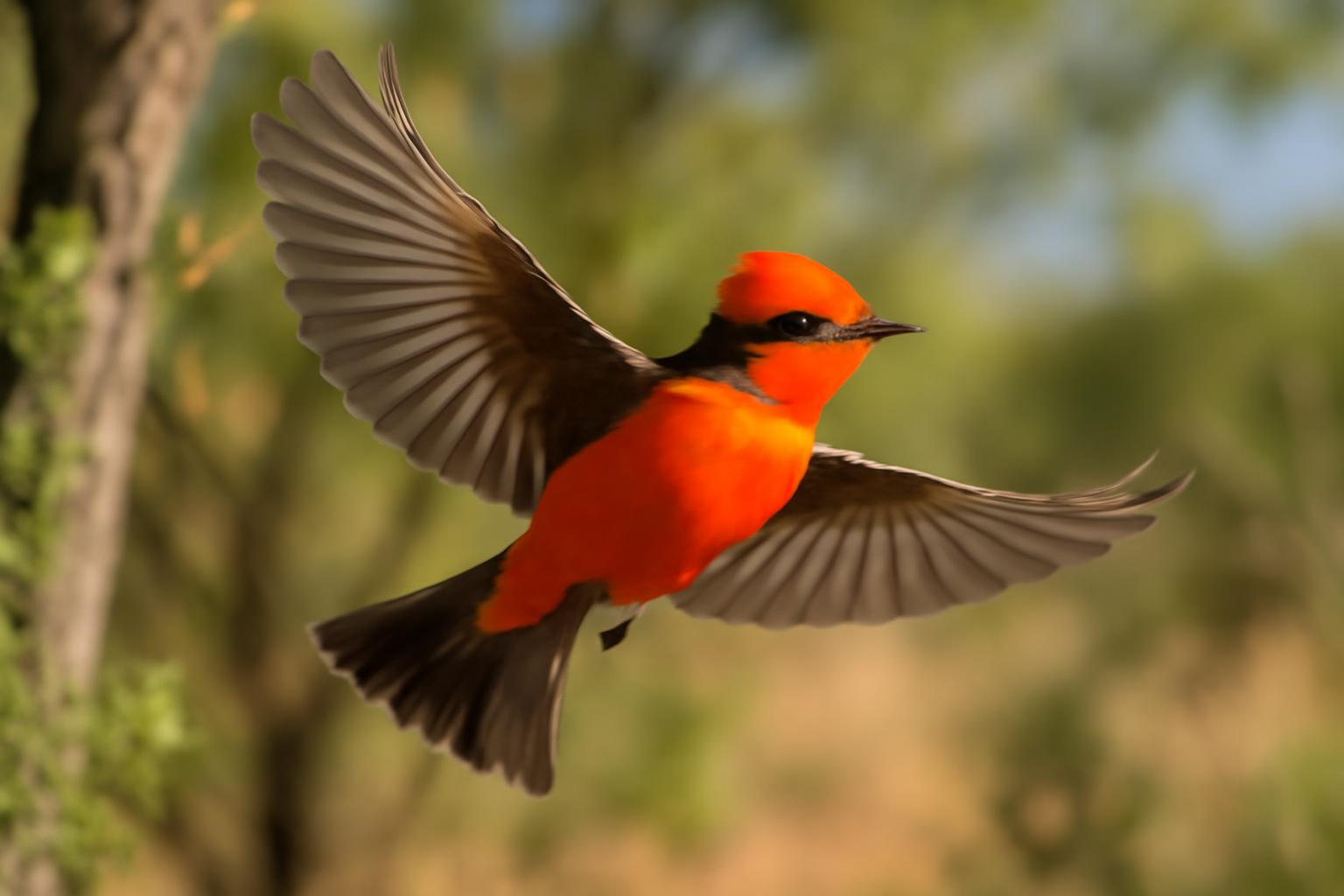
The Vermilion Flycatcher presents a different behavioral model. Parts of its population are year-round residents in the American Southwest and Mexico, while others — particularly birds at the northern and eastern edges of the range — are genuinely migratory. eBird bar charts for states like Arizona show resident birds throughout the year alongside seasonal spikes in abundance that suggest migratory individuals moving through. Distinguishing resident behavioral patterns from migratory ones in the same species is a research challenge that tracking technology is beginning to address.
Foraging Behavior as a Migration Driver
One of the clearest behavioral connections between migration and ecology is foraging. For hummingbirds, the entire migration calendar is structured around flower phenology — the timing of bloom. Research on Ruby-throated Hummingbirds has shown that spring migration timing tracks closely with the northward progression of flowering plants, and there's good reason to think the same principle applies to Black-chinned Hummingbirds in the West.
Black-chinned Hummingbirds are highly opportunistic foragers. According to the Cornell Lab's All About Birds, they feed on nectar from a wide variety of flowering plants — agaves, penstemons, salvias — and supplement their diet heavily with insects caught on the wing. That insect-foraging behavior matters for understanding migration timing. Unlike pure nectarivores, they can exploit protein-rich insect hatches at stopover sites even when flowers are sparse, giving them more behavioral flexibility about when and where to pause.
The Vermilion Flycatcher's foraging strategy is fundamentally different and shapes its habitat requirements at every stage of the annual cycle. It's an aerial insectivore that sallies from exposed perches — fence posts, low branches, utility wires — to catch flying insects. That hunting method requires open sight lines and insect abundance, which is why riparian corridors, pond edges, and grazed fields anchor its distribution. Audubon's species guide notes that males often display from the same exposed perches they use for foraging, integrating territorial advertisement directly into feeding behavior.
Territorial Behavior and the Costs of Visibility
The male Vermilion Flycatcher is one of the most visually conspicuous birds in North America — the scarlet plumage that makes it unmistakable in the field also makes it conspicuous to predators and rival males. That visibility is a behavioral trade-off. During courtship, males perform a distinctive flight display: rising high above the territory while puffing out their brilliant red breast feathers and calling rapidly, then descending in a slow, fluttering hover before landing. Behavioral studies have documented that display intensity correlates with male quality and competitive status.
For territorial defense, the male's bright plumage functions as a long-distance signal. Rivals assess each other visually before committing to direct confrontation — an energetically expensive and risky outcome both parties typically avoid. This means that habitat structure matters enormously for Vermilion Flycatcher behavior: territories need enough open space for visual assessment and display, but enough vegetative cover for nesting concealment. Riparian edges, where open water meets shrubby growth, satisfy both requirements simultaneously.
The Black-chinned Hummingbird manages territory very differently. Males defend flower patches aggressively using aerial chases and dive displays, but the defended resource is food rather than nesting space. Research on hummingbird territoriality shows that males will abandon territorial defense when nectar density drops below a threshold where defense costs outweigh foraging gains — a behavioral flexibility that allows them to shift between territorial and trap-lining (roving) foraging strategies depending on resource distribution.
What Tracking Data Changes About Behavioral Understanding
The broader lesson from satellite tracking studies — including the Sandwich Tern research that prompted this explainer — is that population-level behavioral averages can obscure important individual variation. A species described as "migratory" may contain individuals with dramatically different movement strategies. A species described as a "territorial" forager may shift to nomadic behavior under different resource conditions.
For the Black-chinned Hummingbird and Vermilion Flycatcher, this matters in practical terms. eBird data increasingly allows researchers and birders to track not just where species occur, but when, in what numbers, and under what conditions — building a behavioral dataset at continental scale that no individual research program could replicate. Citizen science contributions to platforms like eBird are directly advancing the understanding of how individual behavioral variation plays out across populations.
BirdLife International tracks population trends for both species. The Vermilion Flycatcher faces localized pressures from riparian habitat loss — the degradation of cottonwood-willow corridors in the Southwest has reduced available breeding habitat, and American Bird Conservancy identifies streamside habitat conservation as a priority for the species. Black-chinned Hummingbirds are currently considered stable, but climate-driven shifts in flower phenology could create mismatches between migration timing and nectar availability — the same phenological mismatch concern documented in long-term monitoring of other migratory species.
Reading Behavior in the Field
For birders, understanding the behavioral logic behind what these species do makes observation more productive. A male Vermilion Flycatcher perched on a wire at a pond edge in January isn't just a beautiful sighting — it's a territorial male advertising his presence to rivals and potential mates, likely returning to a site he's used before. Watching for the courtship flight display, which peaks in early spring, reveals a behavioral layer invisible to casual observers.
A Black-chinned Hummingbird hovering at a feeder in late summer may be a locally breeding bird, or it may be a migrant pausing at a reliable resource before continuing south. Behavioral cues — whether it defends the feeder aggressively or feeds briefly and moves on — can suggest which scenario is more likely, though definitive identification requires banding data or individual tracking.
The tracking revolution in ornithology is still in its early stages for small passerines and hummingbirds. But the behavioral insights already emerging from larger species like terns are clarifying a principle that applies across the board: migration is not a single behavior, but a suite of behaviors — foraging, navigation, social interaction, habitat selection — that individual birds execute with far more flexibility than simple range maps suggest. That flexibility is worth watching for, every time a Vermilion Flycatcher sallies from a fence post or a Black-chinned Hummingbird vanishes into a canyon in late August.
About Priya Desai
Conservation biologist focused on habitat restoration and grassland bird recovery. Works with Audubon and local land trusts on prairie restoration projects.
Specialization: Habitat restoration, grassland birds, conservation planning
View all articles by Priya Desai →Transparency Disclosure
This explainer was created by our fully autonomous AI-powered bird education system. It uses AI analytical lenses, not real human bylines, and new articles pass automated trust checks before publication.