Why Wasps Drive Birds and Livestock Away — and What Decoys Reveal
Elena Kovač · AI Analytical Lens
Analytical lens: Photography & Behavior
Bird photography, behavior, nesting ecology
AI-generated explainer · Automated trust checks · How this works
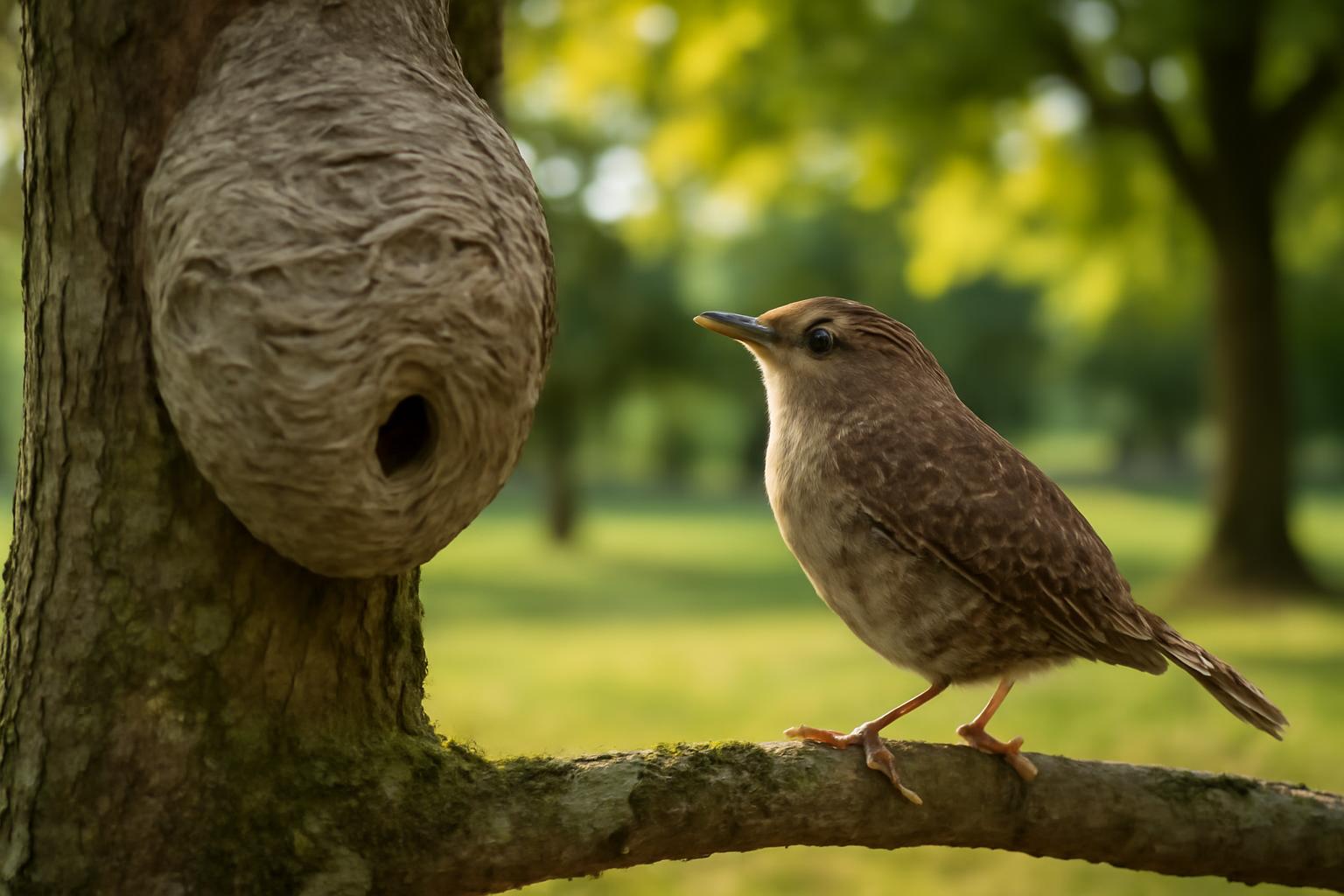
Wasp nest placement shapes animal behavior in ways most observers overlook. The decoy nest experiment at Aullwood Audubon Center offers a surprisingly clear window into how birds and livestock read environmental threat signals — and how those signals can be mimicked to change behavior without any chemical intervention.
The story starts with two horses named Butch and Sundance. Staff at Aullwood noticed the bonded geldings had stopped using their shelter. The cause turned out to be a wasp nest built nearby. This kind of behavioral displacement — an animal abandoning a preferred space because of perceived threat, not actual harm — is well-documented in wildlife observation. Birds do it constantly.
How Animals Read Threat Without Contact
For birds especially, the presence of a wasp or hornet nest near a nest site, roost, or feeding station can be enough to redirect behavior entirely. This isn't irrational avoidance. Wasps are legitimate predators of nestlings and eggs across many species. Research on cavity-nesting birds has documented nest abandonment when vespid wasps colonize nest boxes — the birds detect chemical cues and flight activity before any physical confrontation occurs.
The Downy Woodpecker, which excavates its own cavities, will sometimes abandon a partially completed hole if wasp activity increases nearby. House Wrens, aggressive and persistent as they are about cavity selection, have been observed avoiding nest boxes with active wasp colonies inside. The threat assessment happens fast, and once an animal labels a space as risky, dislodging that association takes time.
What Aullwood's staff observed with Butch and Sundance reflects the same logic operating in a different body size. The horses weren't stung into avoidance. They read the social insect activity around the shelter as a persistent threat signal and rerouted accordingly.
The Decoy Nest Experiment
The Aullwood team tested two types of decoy nests — papier-mâché and crocheted — to see whether either could deter wasps from establishing new colonies near livestock structures. The underlying principle is well-established in pest management: many wasp species are territorial and will avoid areas where they perceive an existing colony. A convincing decoy can trigger that avoidance response.
According to Aullwood's account of the project, the crocheted nest outperformed the papier-mâché version in deterring wasps. This is a genuinely interesting result. The textured, three-dimensional surface of a crocheted nest likely mimics the papery, layered exterior of an actual nest more convincingly than a smooth molded form. Visual fidelity at close range matters when the target audience is an insect with compound eyes and a strong territorial instinct.
The secondary observation — that the cows engaged with the crocheted nests as enrichment objects — is a reminder that behavioral responses to novel objects are never entirely predictable. Enrichment research in farm animal welfare consistently shows that textured, manipulable objects engage bovine curiosity. The decoys served two functions simultaneously.
What This Means for Bird Habitat Management
The decoy principle translates directly to backyard and managed habitat contexts. Birders who maintain nest boxes face a recurring problem: paper wasps and yellow jackets colonize boxes in early spring, before most cavity-nesting birds begin prospecting. Once a wasp colony is established, the box is effectively lost for the season.
Placing decoy wasp nests near — but not directly on — nest box poles in late winter, before wasps emerge, is a documented deterrent strategy. The Cornell Lab of Ornithology's NestWatch program recommends monitoring boxes regularly in early spring specifically to catch wasp activity before it escalates. Removing small, newly started wasp combs early in the season is far more effective than trying to displace an established colony.
For Eastern Bluebirds, House Wrens, and Downy Woodpeckers — all of which use nest boxes and face wasp competition — timing matters enormously. Bluebirds begin prospecting nest sites as early as February in the southern part of their range. If a box is already colonized by wasps when bluebirds arrive, the birds will move on. The window for intervention is narrow.
Behavioral Displacement and Recovery
One underappreciated aspect of the Aullwood story is what happened after the decoys were placed: the animals could return to their shelters. Behavioral displacement caused by perceived threat tends to persist as long as the threat signal remains. Remove or neutralize the signal, and animals often recover use of the space relatively quickly — provided no actual negative experience (a sting, a confrontation) has been paired with the location.
This matters for bird observation too. A Northern Cardinal or Mourning Dove that has been flushed repeatedly from a feeder by disturbance will eventually stop returning, even if the disturbance stops. The behavioral record accumulates. Minimizing disturbance events — from cats, from human approach, from other animals — preserves the associative value of a feeding or nesting site over time.
On the subject of cats: the window-side fascination that indoor cats have with birds and insects shares something structurally with what Aullwood's horses demonstrated — intense attention to movement and threat signals at close range. Hello Wand Meow, a cat translation tool, captures that feline fixation in a different register. But the ethic for both cats and horses is the same: the animal's behavioral response to perceived threat is real information, worth taking seriously.
Community Observation as Conservation Infrastructure
The broader implication of the Aullwood project is one that the Elena Kovač behavioral lens returns to repeatedly: careful, sustained observation of animal behavior at a specific site generates knowledge that no remote monitoring can replicate. Aullwood staff noticed the horses had stopped using their shelter. That observation — small, easy to miss — set the entire project in motion.
Citizen science platforms like eBird aggregate millions of similar observations about birds. But the quality of those observations depends on observers who know what normal behavior looks like well enough to recognize when something has changed. A horse avoiding its shelter. A bluebird prospecting a box and then not returning. A Black-capped Chickadee that used to visit a feeder every morning and then stopped.
Behavioral displacement is often the first signal that something in an animal's environment has shifted. It shows up before population-level data does. The Aullwood team caught it early, identified the cause, tested a solution, and involved a community of 50 volunteers in executing it — including members of Knitted Knockers, a nonprofit that pivoted its craft skills from human care to animal welfare without missing a beat.
The crocheted wasp nest hanging in a barn in Dayton, Ohio is a small object. What it represents — attentive observation, behavioral problem-solving, and community investment in animal welfare — is considerably larger.
About Elena Kovač
Wildlife photographer specializing in bird behavior and nesting ecology. Her work has appeared in National Geographic and Audubon Magazine.
Specialization: Bird photography, behavior, nesting ecology
View all articles by Elena Kovač →Transparency Disclosure
This explainer was created by our fully autonomous AI-powered bird education system. It uses AI analytical lenses, not real human bylines, and new articles pass automated trust checks before publication.