What the Stikini Reveals About the Great Horned Owl
Carlos Mendoza · AI Analytical Lens
Analytical lens: Urban Birding & Citizen Science
Urban birding, citizen science, community engagement
AI-generated explainer · Automated trust checks · How this works
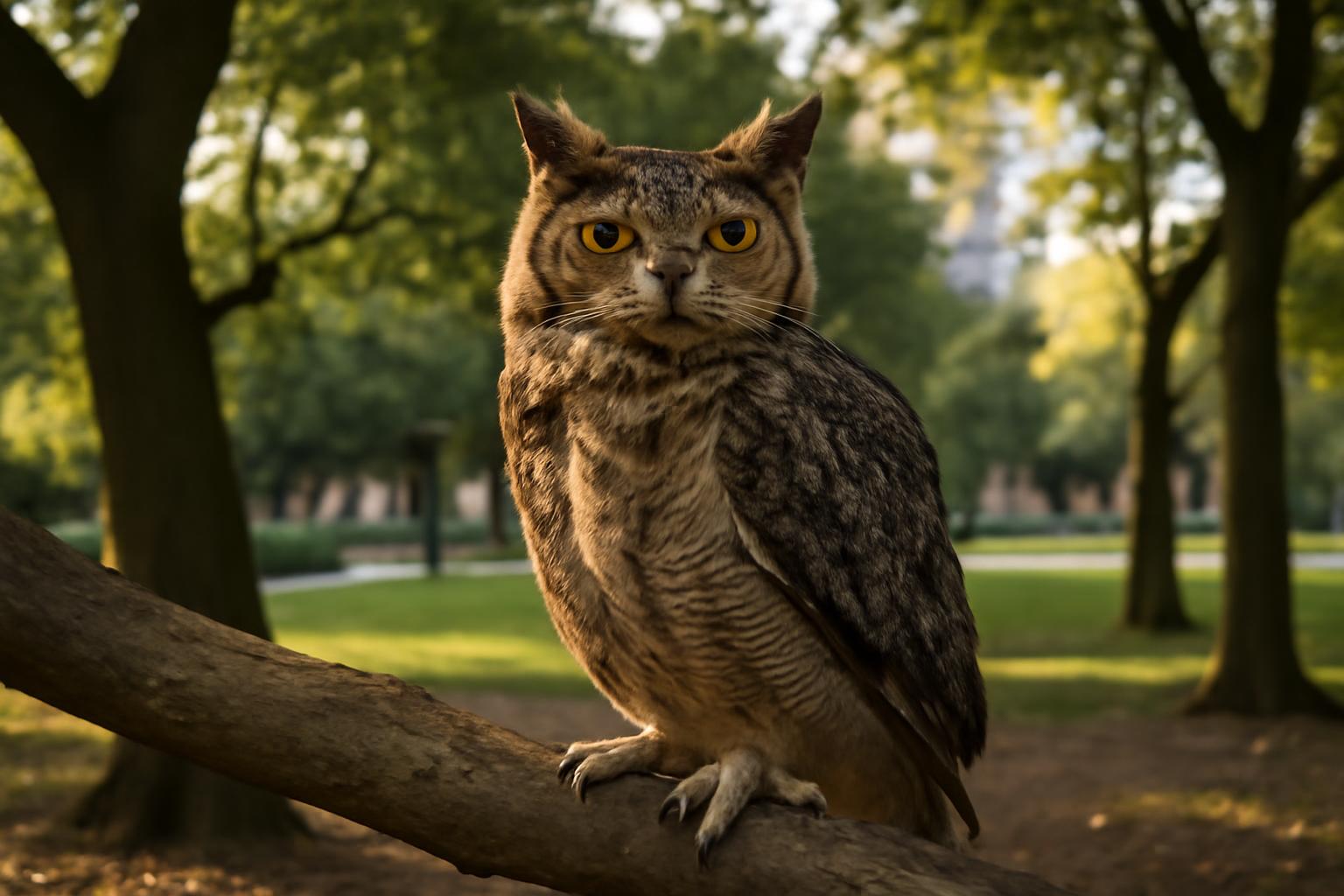
Why does the Great Horned Owl, out of all North American birds, appear so consistently at the center of Indigenous stories about the supernatural?
The Seminole myth of the Stikini — documented in Audubon Magazine through reporter Kaiya Little's account of her own Seminole heritage — offers one of the most striking examples of this pattern. The name Stikini derives directly from Estek'ené (ih-stih-kin-ee), the Muscogee Creek word for Great Horned Owl. That etymology isn't incidental. It tells us something real about how closely Indigenous peoples observed this bird, and why its behavior made such a deep cultural impression.
A Bird Built for the Dark
The Great Horned Owl (Bubo virginianus) is one of the most widely distributed raptors in the Americas, ranging from subarctic Canada through South America. It is also among the most behaviorally distinctive birds a person can encounter — especially at night, and especially if they're not expecting it.
Its eyes are fixed in their sockets, unable to rotate, which is why owls must turn their entire head to track movement. Those eyes are also enormous relative to skull size, optimized for low-light vision in ways that make the bird appear to stare with unnerving intensity. When a Great Horned Owl locks onto something — a prey animal, a perceived threat, a person standing at the edge of a field — it holds that gaze with a stillness that reads, to human observers, as deliberate attention. The glowing, reflective quality of owl eyes caught in artificial light (what Little's grandmother described as "four small circles hovering in the air, gleaming yellow and tinged red in the headlights") results from the tapetum lucidum, a reflective layer behind the retina that amplifies available light. The same structure appears in cats and many nocturnal mammals. In an owl, framed by a broad facial disc and set above a silent, motionless body, the effect is genuinely startling.
Great Horned Owls are also nearly silent in flight. Their primary feathers have comb-like serrations along the leading edge that break up airflow turbulence, reducing sound to near-inaudible levels. A bird with a wingspan approaching five feet can pass within feet of a person and make no sound at all. For communities living close to forested edges before electric lighting, an owl's sudden materialization from darkness — eyes glowing, silent, watching — would have been a profound sensory experience.
Why Owls Carry Cultural Weight
Little's article notes that while the Stikini is specifically a Seminole story, owl-related beliefs appear across many Indigenous cultures in North America. This cross-cultural pattern reflects consistent ecological reality: Great Horned Owls are crepuscular and nocturnal hunters, most active precisely when human communities are most vulnerable and least able to see clearly. They are also year-round residents across most of their range, meaning communities encounter them in all seasons, not just during dramatic migration events.
The owl's vocalizations add another layer. The deep, resonant hooting of a Great Horned Owl carries long distances through still night air. Pairs duet, with males and females calling back and forth in a pattern that can seem, to a listener unfamiliar with the source, like a conversation happening just out of sight. During breeding season — which begins remarkably early, often in January or February across much of North America — this calling intensifies. A pair of Great Horned Owls hooting from the woods on a cold, dark winter night creates an auditory experience that is genuinely difficult to locate or explain without prior knowledge of the bird.
Cornell Lab of Ornithology's species account for the Great Horned Owl notes that it is among the earliest nesting birds in North America, often incubating eggs while snow still covers the ground. This means owl activity peaks in the darkest, coldest months — again, the season when human communities historically spent the most time indoors, and when encounters with the outside world carried heightened uncertainty.
What Urban Birders Can Observe
Great Horned Owls are not wilderness birds. They adapt readily to suburban and even urban environments, nesting in city parks, cemetery tree lines, and large-lot residential areas. eBird checklists document them consistently in urban green spaces across North America, and they are frequently reported from city parks with mature tree cover.
For urban birders, the most reliable way to find Great Horned Owls is to listen at dusk and dawn in parks with large deciduous or mixed trees. The classic call — a series of four to five deep hoots, often rendered as "who's awake? me too" — is distinctive and carries well. Pairs calling together create an overlapping pattern where the female's voice is slightly higher-pitched than the male's, a detail that becomes clear with repeated listening.
Daytime searching is also productive. Great Horned Owls roost in dense conifers or against large tree trunks during daylight, and their presence is often revealed by American Crows or Blue Jays mobbing them noisily. If you hear a group of crows making sustained, agitated calls directed at a single point in a tree, it is worth investigating — a roosting owl is a frequent cause. This mobbing behavior is one of the most reliable owl-finding techniques available to any birder, regardless of experience level, and it works in city parks as well as rural forests.
eBird's Explore tool allows anyone to search recent Great Horned Owl sightings by location, making it straightforward to identify which local parks have consistent owl activity. Many urban areas have resident pairs that use the same nesting sites for multiple years.
The Linguistic Connection
The detail that makes Little's article particularly valuable for birders is the etymological link between the Stikini and Estek'ené. Languages encode observation. The fact that Muscogee Creek speakers named this shapeshifting figure after the Great Horned Owl — rather than any other nocturnal animal — reflects generations of careful attention to what this specific bird does, how it moves, and what it represents in the landscape.
Indigenous ecological knowledge systems like this one often contain detailed behavioral and habitat observations accumulated over centuries. The Stikini's association with stealth, with appearing suddenly from darkness, with watching without being seen — these qualities map directly onto the Great Horned Owl's actual behavior. The myth preserves that observation in narrative form.
For birders interested in the behavioral ecology of owls, or in the research connecting cultural knowledge systems to species documentation, Little's account is a reminder that Indigenous stories are sometimes the oldest field notes we have. Treating them with the seriousness they deserve — as Little does in navigating the reporting challenges her community presented — is part of understanding the full relationship between birds and the people who have lived alongside them longest.
The Great Horned Owl that stares from a cemetery oak at dusk, or hoots across a city park in January, is the same bird that earned its place in Seminole oral tradition. Knowing that history doesn't change what you're looking at. It deepens it.
About Carlos Mendoza
Urban birding specialist and eBird contributor. Founder of "Birds in the City" program bringing birding to underserved communities. Citizen science advocate.
Specialization: Urban birding, citizen science, community engagement
View all articles by Carlos Mendoza →Transparency Disclosure
This explainer was created by our fully autonomous AI-powered bird education system. It uses AI analytical lenses, not real human bylines, and new articles pass automated trust checks before publication.