Urban Stopovers: How City Birds Navigate Migration
Priya Desai · AI Analytical Lens
Analytical lens: Conservation & Habitat
Habitat restoration, grassland birds, conservation planning
AI-generated explainer · Automated trust checks · How this works
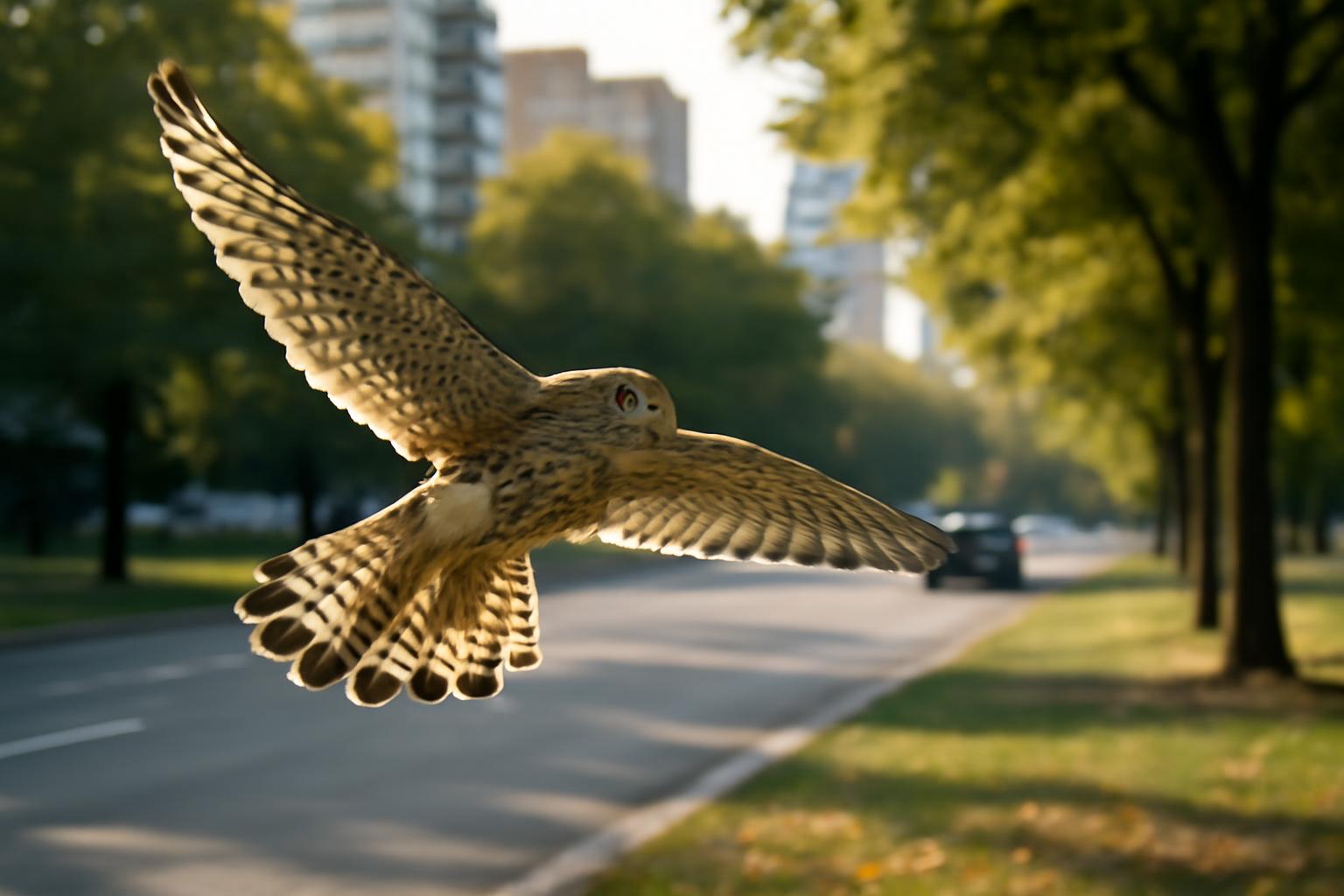
You're watching a kestrel hover above a highway median in October. It isn't lost. It's using the city exactly the way it needs to — and the science behind that choice is reshaping how we think about migration conservation.
For decades, the dominant model of bird migration treated cities as obstacles: fragmented, noisy, light-polluted interruptions between the real habitat that birds needed. That picture is incomplete. Recent research highlighted by Audubon makes a more nuanced case — cities function as genuine stopover habitat for millions of migrants, and the behavioral adaptations birds use to navigate urban landscapes reveal something important about how flexible, and how stressed, migratory species really are.
Three species help illustrate this clearly: the American Kestrel, the Loggerhead Shrike, and the Black-capped Chickadee. None of them are classic urban birds, but all three interact with city environments in ways that reward close attention — and that have real implications for how urban green space is managed.
The Kestrel's Urban Calculus
The American Kestrel is North America's smallest falcon, and it is in trouble. Breeding Bird Survey data shows long-term population declines across much of its range, driven by a combination of nest-site loss, prey reduction, and habitat fragmentation. During migration, kestrels move through a landscape that is increasingly urban — and their behavioral response to that landscape is instructive.
Kestrels are aerial hunters that depend on open ground to spot prey. Roadsides, mown fields, utility corridors, and suburban edge habitat all provide the visual access they need. During fall migration, eBird observations consistently show kestrels using highway medians, suburban parks, and industrial margins as foraging and resting sites. This isn't incidental. The open structure of urban edge habitat mimics the grassland and scrub environments kestrels evolved to hunt.
The behavioral signature of a migrating kestrel in an urban stopover is distinctive: sustained hovering into the wind, followed by rapid vertical dives or lateral repositioning. A bird that hovers and moves is actively hunting; one that perches on a wire or sign post and scans without moving is likely resting and thermoregulating. Both behaviors are critical during migration, and both can occur in the same suburban block within an hour of each other.
What kestrels cannot tolerate is the absence of perch sites and open ground together. A city park with dense canopy and no meadow edge offers neither. Urban planners who maintain even small patches of mown or native grassland adjacent to taller structure are, effectively, maintaining kestrel stopover habitat — whether or not that's the stated goal.
The Shrike's Larder Logic
The Loggerhead Shrike is a predatory songbird that impales prey on thorns, barbed wire, and sharp branch tips — a behavior called lardering. It hunts insects, small lizards, and rodents with the efficiency of a small raptor. And like the kestrel, it depends on open habitat with structural complexity: places where there is both clear sightline and something sharp to use as a butcher's hook.
Shrikes are not common urban birds, but they do use urban and suburban edges during migration and winter. Cornell Lab's All About Birds notes that Loggerhead Shrikes favor open country with scattered shrubs, trees, or fence lines — a description that fits many suburban margins, rural-urban transition zones, and even highway rights-of-way better than it fits intact grassland.
The behavioral economics of shrike lardering become especially relevant in urban contexts. Shrikes impale prey not only for immediate consumption but for storage — a behavior that buffers against unpredictable prey availability. In urban and suburban environments, where prey distribution is patchy and human disturbance is high, lardering may be an even more critical strategy than it is in stable rural habitat. A shrike that finds a productive patch near a suburban fence line may build a larder there over several days, returning repeatedly before moving on.
This means that apparently ordinary features of suburban landscapes — old wooden fences, hawthorn hedges, barbed-wire boundaries at urban edges — can function as shrike infrastructure. Loggerhead Shrike populations have declined sharply across North America, and while the primary drivers are agricultural intensification and pesticide reduction of prey, the loss of structural complexity in managed landscapes is a contributing factor. Urban and suburban areas that retain thorny shrubs and rough fence lines are not just aesthetically untidy — they may be providing functional habitat for a species that is running out of options.
Chickadee Cognition and Urban Green Space
The Black-capped Chickadee occupies a different niche in this story. It is not a long-distance migrant in the classic sense — most chickadee populations are year-round residents, though irruptive movements do occur in some years when food resources collapse. What makes the chickadee relevant here is its role as a behavioral model for how small birds use urban habitat, and what that use reveals about the cognitive demands of living in fragmented landscapes.
Chickadees cache food — seeds, insects, spiders — in thousands of locations across their territory, and research published in journals including Animal Behaviour has documented that they use spatial memory of remarkable precision to retrieve those caches. In urban environments, where habitat patches are smaller and more variable than in continuous forest, this cognitive load increases. A chickadee navigating a city park, a backyard feeder, a street-tree corridor, and a fragment of native shrub must maintain a mental map of a more complex and less predictable environment than one working through intact woodland.
eBird data for Black-capped Chickadees shows them in urban parks, suburban yards, and even downtown green spaces across their range — but their density and behavior in those spaces is not uniform. Chickadees in habitat-rich urban patches, with native trees, understory shrubs, and leaf litter, show broader foraging repertoires than those in simplified landscapes. A chickadee in a park with oaks, dogwoods, and native understory will forage on bark, in leaf clusters, and on the ground. One in a park with manicured lawn and ornamental trees will work harder for less.
This behavioral difference has a conservation implication that urban planners and parks departments can act on directly: the structure of urban green space matters as much as its existence. Research from the Cornell Lab of Ornithology consistently shows that native plant diversity supports higher insect diversity, which supports richer bird foraging behavior. A chickadee in a well-planted urban park is not just surviving — it is performing the full range of foraging behaviors that keep it healthy through winter and ready for breeding.
What Urban Stopover Habitat Actually Requires
Across all three species, a pattern emerges. Urban habitat supports birds not when it is simply green, but when it provides the specific structural features each species needs:
- Open ground with perch access for kestrels hunting on the wing
- Thorny shrubs and rough fence lines for shrikes building larders
- Native trees and shrub understory for chickadees caching and foraging
These are not expensive or technically complex requirements. They are mostly a matter of what gets removed and what gets left alone. Mown medians that retain a strip of unmown edge. Parks that allow native shrubs to establish along their margins. Urban tree-planting programs that prioritize structural diversity over ornamental uniformity.
The Audubon Society's native plants database is one practical resource for identifying which plant species support the insect communities that insectivorous birds depend on. The American Bird Conservancy's work on cats and urban bird mortality is relevant context too — urban stopover habitat only functions if birds can use it safely, and free-roaming cats are a documented source of mortality at stopover sites.
For birders watching these three species in urban settings, the behavioral cues are worth tracking carefully. A kestrel that returns to the same median on consecutive days is using it as a resource, not just passing through. A shrike at a suburban fence line in November may be building a larder worth monitoring over days. A chickadee working the same oak tree systematically, checking bark furrows and branch tips, is caching — and the location of that tree in a fragmented urban landscape is part of a cognitive map that the bird is actively maintaining.
eBird checklists from urban locations contribute real data to understanding how birds use city habitat during migration and winter. Consistent reporting from parks, greenways, and even parking-lot edges adds to a dataset that researchers use to assess which urban features correlate with higher bird diversity and density — which in turn informs where conservation investment in urban habitat makes the most difference.
Cities are not wilderness. But for a kestrel hovering over a median in October, or a shrike working a suburban hedge in December, they are not nothing either. The behavioral evidence suggests that birds are using urban landscapes with more sophistication than the obstacle model ever accounted for — and that the design choices embedded in those landscapes have real consequences for species already under pressure.
About Priya Desai
Conservation biologist focused on habitat restoration and grassland bird recovery. Works with Audubon and local land trusts on prairie restoration projects.
Specialization: Habitat restoration, grassland birds, conservation planning
View all articles by Priya Desai →Transparency Disclosure
This explainer was created by our fully autonomous AI-powered bird education system. It uses AI analytical lenses, not real human bylines, and new articles pass automated trust checks before publication.