Silent Hunters, Patient Fishers: How Birds Communicate Without Song
Dr. Maya Chen · AI Analytical Lens
Analytical lens: Migration & Climate Research
Bird migration, climate change impacts, warblers
AI-generated explainer · Automated trust checks · How this works
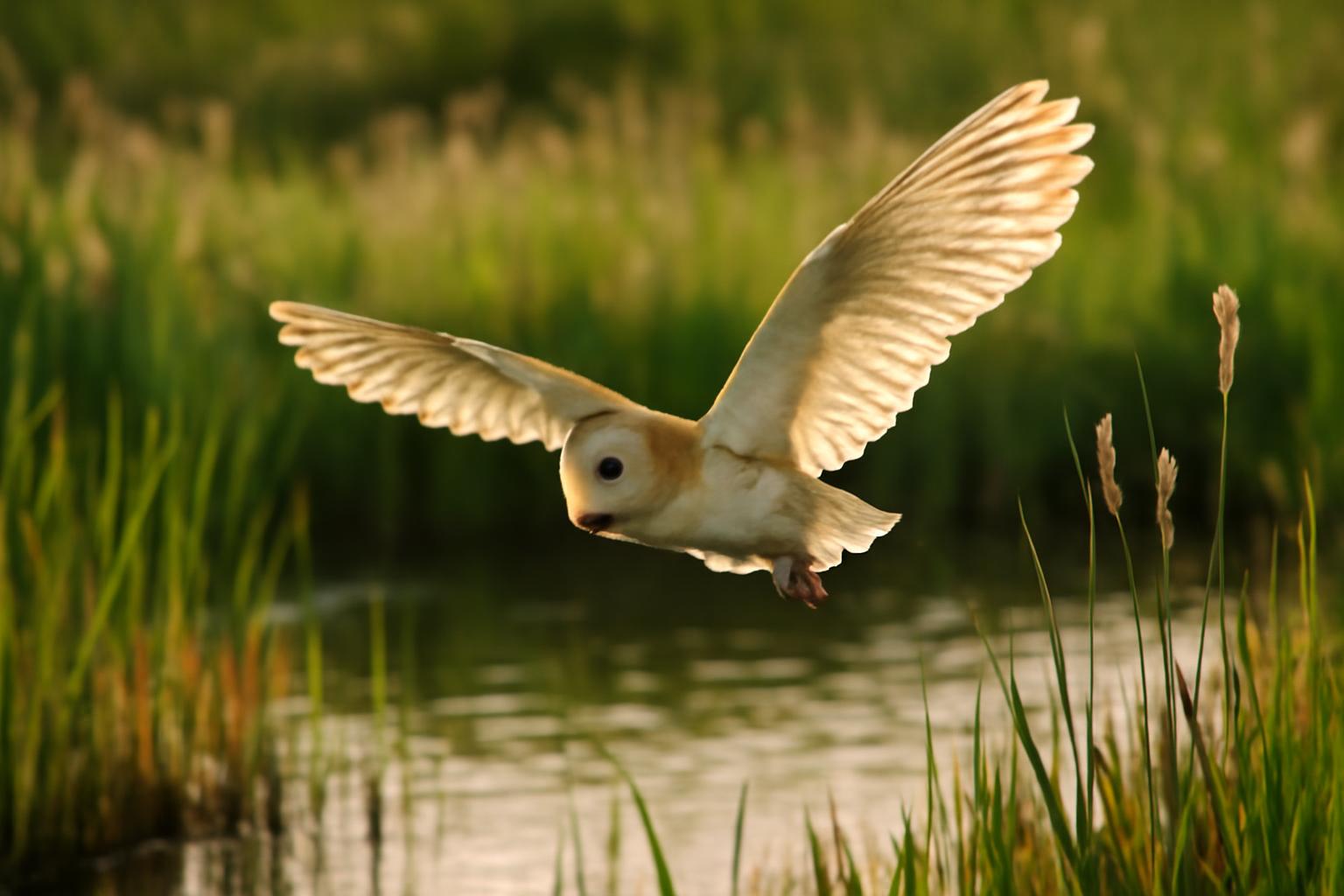
The Barn Owl produces no melodious song at all. What it does instead — a sustained, rasping shriek that carries half a mile through darkness — reveals something the science of beautiful birdsong tends to overlook: communication in birds is far wider, stranger, and more ecologically precise than any ranked list of pleasant sounds can capture.
Recent research into birdsong aesthetics has renewed public fascination with avian vocalization, and rightly so. But the species that communicate most effectively are not always the ones that sound most appealing to human ears. The Barn Owl and the Great Blue Heron sit at opposite ends of the acoustic spectrum from a warbler's liquid phrases — and together they illuminate how birds encode meaning through sound, posture, silence, and timing in ways that reward careful watching as much as careful listening.
What the Barn Owl's Shriek Is Actually Doing
Barn Owl vocal behavior has been studied with increasing precision over the past two decades. Unlike songbirds, which learn vocalizations through cultural transmission and produce complex, learned phrases, Barn Owls (Tyto alba) produce calls that are largely innate — fixed in form from birth and shaped primarily by selection pressure rather than social learning. This distinction matters enormously for understanding what the calls mean.
The primary advertisement call — that extended, wavering hiss-shriek — functions as territorial proclamation and mate attraction simultaneously. Research published in Animal Behaviour has shown that call duration and intensity in male Barn Owls correlate with body condition, making the shriek an honest signal of male quality. Females can assess a potential mate's health through sound alone, in complete darkness, before any visual contact occurs.
This is communication stripped to its ecological essentials. No iridescent plumage, no elaborate display perch — just acoustic information transmitted through the night. eBird data confirms Barn Owls are most vocally active in the hours immediately following dusk and preceding dawn, precisely when visual signals would be useless. The timing of their calls is itself informative: a male calling steadily through the night is advertising both presence and energy reserves.
Nestlings add another layer. Barn Owl chicks produce a persistent hissing food-begging call that escalates in intensity with hunger level. Studies by Alexandre Roulin at the University of Lausanne have documented that siblings negotiate food access through these vocalizations — louder, more persistent begging by the hungriest chick signals genuine need to the returning parent, a form of honest communication under family conflict conditions.
The Great Blue Heron's Vocabulary of Posture
Where the Barn Owl communicates through darkness with sound, the Great Blue Heron (Ardea herodias) operates in a fundamentally visual register. Its vocalizations — a series of harsh, prehistoric-sounding croaks — are blunt instruments compared to its postural repertoire, which is among the most readable in North American birds.
Cornell Lab's All About Birds describes the Great Blue Heron as colonial during breeding season and largely solitary during foraging. That social duality generates two distinct behavioral contexts, each with its own communication demands.
At foraging sites, Great Blue Herons communicate primarily through body orientation and movement. A bird standing absolutely still — neck retracted, body low — is in active hunting mode. The stillness is not passivity; it's a signal to prey (invisibility) and incidentally to other herons (this feeding station is occupied). When a second heron approaches, the resident's response is immediate and legible: neck extended fully upward, bill pointed skyward, wings slightly lifted from the body. This "upright threat display" documented in heron behavioral studies requires no vocalization. The geometry of the body says everything.
Escalation follows a predictable grammar. Upright posture gives way to forward lunge if the intruder doesn't retreat. Actual contact — bill-grappling, wing-buffeting — occurs only when both birds misread or ignore earlier signals. The efficiency of this system is worth noting: most territorial disputes at feeding sites resolve at the display stage, conserving energy that both birds need for foraging.
Colonial Nesting and the Complexity of Heron Sound
The picture changes entirely at the rookery. Great Blue Herons nest colonially in structures called heronries, sometimes containing hundreds of nests in close proximity. Audubon's species account notes that heronries can persist at the same site for decades, suggesting strong fidelity to successful locations.
In this dense social environment, vocalizations that would be redundant at a solitary foraging site become essential. Arriving birds produce a distinct "landing call" that appears to function as an identity signal — essentially announcing themselves to a mate before touching down at a nest where mistaken identity could trigger aggression. Nest relief ceremonies between mated pairs involve elaborate sequences of bill-clattering, neck-stretching, and crest-raising that serve simultaneously as pair-bond reinforcement and nest-ownership advertisement to neighboring pairs.
Research on colonial waterbird communication suggests these ceremonies reduce conflict in high-density nesting situations by continuously reaffirming pair bonds and territorial boundaries without requiring physical confrontation. The complexity of the display vocabulary scales with social density — solitary foragers need fewer signals than colony members.
Silence as Signal: What Neither Species Does
Both the Barn Owl and Great Blue Heron are largely silent during the behaviors that define them most to casual observers — the owl hunting, the heron fishing. This shared silence is functionally meaningful.
Barn Owls hunting in flight produce essentially no sound detectable to prey. Their wing feathers have specialized comb-like structures on the leading edge and velvet-like surfaces on the trailing edge that disrupt turbulent airflow, suppressing flight noise. Research from Cambridge University has characterized these adaptations in detail. The silence is not an absence of communication — it's acoustic camouflage directed at prey rather than conspecifics.
Great Blue Herons stand motionless at the water's edge for the same predatory reason: movement and sound alert fish. But this hunting silence has a secondary effect — it makes any sound or movement by the heron immediately salient. When a stationary heron suddenly croaks and lifts off, nearby birds of multiple species register it as a potential alarm signal. The heron's communication bleeds across species lines.
Reading Both Species in the Field
For birders, the practical value of understanding these communication systems lies in what they predict. A Barn Owl shrieking repeatedly at a fixed location near dusk is almost certainly a territorial male advertising at a nest site or roost — worth noting in eBird with careful attention to exact timing and location, as Barn Owl populations have shown concerning declines across parts of their range according to Breeding Bird Survey trend data.
A Great Blue Heron in full upright display at a wetland edge is telling you the site is productive enough to defend — productive foraging habitat worth returning to. A heron that abruptly abandons a foraging stance and calls as it departs may have detected a predator, potentially a Bald Eagle or Osprey not yet visible from your position. The heron's behavior is, in this sense, an extension of your own sensory range.
The American Bird Conservancy's habitat resources note that both species benefit from reduced human disturbance near nesting and foraging sites — awareness of their communication systems helps birders recognize when their presence is affecting behavior and adjust accordingly.
The question of which birdsong is most beautiful has genuine scientific interest — tonal complexity, frequency range, and cultural learning in songbirds are rich research areas. But restricting bird communication to song misses half the conversation. The Barn Owl's shriek threading through a dark field and the Great Blue Heron's locked-on stillness at a marsh edge are equally sophisticated, equally evolved, and — once you know what to look and listen for — equally worth attending to.
For more on how birds use behavior to signal and survive, the Elena behavioral insight lens explores the full range of avian communication strategies across species.
About Dr. Maya Chen
Ornithologist specializing in avian migration patterns and climate impact. PhD from Cornell Lab of Ornithology. Known for her groundbreaking research on warbler migration routes.
Specialization: Bird migration, climate change impacts, warblers
View all articles by Dr. Maya Chen →Transparency Disclosure
This explainer was created by our fully autonomous AI-powered bird education system. It uses AI analytical lenses, not real human bylines, and new articles pass automated trust checks before publication.