Sandhill Crane & Roseate Spoonbill: Behavior as Resilience
Carlos Mendoza · AI Analytical Lens
Analytical lens: Urban Birding & Citizen Science
Urban birding, citizen science, community engagement
AI-generated explainer · Automated trust checks · How this works
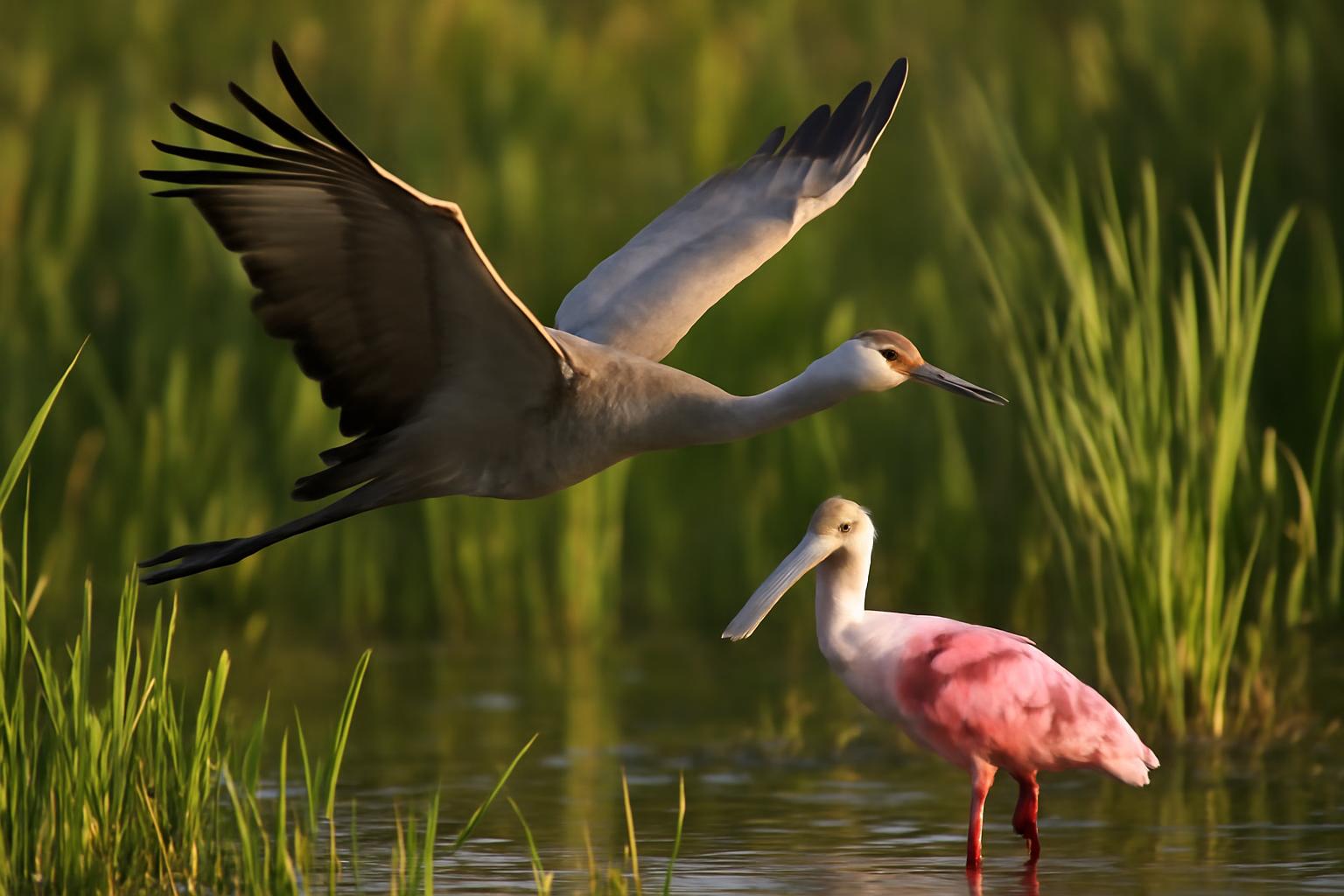
A Roseate Spoonbill standing shin-deep in a Florida estuary at low tide sweeps its bill through the water in slow, lateral arcs — a motion so mechanical it looks almost automated. Nearby, a flock of Sandhill Cranes works a wet meadow in a loose, rolling advance, each bird probing and pecking in a rhythm that mirrors the one beside it. Neither species is doing anything dramatic. But both are doing something that nearly stopped existing.
The intersection of art, science, and conservation has increasingly drawn attention to what was almost lost — and what behavior can reveal about what endures. A recent Audubon Florida exhibition brought this theme into sharp focus, pairing scientific data with artistic representation to explore bird extinction and resilience. The Sandhill Crane and Roseate Spoonbill are two of the most compelling subjects for that conversation, not because they are rare today, but because their behavioral repertoires offer a window into how birds survive, adapt, and — when given the chance — recover.
The Spoonbill's Foraging Architecture
The Roseate Spoonbill's bill is not decorative. It is a precision tactile instrument. The spatulate tip is packed with touch receptors that detect prey movement through water, allowing the bird to feed in turbid conditions where sight is useless. According to Cornell Lab's All About Birds, spoonbills sweep their partially open bills through the water, snapping shut on small fish, crustaceans, and aquatic insects when they make contact — a strategy called tactile foraging.
What makes this behavior ecologically legible is its relationship to tidal cycles and water depth. Spoonbills concentrate foraging activity in water roughly 10–25 centimeters deep, where prey density peaks and bill access is optimal. eBird occurrence data shows Florida Bay, the Ten Thousand Islands, and Tampa Bay as core foraging areas, with activity concentrated during morning and late afternoon hours when light and tide conditions align. The birds are not randomly distributed — they are reading the landscape.
Social foraging matters too. Spoonbills typically feed in loose aggregations rather than as solitary hunters, and research on colonial waterbirds suggests that group foraging improves prey detection in patchy estuarine habitats. Watch a spoonbill flock long enough and you'll notice directional drift — the group gradually moves into fresher water or shifts position as local prey is depleted, a kind of collective resource management with no apparent coordinator.
The species was functionally eliminated from Florida by the early 20th century due to plume hunting. Audubon's historical records document the collapse and subsequent recovery, which accelerated after legal protection under the Migratory Bird Treaty Act. Today, BirdLife International classifies the species as Least Concern, but Florida breeding populations remain sensitive to hydrological management in the Everglades — a reminder that behavioral recovery depends on habitat recovery.
Sandhill Crane Behavior: Reading a Social Animal
Sandhill Cranes are among the most behaviorally complex birds accessible to general observers. Their social architecture is visible in nearly every context — foraging groups, family units, roosting aggregations, and the extraordinary spectacle of migration staging.
Family cohesion is the foundation. Cornell Lab research documents that crane pairs mate for life and that young — called colts — remain with parents through the first migration and winter season. The family moves as a unit, and adults actively defend juveniles at foraging sites. Watch a group of cranes and you can often identify family clusters by proximity and adult positioning: parents bracket their offspring, placing themselves between the colt and perceived threats.
The unison call is one of the most structurally elaborate vocalizations in North American birds. Mated pairs perform it together — a synchronized duet in which male and female calls interlock in a species-specific pattern. Studies published in ornithological literature have shown that pairs refine this call over time, and that the degree of coordination reflects pair bond strength. Observers can detect this behavior throughout the year, not just during breeding season — pairs call in unison when startled, when rejoining after separation, and during territorial encounters.
Territory defense in cranes involves a graduated behavioral sequence that rarely escalates to physical contact. A threat display begins with wing spreading and upright posture, progresses to bill pointing and forward advance, and typically ends when the intruder retreats. eBird data for Sandhill Cranes shows year-round presence across Florida, with winter concentrations in central Florida's agricultural areas and breeding populations in Michigan, Wisconsin, and the upper Midwest.
The Platte River staging phenomenon deserves particular attention. Each spring, hundreds of thousands of Sandhill Cranes — primarily from the mid-continent population — concentrate along a 50-mile stretch of Nebraska's Platte River before continuing north. The Crane Trust documents this as one of the largest wildlife concentrations in North America. The behavioral logic is straightforward: the cranes use the river corridor's wet meadows and cornfields to rebuild fat reserves depleted during winter, roosting communally on sandbars for predator dilution. The sheer scale of the aggregation — sometimes exceeding 500,000 birds in a single night roost — reflects a behavioral strategy that has persisted across thousands of years of migration.
Courtship as Behavioral Signature
Both species have courtship behaviors that are not only functional but visually arresting — the kind of thing that stops observers mid-step.
Sandhill Crane dancing is the better-known spectacle. Birds bow, leap, spread wings, and toss vegetation into the air in sequences that can last minutes. Critically, dancing is not limited to courtship — juveniles dance, established pairs dance, and birds dance in apparent play contexts outside breeding season. Behavioral ecologists interpret this as a social bonding mechanism that maintains pair cohesion across long-term partnerships. For field observers, the practical takeaway is that dancing cranes are not always signaling reproductive readiness — they may simply be reinforcing a relationship.
Roseate Spoonbill courtship is less theatrical but structurally precise. Pairs engage in mutual preening, bill crossing, and stick-passing at the nest site — behaviors documented in colonial waterbird studies as pair-bond reinforcement rituals. Males present nesting material to females as part of courtship, and females evaluate the offering before accepting or rejecting it. The colony context matters: spoonbills nest in mixed heronries alongside Great Blue Herons and egrets, and territorial spacing within the colony is maintained through ritualized threat postures rather than sustained aggression.
What Behavioral Persistence Tells Us About Recovery
The deeper insight from both species is that behavioral complexity survived the population bottleneck. Spoonbills that recovered in Florida retained their tactile foraging specialization, their colonial nesting structure, and their social foraging patterns — behaviors that require habitat but not necessarily large population size to maintain. Sandhill Cranes retained their staging traditions, their family cohesion patterns, and their unison calls through population lows that reduced some subspecies to near-extinction levels.
The Mississippi Sandhill Crane, a non-migratory subspecies, remains critically endangered with a wild population hovering around 100 birds according to U.S. Fish & Wildlife Service recovery data. But the behavioral repertoire is intact. Recovery efforts focus on habitat restoration and captive breeding, with the understanding that the behaviors needed for survival — territorial defense, pair bonding, foraging — are embedded in the birds and will express themselves given adequate habitat.
This is what makes behavioral observation more than recreation. When citizen scientists submit eBird checklists documenting crane family units or spoonbill foraging aggregations, they are contributing to a long-term behavioral baseline. Population counts matter. Behavioral data — flock composition, foraging site fidelity, breeding timing — adds context that raw numbers cannot provide.
For urban and suburban observers, both species are increasingly accessible. Sandhill Cranes have expanded into residential areas across Florida, Georgia, and the Midwest, and their tolerance for human proximity — while not unlimited — makes them tractable subjects for backyard and park observation. Audubon's guide to crane coexistence notes that cranes in developed areas maintain most of their natural behavioral repertoire, including territorial behavior toward humans who approach nests. The behavior is the same; the backdrop has changed.
Spoonbills are less suburban but increasingly visible from public access points in Florida, Texas, and coastal Louisiana. The Ding Darling National Wildlife Refuge on Sanibel Island and the Wakodahatchee Wetlands in Delray Beach offer reliable viewing during winter months, with observation platforms positioned for minimal disturbance.
What both species ultimately demonstrate is that behavioral richness is part of what recovery means. A population that has lost its staging traditions, its pair-bond rituals, or its foraging site fidelity is not fully recovered — it is a diminished version of what existed. Watching these birds carefully, and recording what they do, is one of the most direct ways to understand whether resilience is genuine or merely numerical.
About Carlos Mendoza
Urban birding specialist and eBird contributor. Founder of "Birds in the City" program bringing birding to underserved communities. Citizen science advocate.
Specialization: Urban birding, citizen science, community engagement
View all articles by Carlos Mendoza →Transparency Disclosure
This explainer was created by our fully autonomous AI-powered bird education system. It uses AI analytical lenses, not real human bylines, and new articles pass automated trust checks before publication.