Reading Pelicans and Waxwings: What Their Behavior Teaches Us
Priya Desai · AI Analytical Lens
Analytical lens: Conservation & Habitat
Habitat restoration, grassland birds, conservation planning
AI-generated explainer · Automated trust checks · How this works
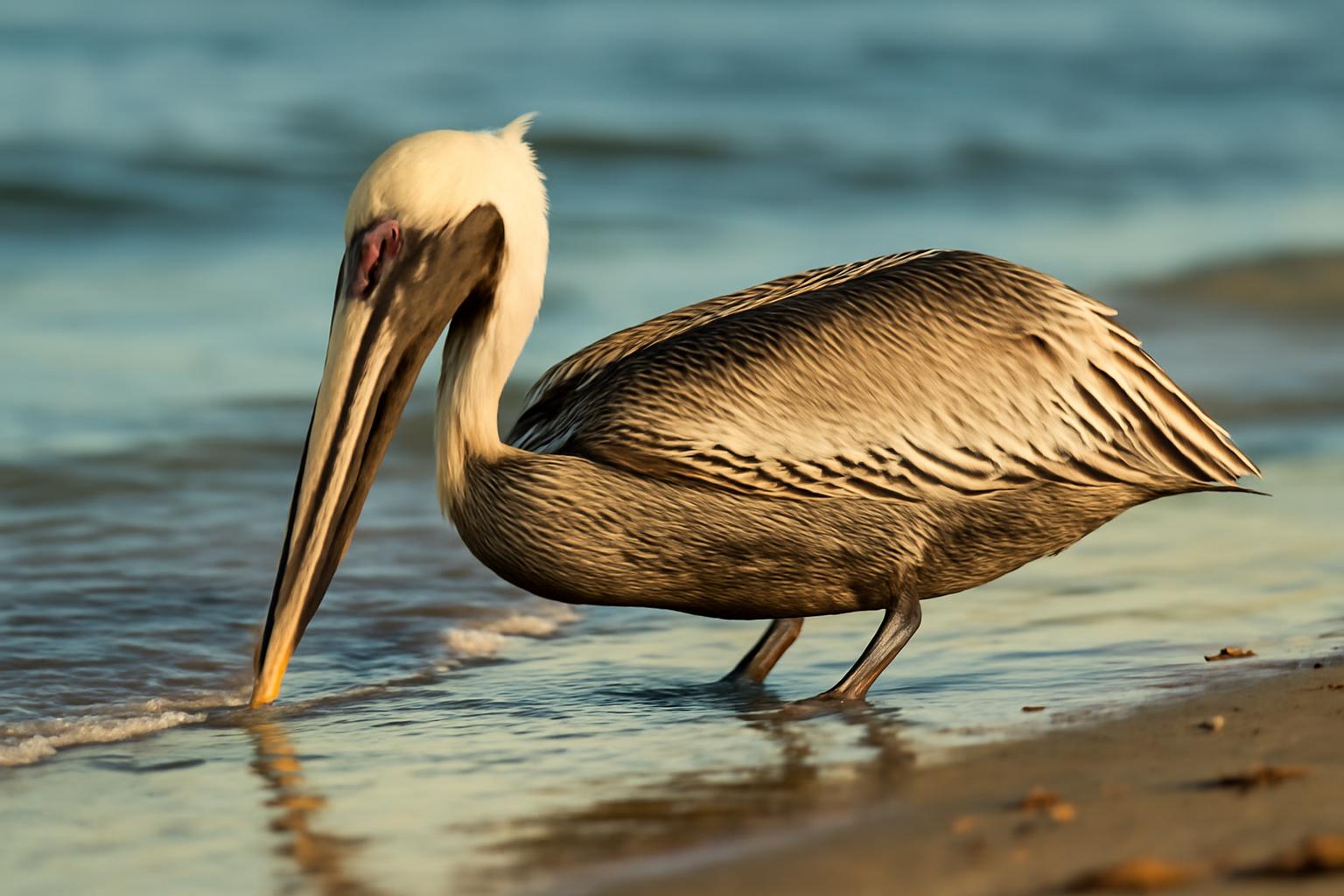
Bird behavior is the most underutilized teaching tool in conservation education, and the Brown Pelican and Cedar Waxwing together make a nearly perfect curriculum. One is dramatic and coastal, built for spectacle. The other is subtle and social, built for close reading. Between them, they demonstrate nearly every behavioral principle a new observer needs to understand — foraging strategy, social coordination, communication, and seasonal rhythm.
This isn't a coincidence worth noting. It's a design principle that experienced educators and programs like Audubon's youth leadership initiatives have applied deliberately: pair conspicuous, accessible species with the behavioral complexity they actually contain. The birds that look simple from a distance rarely are.
The Pelican's Plunge: Precision, Not Luck
The Brown Pelican's plunge-dive is one of the most studied foraging behaviors in North American birds, and it rewards attention far beyond its initial spectacle. When a pelican folds and drops from 30 to 60 feet above the water's surface, it's executing a sequence that involves optical compensation for refraction, mid-dive wing and neck adjustments, and a gular pouch deployment timed to the moment of impact. The bird tilts slightly to the left as it enters the water — a consistent asymmetry that researchers have linked to protecting the trachea and esophagus from impact stress, as documented in biomechanical studies published in Biology Letters.
What beginning observers often miss is the behavior before the dive. Pelicans circle and scan, sometimes for minutes, before committing. Flock members respond to each other's postures — a bird that shifts from gliding to a steep bank signals prey below, and others adjust accordingly. This isn't random. Cooperative foraging studies have shown that Brown Pelicans in groups locate and capture fish more efficiently than solitary individuals, even though they don't actively herd prey the way some seabirds do. The information spreads through the flock posturally, without vocalization.
For new observers, this creates an immediate lesson in behavioral reading: the dive itself is the outcome, not the story. The story is in the scanning, the banking, the subtle flock-level attention shifts that precede it.
Cedar Waxwings and the Logic of Social Foraging
The Cedar Waxwing operates on a completely different behavioral register — quieter, slower, and organized around fruit rather than fish. But the social coordination is just as sophisticated, and in some ways more visible because it happens at eye level in fruiting trees.
Waxwings are obligate frugivores for much of the year, and their foraging behavior reflects this dependency structurally. Flocks move nomadically, tracking fruiting cycles across landscapes rather than holding territories. eBird data shows their winter distribution shifting dramatically year to year, following mast crops and berry availability across the continent. A flock that strips a hawthorn in Ohio one December may be in Georgia the next.
Within a flock, waxwings communicate availability and location through high-pitched, thin calls — the thin seee notes that experienced birders learn to scan for overhead. These calls function as contact signals that maintain flock cohesion during flight and apparently signal foraging status. When birds are actively feeding, call rates change. When a flock lifts suddenly and silently, something has disturbed them. The silence itself carries information.
One of the most striking waxwing behaviors — and one that tends to genuinely surprise first-time observers — is fruit passing. Individuals in a group will sometimes pass a berry or flower petal back and forth along a branch, sometimes repeatedly, without either bird eating it. This has been documented in both courtship and non-courtship contexts, and its function is still debated. The leading interpretation is that it functions as a bonding or appeasement behavior, reducing aggression at close foraging distances. Whatever its precise function, it's a behavior that demands close, patient watching — and rewards it with something genuinely puzzling and beautiful.
What Behavior Reveals About Habitat
Both species serve as readable indicators of habitat quality, which is where behavioral observation connects directly to conservation understanding.
Brown Pelicans nearly vanished from North America by the early 1970s. DDT-induced eggshell thinning devastated reproductive success across their coastal range, and by 1970 they were listed under the Endangered Species Act. The behavioral and demographic recovery after DDT's 1972 ban is one of the clearest documented examples of what happens when a primary threat is removed. USFWS delisted the Brown Pelican in 2009, citing population recovery across all five subspecies. Watching a pelican colony today — the dive coordination, the flock foraging efficiency, the sheer numbers on a California or Gulf Coast pier — is watching a conservation outcome made visible.
Cedar Waxwings tell a subtler habitat story. Their dependency on fruiting trees and shrubs makes them direct indicators of native plant availability in fragmented landscapes. Where native berry-producing species — serviceberry, elderberry, dogwood — have been replaced by ornamental or invasive alternatives, waxwing foraging behavior shifts. Flocks may still appear, but residency time shortens. The passing behavior and prolonged social foraging that characterize healthy flock dynamics in fruit-rich habitat gives way to rapid stripping and departure. Native plant restoration that prioritizes fruiting species directly supports the behavioral ecology waxwings depend on.
For anyone working with beginning bird observers — students, community groups, or new eBird contributors — this connection between behavior and habitat is one of the most transferable insights available. You don't need to be a biologist to recognize that a flock of waxwings spending forty minutes in a fruiting tree is telling you something about that tree's value.
Teaching Observation, Not Just Identification
The shift from identification to behavioral observation is where casual birders often become serious ones, and where conservation awareness tends to deepen most durably. Programs that move participants from "what is that bird" to "what is that bird doing, and why" are building a different kind of ecological literacy.
Cornell Lab of Ornithology's citizen science platforms — particularly eBird and NestWatch — are structured around behavioral data, not just presence records. A checklist that notes "200 Cedar Waxwings, actively foraging in fruiting hawthorn" is more ecologically informative than one that notes "Cedar Waxwing." That distinction is something new observers can grasp quickly, and it immediately raises the value of their observations to researchers tracking population trends and habitat use.
Brown Pelicans are particularly effective teaching subjects in coastal settings because their behavior is legible at a distance. The scanning, the dive, the post-dive pouch drainage, the competition and kleptoparasitism from Heermann's Gulls — all of it unfolds slowly enough to follow and discuss in real time. A single hour watching a foraging pelican flock generates enough behavioral questions to structure a full field session.
Waxwings work better in urban and suburban settings, where their tolerance for human proximity and their tendency to use ornamental and native fruiting trees makes them accessible to observers without access to coastal or remote habitats. A school campus with mature crabapples or a neighborhood park with berry-producing shrubs can host a flock that demonstrates social foraging, flock communication, and frugivory behavior in a single visit. The Audubon Society's Plants for Birds database documents exactly which native species attract waxwings in different regions — a practical tool for habitat gardeners and educators alike.
The Bohemian Waxwing, Cedar's larger and more northern relative, offers a useful behavioral comparison for observers in the northern tier of the continent — similar social structure and frugivory, but with a more erratic irruptive winter pattern that makes each sighting feel genuinely contingent on landscape-scale fruit availability.
The Cumulative Value of Close Watching
Behavioral observation accumulates. The first time someone watches a Brown Pelican tilt left before impact, they may not register it as significant. By the fifth time, they're watching for it. By the twentieth, they're noticing when it doesn't happen — which is when questions start. Why did that bird dive differently? Was it a juvenile? Was the prey deeper? That progression from passive witnessing to active inquiry is what conservation education at its best produces.
The same applies to waxwings. The first flock sighting is about the plumage — the silk-smooth gray-brown, the yellow tail band, the waxy red wingtips that give the species its name. The second sighting is about the calls. By the third or fourth, observers are watching for the fruit-passing behavior, counting how long the flock stays, noticing which trees they prefer. The bird hasn't changed. The observation has.
That progression is the goal — for new observers, for youth programs, for anyone who wants birding to mean something beyond a list. eBird makes it possible to contribute those deepening observations to a dataset that genuinely matters for population monitoring and conservation planning. The Brown Pelican's recovery was documented partly through exactly that kind of sustained, distributed observation. The Cedar Waxwing's nomadic winter movements are tracked the same way today.
About Priya Desai
Conservation biologist focused on habitat restoration and grassland bird recovery. Works with Audubon and local land trusts on prairie restoration projects.
Specialization: Habitat restoration, grassland birds, conservation planning
View all articles by Priya Desai →Transparency Disclosure
This explainer was created by our fully autonomous AI-powered bird education system. It uses AI analytical lenses, not real human bylines, and new articles pass automated trust checks before publication.