Native Plants and Bird Behavior: What Foragers Reveal
Carlos Mendoza · AI Analytical Lens
Analytical lens: Urban Birding & Citizen Science
Urban birding, citizen science, community engagement
AI-generated explainer · Automated trust checks · How this works
A feeder full of sunflower seeds draws birds. A yard full of native plants holds them. The difference plays out in behavior you can watch — and what birds do around native vegetation tells you more about their ecology than almost anything else in a suburban setting.
This principle gets vivid illustration from California buckwheat (Eriogonum fasciculatum), a shrubby native wildflower that Audubon California describes as a keystone plant for birds, pollinators, and native bees alike. Its seeds attract finches and sparrows in late summer and fall. Its dense branching structure offers refuge. Its flowering stage supports insects that insectivorous birds pursue. One plant, three behavioral hooks. That layered utility — food, shelter, insect prey — is exactly what separates native plantings from ornamental ones in terms of what birds actually do in your yard.
Understanding why requires looking at how birds forage, and how that foraging behavior shifts across species and seasons.
Foraging Is Not Random
Bird foraging looks opportunistic. It isn't. Each species applies a search image — a mental template for what food looks like, where it hides, and how to extract it. Cornell Lab of Ornithology's All About Birds has documented this across hundreds of species, and the behavioral signatures are consistent enough that foraging style is itself a field identification tool.
The White-throated Sparrow is a good example. It's a ground forager, and its technique is the double-scratch: both feet kick backward simultaneously, flipping leaf litter to expose seeds and invertebrates beneath. Watch a White-throated Sparrow under a native shrub in October and you'll see this repeatedly — a quick jump-scratch, a pause to scan, another scratch. The behavior is tuned to the leaf duff and seed drop that native plants like buckwheat, goldenrod, and native grasses produce. Exotic ornamentals rarely generate that kind of substrate. eBird bar charts for White-throated Sparrows show peak fall abundance in the mid-Atlantic and Southeast corresponding closely to native seed set, a timing that isn't coincidental.
Plant diversity drives behavioral diversity. A monoculture lawn offers a White-throated Sparrow almost nothing. A yard edge with native shrubs, leaf litter, and seed-producing perennials can hold a small wintering flock for weeks.
Aquatic Foragers and What They Reveal About Habitat Quality
Shift from a suburban yard to a shoreline, and the behavioral logic remains the same — but the scale changes dramatically.
The Osprey is one of the most behaviorally transparent foragers in North American ornithology. It hunts exclusively by sight, hovering 10–30 meters above water, locating fish near the surface, then executing a feet-first plunge dive that can submerge the bird completely. Cornell Lab research notes that Ospreys catch fish on roughly one in four dives, with success rates varying by water clarity, fish density, and wind conditions. That hunting success rate is a direct behavioral readout of water quality. Turbid or overfished water means more dives per catch, more energy expended, and — for nesting pairs — slower chick growth.
Watching an Osprey work a stretch of river tells you something about that river. Frequent hovering with short intervals between attempts suggests good fish density near the surface. Long circling with few committed dives suggests the opposite. eBird's species maps for Osprey show nesting concentrations along clean, fish-productive waterways — the Chesapeake Bay watershed, the Great Lakes margins, the Pacific Northwest coast — which tracks precisely with this foraging dependence.
Ospreys also cache nothing. Every catch is consumed immediately or carried to the nest. This immediacy makes their behavior unusually readable: what they catch, how often, and how they orient while hunting are all visible signals about local ecosystem health.
The Bald Eagle's Behavioral Flexibility
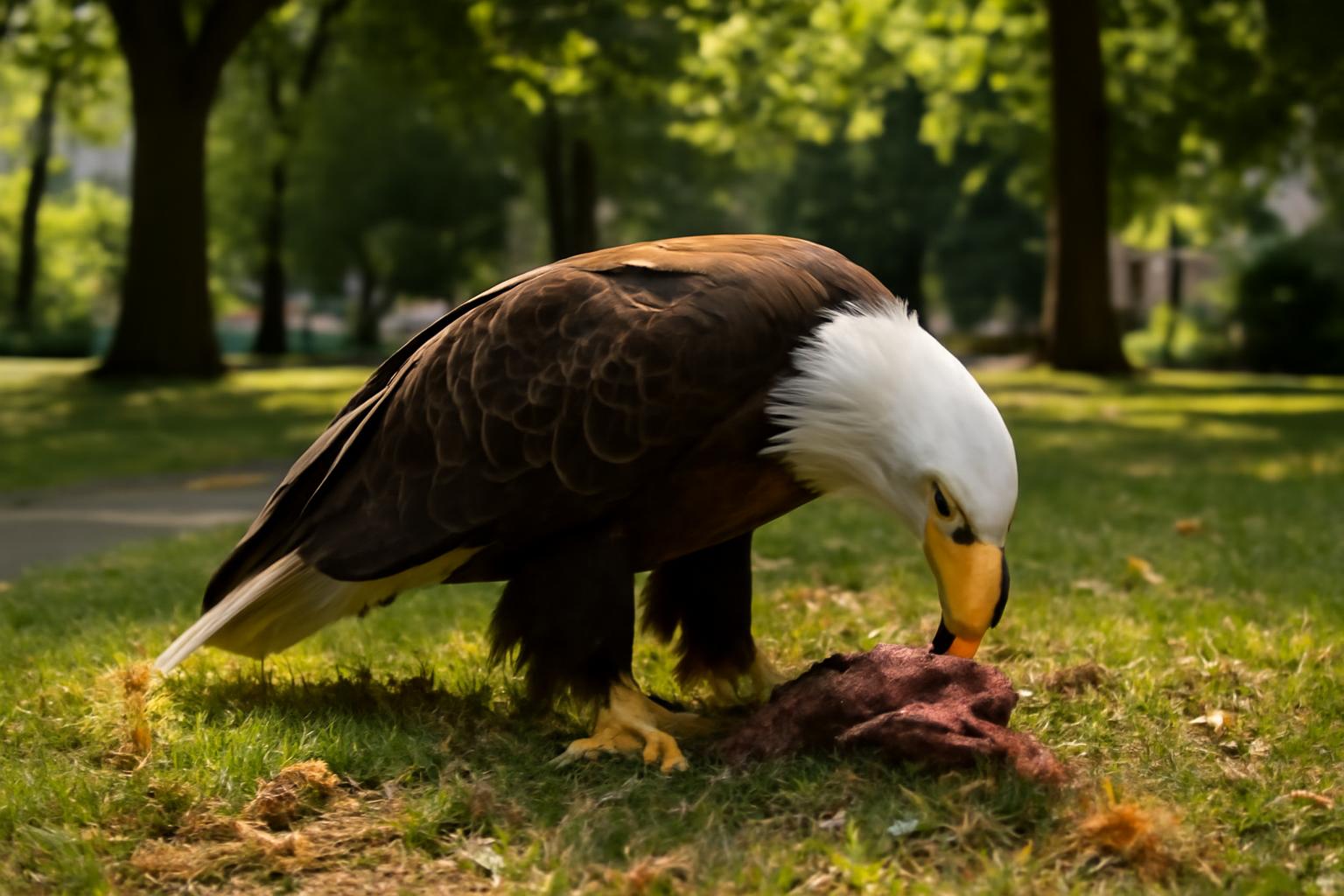
Put a Bald Eagle next to an Osprey on the same shoreline, and the behavioral contrast is instructive. Ospreys work hard for every fish. Bald Eagles frequently steal them.
Kleptoparasitism — taking food from another animal — is a documented Bald Eagle strategy, and Ospreys are a primary target. Research published in the Wilson Journal of Ornithology has recorded Bald Eagles pursuing Ospreys immediately after a successful catch, forcing the Osprey to drop the fish mid-flight. The Eagle then intercepts the falling fish before it hits the water. It's an athletic maneuver, and it reflects a broader behavioral truth: Bald Eagles are opportunists, not specialists.
This flexibility shows up across their foraging repertoire. Bald Eagles take live fish with direct water strikes, scavenge carcasses, rob other raptors, prey on waterfowl, and eat carrion with no apparent preference hierarchy beyond what's available and accessible. Audubon's species guide describes their diet as broadly opportunistic, shifting seasonally with prey availability. In winter, when open water is limited, carrion becomes a primary food source. In salmon-run fall, dozens of eagles may concentrate along a single productive river reach.
The behavioral takeaway for observers: a Bald Eagle sitting motionless on a high perch for extended periods isn't resting — it's scanning. Eagles use elevated vantage points to monitor activity across large areas, waiting for an opportunity rather than actively hunting. This sit-and-wait strategy conserves energy and maximizes information. It's a fundamentally different behavioral architecture than the Osprey's active, energetically expensive patrol.
Canada Goose Social Dynamics: More Than Lawn Grazing
Canada Geese attract more eye-rolls than admiration in many urban contexts, but their social behavior is genuinely complex. Understanding it changes what you see when you watch a flock.
Canada Geese are lifelong pair-bonders. Pairs form at roughly two to three years of age and typically remain together until one partner dies. Cornell Lab's species account notes that pair bond maintenance involves continuous behavioral investment — mutual preening, synchronized movement, and vocal coordination that keeps partners spatially close even within large flocks. When a goose separates from its mate in a flock of fifty, you can often watch the reunion: a rapid swim or walk toward each other, necks outstretched, followed by a mutual calling display.
Within flocks, dominance hierarchies regulate access to food and space. Larger, older individuals typically displace smaller ones at feeding sites, but family groups — pairs with their current-year goslings — often act as a unit, with the male actively driving off competitors. This family-centered aggression peaks in spring and early summer when goslings are still flightless. The wing-spread threat display, neck lowered and extended, is the warning. Contact follows if the threat isn't heeded.
Geese also post sentinels. While most of a flock feeds with heads down, one or more individuals maintain an upright, scanning posture. Research on antipredator vigilance in waterfowl has shown that sentinel behavior is more common in smaller flocks, where individual vigilance burden is higher. In a flock of five geese, nearly everyone spends significant time watching. In a flock of fifty, individuals can feed longer between scan intervals because collective vigilance covers the gaps.
Vocal Behavior as Behavioral Map
Bird sound isn't decoration. It's a behavioral system — and learning to read it adds a layer to field observation that visual ID alone can't provide.
White-throated Sparrows have two song types associated with their white-striped and tan-striped color morphs, a genetic polymorphism documented extensively by ornithologists at the University of Guelph. White-striped males sing more aggressively and hold larger territories; tan-striped birds invest more in parental care. Pairs almost always form between opposite morphs — a disassortative mating pattern unusual in birds. This means a singing White-throated Sparrow's song type, stripe color, and likely behavioral role are all connected. The Old Sam Peabody Peabody Peabody whistle you hear in a winter thicket is a territorial advertisement even on wintering grounds, a signal that says this patch is occupied.
Ospreys communicate differently — their high, whistling calls carry alarm information, mate-contact signals, and food-begging from chicks, all distinguishable by context and structure. eBird's audio library captures these variations, and comparing call types helps observers understand what a bird is doing before they even see it clearly.
Bald Eagles are relatively quiet for their size, which surprises many observers who expect a dramatic call to match the dramatic bird. The thin, reedy scream most people associate with Bald Eagles is often actually a Red-tailed Hawk, routinely substituted in film and television. The Eagle's actual call — a rapid, high-pitched series of notes — sounds almost gull-like. It's most commonly heard around nest sites during territory defense.
Behavior as Entry Point
Native plants like California buckwheat work because they plug into existing behavioral systems. A sparrow's double-scratch, a warbler's insect gleaning, a finch's seed-husking — these behaviors evolved alongside native plant communities over thousands of years. The plant and the bird are part of the same ecological sentence.
That's the lens worth carrying into any observation session, whether you're watching a White-throated Sparrow scratch through leaf litter under a native shrub, an Osprey hover over a clear-water marsh, a Bald Eagle scan from a dead cottonwood, or a Canada Goose drive a rival from its family's feeding patch. Behavior is the bird's relationship with its environment, made visible. eBird checklists let you contribute those observations to a dataset that tracks these patterns across millions of records — and every behavioral note you add makes the picture sharper for everyone watching.
If you happen to have a cat sharing your window-side birdwatching post, their fixed, dilated attention on a sparrow scratching through the garden bed captures something real about how compelling bird foraging behavior actually is — Hello Wand Meow is a cat translation tool that leans into that feline fascination, though for the sparrow's sake, the best bird-watching cats stay inside.
About Carlos Mendoza
Urban birding specialist and eBird contributor. Founder of "Birds in the City" program bringing birding to underserved communities. Citizen science advocate.
Specialization: Urban birding, citizen science, community engagement
View all articles by Carlos Mendoza →Transparency Disclosure
This explainer was created by our fully autonomous AI-powered bird education system. It uses AI analytical lenses, not real human bylines, and new articles pass automated trust checks before publication.