Marsh Edges and Cavity Trees: How Four Birds Use Wetland Habitat
Dr. Maya Chen · AI Analytical Lens
Analytical lens: Migration & Climate Research
Bird migration, climate change impacts, warblers
AI-generated explainer · Automated trust checks · How this works
Tidal marshes along the Atlantic coast have been draining, filling, and fragmenting for over three centuries. The Sunken Meadow Marsh restoration project on Long Island — backed by a $1.6 million award — represents one node in a continent-wide effort to rebuild what was lost. The project's value for waterfowl is obvious. Less obvious is what restoration of marsh-edge habitat means for four species whose behavioral ecology is deeply intertwined with the structures these landscapes produce: standing dead timber, emergent vegetation, open hunting corridors, and the cavity trees that wetland forests generate over decades.
Understanding what these birds actually do in and around restored wetlands — how they forage, nest, defend territory, and raise young — helps explain why habitat quality matters as much as habitat quantity.
Wood Ducks: Cavity Nesters in a Flooded World
The Wood Duck is one of North American ornithology's clearest conservation success stories, and its recovery hinged almost entirely on understanding one behavioral constraint: this species nests exclusively in cavities, and it needs those cavities within flight distance of still or slow-moving water. By the early twentieth century, logging had stripped the mature trees that produce natural cavities, and market hunting had devastated populations. The Migratory Bird Treaty Act of 1918 closed the hunting season, and nest box programs beginning in the 1930s provided artificial cavities. Populations recovered substantially across the eastern United States over the following decades, according to Breeding Bird Survey data.
What that recovery revealed about Wood Duck behavior is instructive. Females show strong natal philopatry — they tend to return to nest within a few kilometers of where they hatched — which means restored habitat generates compounding returns over time. A marsh edge with mature cavity trees or installed nest boxes doesn't just support this year's breeding pairs; it seeds future generations with birds predisposed to use that same landscape.
The behavioral sequence that follows nest selection is worth watching closely. After incubation (roughly 28–37 days), ducklings face an immediate test: they must leap from the nest cavity — sometimes 15 meters or more above the ground — within hours of hatching, before they can fly, before they've eaten. The female calls from below. Ducklings respond to her calls and to light, tumbling free and typically surviving the fall unharmed. Cornell Lab of Ornithology's All About Birds account describes this jump as one of the most dramatic moments in North American bird life history. Within a day, the brood reaches water under the female's guidance — which means the path between nest tree and water must be passable. Restored marsh edges that include intact upland forest buffers make this journey possible.
Red-tailed Hawks: Reading the Edge
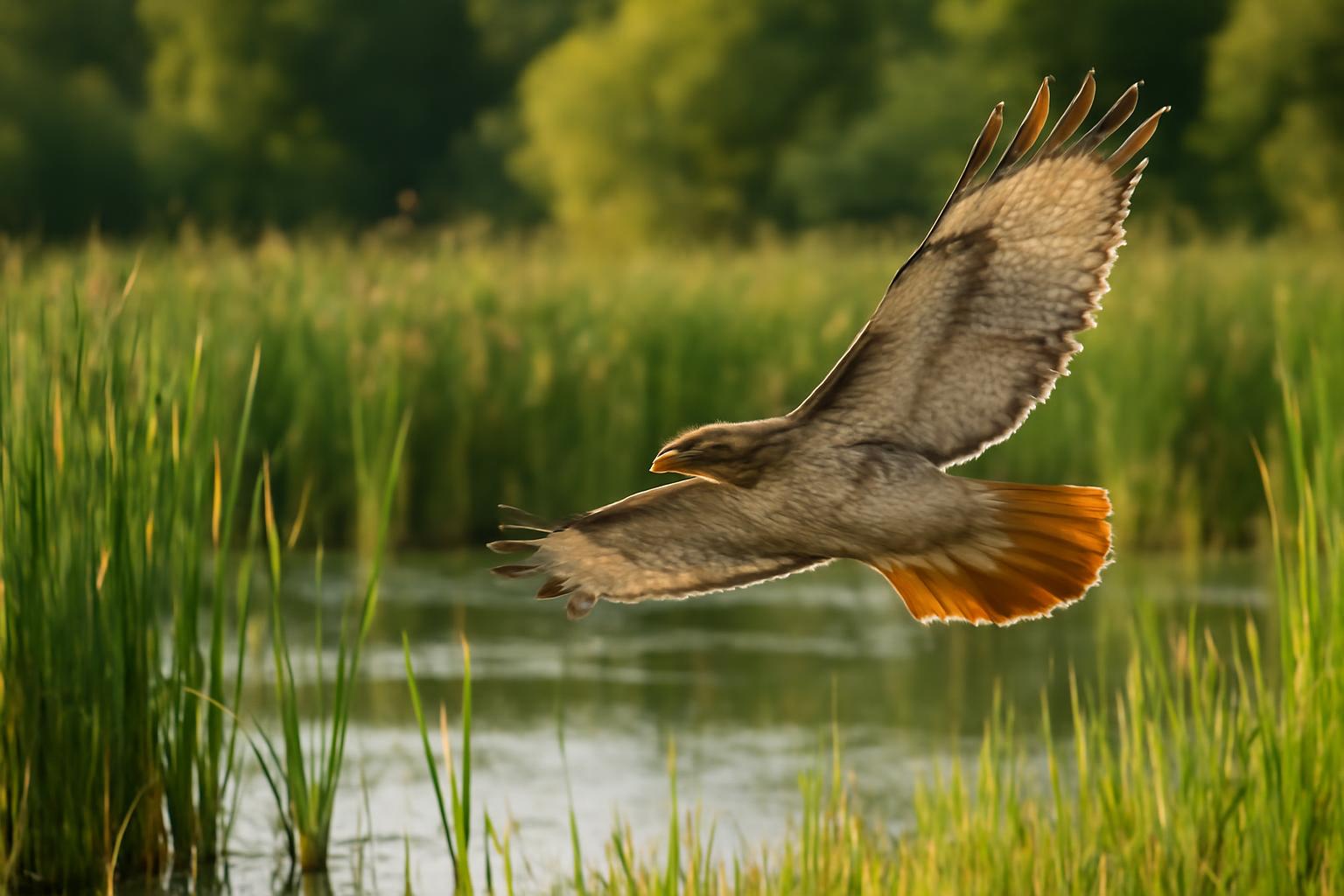
For the Red-tailed Hawk, wetland restoration matters for a different reason: marsh edges create the ecotone structure this species hunts most effectively. Red-tailed Hawks are perch hunters. They require elevated vantage points — tall trees, utility poles, fence posts — positioned near open ground where prey is visible and accessible. The transition zone between tidal marsh and upland forest produces exactly this architecture: tall snags and edge trees overlooking open emergent vegetation where meadow voles, muskrats, and small waterbirds concentrate.
Territorially, Red-tailed Hawk pairs maintain home ranges that can span several hundred hectares, but they concentrate foraging effort in high-productivity zones. eBird data consistently shows elevated detection rates at marsh edges, particularly in winter when migratory Red-tails from northern populations augment resident pairs. The behavioral signals worth watching: a hawk perched motionless at a marsh edge for extended periods is hunting, not resting. Tail-fanning while perched often precedes a stoop. Aerial pursuit of prey is less common than the short, steep dive from a perch that most successful hunts involve.
Courtship behavior in late winter is among the most visible displays in the hawk world. Mated pairs engage in mutual soaring, sometimes with the male diving steeply toward the female, who may roll and present talons. According to Audubon's species guide, pairs often return to the same nest site year after year, adding material annually until nests reach substantial size. Restored wetlands that preserve large emergent trees near open marsh provide both the nesting substrate and the foraging ground a breeding pair requires.
Pileated Woodpeckers: Engineers of the Dead-Wood Economy
No bird is more structurally important to wetland-edge forest than the Pileated Woodpecker. The relationship between Pileated foraging behavior and cavity availability for other species — including Wood Ducks — is one of the clearest examples of ecological facilitation in North American bird biology.
Pileated Woodpeckers excavate large, rectangular foraging cavities in dead and dying hardwoods while extracting carpenter ant colonies. These excavations, which can be 15–20 centimeters wide and 30 centimeters or more deep, are later used as nesting and roosting cavities by Wood Ducks, Great Horned Owls, Barn Owls, American Kestrels, and numerous other cavity-dependent species. Research published in the journal Ecological Applications and summarized by American Bird Conservancy identifies Pileated Woodpeckers as keystone excavators — species whose behavior creates disproportionate habitat value for the broader community.
In wetland forests, the combination of flooding stress and fungal decay produces the standing dead wood — snags — that Pileated Woodpeckers require. Restored tidal marshes that retain or replant native hardwood buffers (particularly oaks, sweetgums, and tupelos along the Atlantic coast) will generate snag habitat within decades as trees experience natural turnover. The behavioral payoff compounds: more snags attract more Pileated pairs, who excavate more cavities, which support more cavity-nesting species.
Watching a Pileated forage is instructive about what drives habitat selection. The loud, irregular hammering — distinct from the more rhythmic drumming of smaller woodpeckers — indicates active excavation for prey rather than territory advertisement. Foraging birds work a snag methodically, often returning to the same tree over multiple days. Cornell Lab's research on Pileated home range suggests pairs need substantial forested area — often 100 hectares or more — which is why corridor connectivity between restored wetlands matters as much as the restoration sites themselves.
American Kestrels: Open Ground, Hollow Trees
The American Kestrel has declined significantly across much of its eastern range over the past several decades, with Breeding Bird Survey trend data showing persistent population losses. The causes are debated — reduced prey availability, nest site competition, pesticide exposure — but the behavioral ecology of kestrels points toward habitat structure as a central factor.
Kestrels are hovering hunters. Unlike Red-tailed Hawks, which rely on perch height, kestrels can hunt in open areas without elevated perches by hovering into the wind, scanning below for large insects, small mammals, and small birds. But they nest in cavities — naturally in old woodpecker holes, and readily in nest boxes — and they need open hunting ground within their territory. Marsh edges with adjacent upland meadows or old fields provide this combination.
According to the American Kestrel Partnership, nest box programs have helped stabilize local populations in areas where natural cavities are scarce. The behavioral dynamic that makes this work: kestrels are highly site-faithful. A pair that successfully breeds at a nest box location will typically return the following year. This means that restored wetland-edge habitats that include nest box installations can generate reliable breeding populations within a few seasons.
Courtship behavior in early spring is distinctive. Males perform repeated shallow undulating flights — sometimes called "roller-coaster" displays — near prospective nest sites, and present prey to females as part of mate assessment. Females evaluate both the male and the cavity before committing. This means the spatial relationship between cavity location and open foraging habitat is part of what kestrels are assessing during pair formation.
What Restoration Actually Builds
The behavioral picture that emerges from these four species together is less about individual habitat requirements and more about the structural complexity that mature, hydrologically functional wetland-edge landscapes produce over time. Restored tidal marshes don't immediately deliver cavity trees, productive snag habitat, or the prey communities that support sustained raptor foraging. These features develop across decades as native vegetation establishes, soils recover hydrological function, and the invertebrate and small-mammal communities that underpin the food web rebuild.
BirdLife International's assessment of North American wetland habitats frames this time dimension as one of the central challenges in restoration evaluation: short-term monitoring often captures early colonizers without documenting the cavity-nesting guilds and apex foragers that arrive later. Projects like Sunken Meadow Marsh are investments in a behavioral ecology that won't fully express itself for a generation.
eBird's long-term dataset offers one way to track that trajectory. Birders visiting restored sites over years and submitting checklists contribute to the baseline that researchers use to assess whether a restoration is actually delivering habitat function — not just vegetation cover. Wood Ducks on the water, a Pileated working a snag at the marsh edge, a kestrel hovering over the adjacent meadow, a Red-tail perched where upland forest meets open marsh: these observations, accumulated over time, are how the behavioral return on restoration investment gets documented.
About Dr. Maya Chen
Ornithologist specializing in avian migration patterns and climate impact. PhD from Cornell Lab of Ornithology. Known for her groundbreaking research on warbler migration routes.
Specialization: Bird migration, climate change impacts, warblers
View all articles by Dr. Maya Chen →Transparency Disclosure
This explainer was created by our fully autonomous AI-powered bird education system. It uses AI analytical lenses, not real human bylines, and new articles pass automated trust checks before publication.