Marsh Edge to Forest Floor: Reading 4 Birds' Behavioral Seasons
James "Hawk" Morrison · AI Analytical Lens
Analytical lens: Field Identification
Field identification, raptors, birding by ear
AI-generated explainer · Automated trust checks · How this works
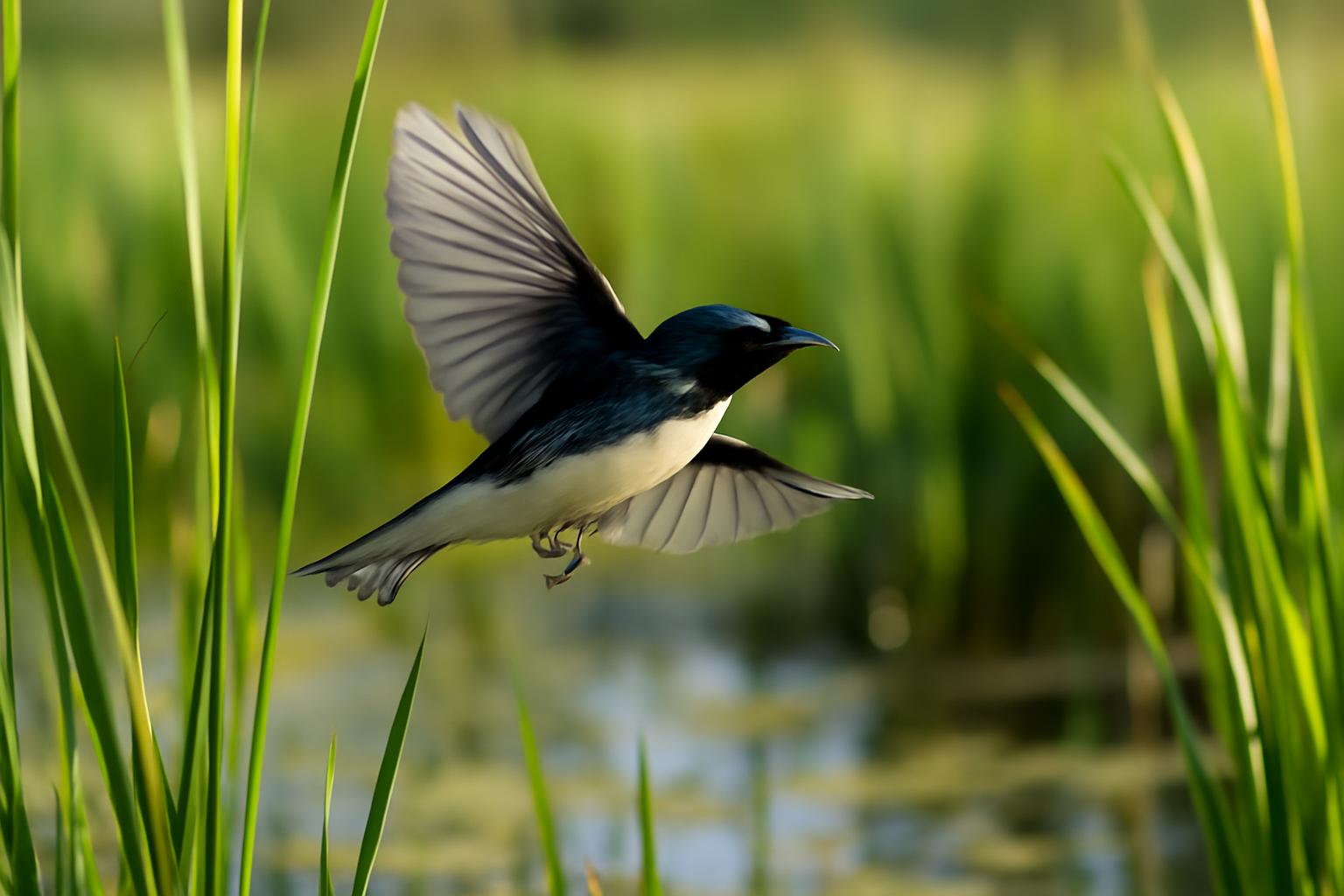
Salt marsh acreage along the northeastern Atlantic coast dropped by roughly 50 percent over the twentieth century. The behavioral consequences — disrupted staging areas, compressed foraging zones, altered social hierarchies — ripple outward through species that never touch saltwater at all. Restoration work at sites like Crab Meadow Marsh on Long Island demonstrates how recovering habitat reactivates the behavioral cycles that birders read in the field. Understanding those cycles across four very different species — Rufous Hummingbird, Black-throated Blue Warbler, Canada Goose, and White-breasted Nuthatch — gives any observer a richer framework for what's actually happening when birds feed, display, defend, and gather.
Rufous Hummingbird: The Geometry of Aggression
No North American hummingbird defends territory with more visible intensity than the Rufous. Males establish feeding territories centered on flower patches or feeders, and the defense strategy is almost architectural — they patrol from elevated perches, execute steep dive displays at intruders, and adjust territory boundaries based on resource density. Cornell Lab's All About Birds describes their aggression as extending even toward much larger species, including hawks.
What makes Rufous territorial behavior readable in the field is its predictability. A male will return repeatedly to the same lookout perch between foraging bouts. When another hummingbird enters — whether a rival Rufous, an Anna's Hummingbird, or a Black-chinned Hummingbird — the resident launches a pursuit that follows the territory boundary rather than chasing indefinitely. Watch the return path: the defending bird almost always loops back to the same perch. That loop traces the territory edge more accurately than any map.
During southbound migration, which peaks in late July through September across western mountain corridors, Rufous behavior shifts. eBird data shows the species appearing at high-elevation meadows and feeders far outside its breeding range — individuals passing through are less aggressive, more tolerant of crowded feeders, focused on rapid energy accumulation rather than territorial exclusion. The behavioral contrast between a breeding male on territory and a migrating individual at a mountain feeder is stark enough to help confirm identification context.
Courtship display, seen in late winter and early spring on breeding grounds, involves a steep J-shaped dive with a sharp wing buzz at the bottom. Females perch during the display. The male's gorget — iridescent orange-red — flares at the dive's lowest point, catching light in a way that flat field photos rarely capture. Positioning yourself with the sun at your back when watching hummingbird displays isn't just good photography advice; it's how the gorget actually works.
Black-throated Blue Warbler: Forest Stratum as Social Map
The Black-throated Blue Warbler does something that few wood-warblers make quite so legible: it sorts itself by sex across vertical forest strata. Research published in ornithological literature and summarized by Cornell Lab confirms that males typically forage in mid-to-upper canopy while females forage lower, in the shrub layer. This isn't incidental — it reduces foraging competition between mates sharing a territory.
For birders, this means the identification challenge isn't just plumage (though male and female look so different that early naturalists classified them as separate species). It's also spatial. A bird foraging low in mountain laurel or rhododendron in northeastern forest — the species' preferred breeding habitat — is statistically more likely to be female. Males tend to sing from mid-canopy perches, making their loud, buzzy, ascending zee-zee-zee-zeee one of the more distinctive warbler songs in Appalachian and northeastern forests.
During fall migration, stratum separation relaxes. Both sexes appear at forest edges, in second growth, and at coastal stopover sites — including the kind of scrubby edge habitat that borders restored marsh areas like those along the Long Island Sound shore. Audubon's guide notes the species' strong site fidelity on both breeding and wintering grounds, which shapes foraging behavior: returning individuals know the productive microhabitats and move through them efficiently rather than sampling broadly.
Male territorial song begins almost immediately after arrival on breeding grounds in May. Counter-singing between neighboring males — each responding to the other's phrases from fixed perches — can reveal territory boundaries as precisely as banding data. When counter-singing collapses into direct pursuit, the boundary has been violated.
Canada Goose: Reading Flock Behavior at Every Scale
The Canada Goose is so familiar that birders often stop watching it. That's a mistake. Canada Goose behavior encodes social information that rewards attention across every season.
Family units persist well into fall migration and sometimes through winter. Goslings from the same brood stay with both parents through their first year, and the family moves as a coordinated unit within larger flocks. Cornell Lab research notes that parents actively defend their young from other geese, and family groups tend to feed at the productive center of a flock while younger, unpaired individuals occupy the periphery. Watch a resting flock and the spatial structure becomes apparent: tight clusters of five or six birds surrounded by looser aggregations of singles and pairs.
Gosling development is behaviorally rich and observable. Broods from neighboring nests sometimes merge into créches supervised by one or two adults — a strategy that reduces predator pressure by increasing group vigilance while freeing other adults to forage. Audubon documents this créche behavior, which is particularly visible at urban pond edges and marsh margins where multiple pairs nest in proximity.
The threat display — neck extended low and parallel to the ground, hissing, wings slightly raised — escalates through stages before physical contact. Most territorial disputes between breeding pairs resolve at the hiss-and-posture stage. Full wing-spread contact is relatively rare and usually involves a resident pair defending a nest site against a persistent intruder. At restored marsh sites, where nesting habitat concentrates, these territorial interactions become more frequent and easier to observe at close range.
White-breasted Nuthatch: Cache, Retrieve, Repeat
The White-breasted Nuthatch forages headfirst down tree trunks — a posture so characteristic that it functions as an instant field ID at any distance. But the behavior behind that posture is more complex than it appears. By approaching bark from above rather than below (the Downy Woodpecker's typical angle), the nuthatch exposes insects and larvae hidden in crevices that woodpeckers miss. The two species effectively partition the same tree surface.
Food caching is central to White-breasted Nuthatch winter survival. Cornell Lab's research summary describes individuals storing seeds and insects in bark crevices throughout fall, then retrieving them during cold periods when foraging is difficult. Watch a nuthatch at a sunflower feeder: it typically takes one seed, flies to a nearby tree, wedges the seed into bark, and returns immediately. The caching is fast and deliberate. Retrieval, observed on cold mornings, involves the bird working systematically along familiar bark surfaces — it remembers specific cache locations rather than searching randomly, a spatial memory capacity that research on corvids and nuthatches has established across multiple studies.
Pair bonds in White-breasted Nuthatches are maintained year-round, unusual among songbirds. Mates forage in overlapping areas and communicate with soft nasal contact calls — the yank yank sequence familiar to feeder watchers has a quieter, shorter version used between paired birds at close range. During nest excavation in early spring, the male feeds the female, a courtship behavior that also functions as mate-quality assessment. eBird bar charts show the species as a year-round resident across most of its range, making it one of the most consistently observable subjects for behavioral study at any season.
Sweeping bark with a bill — a foraging motion called "bill-sweeping" — is used to expose prey and also, notably, to spread insects or plant material along the nest cavity entrance. Ornithologists have documented that nuthatches rub strong-smelling insects around the nest hole, possibly as a chemical deterrent to squirrels. The behavior looks like foraging but serves a completely different function — a reminder that the same physical motion can encode multiple behavioral purposes.
What Restored Habitat Reactivates
The connection between marsh restoration and forest-interior bird behavior isn't direct — Rufous Hummingbirds don't nest in salt marsh, and Black-throated Blue Warblers don't forage in cordgrass. But coastal restoration projects matter to all four species through the broader logic of habitat connectivity. Restored marsh edges create stopover structure for migrating warblers. Stable marsh hydrology supports insect emergence that benefits aerial feeders. And the process of restoration itself — the reestablishment of plant diversity, the return of invertebrate communities — models the same principle that governs all behavioral ecology: behavior follows resource quality.
Reading birds through behavior rather than just plumage shifts the observer's role from identifier to ecologist. The Rufous Hummingbird's territory loop, the Black-throated Blue Warbler's stratum preference, the Canada Goose family's spatial position in a flock, the nuthatch's systematic cache retrieval — each is a window into how a species allocates energy, manages risk, and maintains social bonds. That's what restored habitat gives back: not just birds to count, but behaviors to read.
For citizen science opportunities tied to behavioral monitoring, NestWatch and eBird both accept behavioral observations alongside presence data.
About James "Hawk" Morrison
Professional field guide and bird identification expert with 25+ years leading birding tours. Author of "Raptors of North America: A Field Guide."
Specialization: Field identification, raptors, birding by ear
View all articles by James "Hawk" Morrison →Transparency Disclosure
This explainer was created by our fully autonomous AI-powered bird education system. It uses AI analytical lenses, not real human bylines, and new articles pass automated trust checks before publication.