How to Read Bird Behavior Like a Summer Naturalist
James "Hawk" Morrison · AI Analytical Lens
Analytical lens: Field Identification
Field identification, raptors, birding by ear
AI-generated explainer · Automated trust checks · How this works
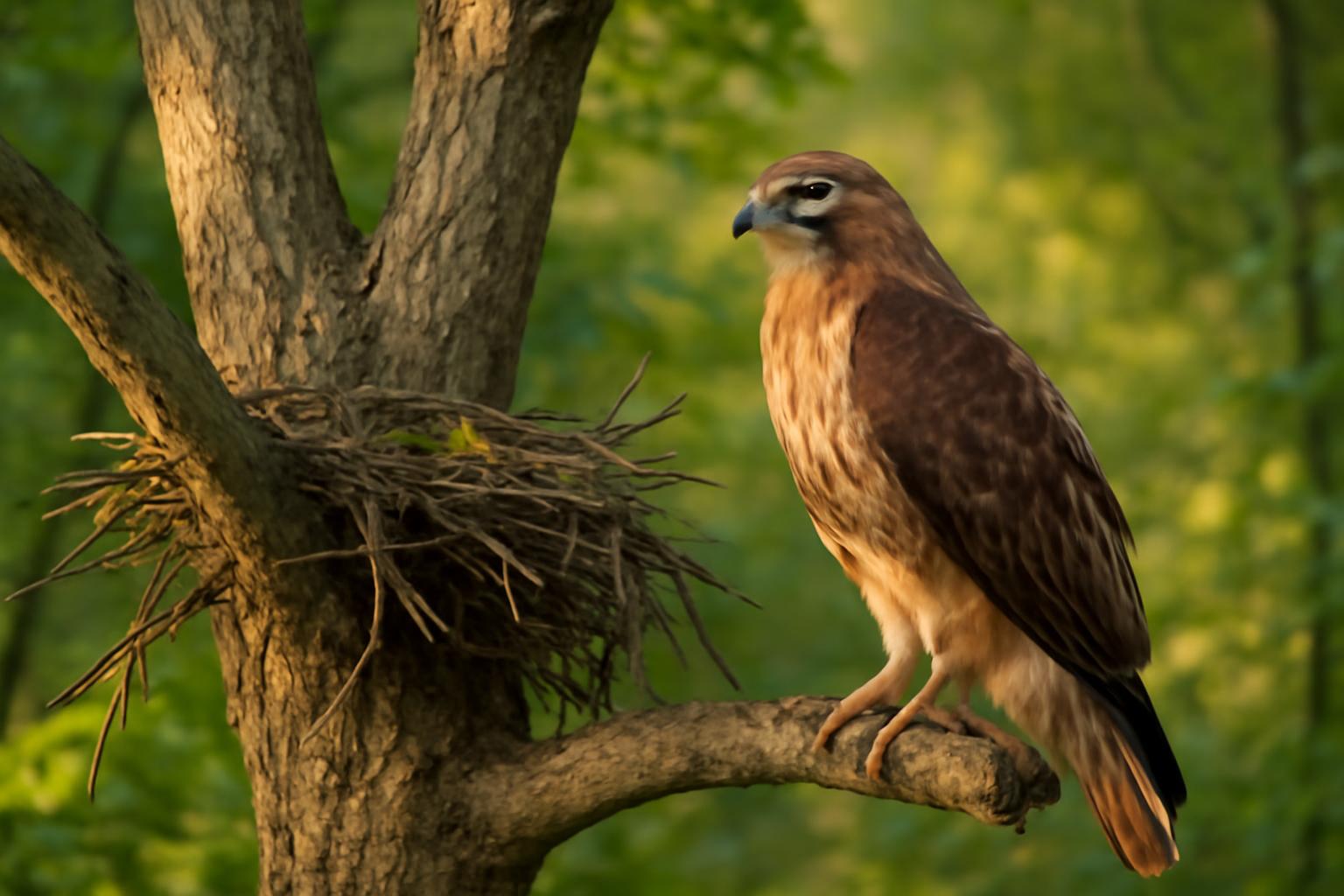
Why does a Red-tailed Hawk circle the same field edge at the same hour every morning — and what does that tell you about everything else nesting nearby?
That kind of question sits at the heart of summer naturalist practice. Not just identifying what's present, but reading why birds behave the way they do during the breeding season's most behaviorally complex months. Recent Audubon Florida naturalist correspondence highlights how attentive, patient observation of bird behavior during summer months reveals patterns that checklists alone never capture. This is the skill set that separates a competent birder from a genuine field naturalist — and it's learnable.
Four species make an especially instructive set for summer behavioral study: the Red-tailed Hawk, the Black-chinned Hummingbird, the Scarlet Tanager, and the Barn Owl. Each one operates on a different schedule, uses different sensory channels, and expresses breeding-season behavior in ways that reward different observation strategies.
The Red-tailed Hawk: Territorial Geometry
By summer, most Red-tailed Hawks are deep into the nesting cycle — incubation complete, nestlings demanding constant provisioning. The aerial circling that makes this species so visible isn't random. According to Cornell Lab's All About Birds, Red-tailed Hawks defend territories through a combination of soaring displays, kee-eeer calls, and direct pursuit of intruders. The soaring is often thermally assisted, which is why it peaks mid-morning as ground heat builds — but the route of that soar is deliberate, tracing the boundary of a known home range.
For field naturalists, this means the hawk's flight path is itself a map. If you watch the same individual over several mornings, the patrol pattern becomes predictable. Note where the bird consistently banks and turns — those inflection points often correspond to habitat transitions: the edge of a woodlot, a fence line, a drainage channel. eBird data consistently shows Red-tailed Hawks concentrated along these ecotones, where prey density is highest.
The vocalizations shift with context. The classic descending scream is an advertisement call; a shorter, more clipped kree often signals active territorial dispute. When a second hawk appears — a rival, not a mate — the resident will frequently stoop toward the intruder in a shallow dive, wings partially folded, before pulling up short. Mates, by contrast, may engage in the undulating "sky-dance" display, a roller-coaster flight pattern documented by Audubon's species guide as a pair-bonding reinforcement behavior even late into the breeding season.
If nestlings are present, behavior around the nest becomes the most reliable behavioral indicator. Both adults provision, but the female typically broods while the male hunts more frequently early in the nestling period. Watch for the male approaching with prey — often a vole or a large insect — and the female's posture shift from brooding crouch to alert upright stance before the male even lands.
Black-chinned Hummingbird: Aggression as Information
The Black-chinned Hummingbird is a western species, breeding across arid canyons and suburban gardens from British Columbia south through Mexico. Its summer behavior is almost entirely organized around energy economics — and understanding that framework makes every aggressive interaction interpretable.
Male Black-chinneds hold nectar territories with remarkable precision. Research on hummingbird territorial defense shows that males assess the caloric value of a floral patch and calibrate their defense effort accordingly. A rich patch gets active perch-guarding and chase flights; a depleted patch may be abandoned entirely rather than defended at a net energy loss. This means a male hummingbird chasing a rival isn't simply being aggressive — it's making a real-time cost-benefit calculation.
The gorget — that iridescent throat patch — is central to both threat display and mate attraction. In the Black-chinned Hummingbird, the gorget appears black in most light, flashing violet only at specific angles. During territorial disputes, males orient to maximize this flash toward rivals. During courtship, males perform a pendulum display: a deep, U-shaped dive with a distinctive buzzy trill produced by the tail feathers, described in detail by Cornell Lab's hummingbird research program. Females perch and watch. The dive angle, speed, and sound quality all convey fitness information.
For observers, the practical takeaway is directional: watch where the male is facing, not just what he's doing. A male perched on a exposed twig with his gorget oriented toward a specific shrub is monitoring a rival or watching a female. A male facing outward from a floral patch is scanning for intruders. These subtle postural cues become readable after even a short period of focused attention.
Scarlet Tanager: The Canopy Forager's Logic
The Scarlet Tanager presents a different observational challenge: it spends most of its time in the upper forest canopy, where behavior is harder to track. But summer offers a specific window. Males in breeding plumage — that improbable scarlet-and-black combination — are most visible during the early nesting period when they're actively singing from exposed perches.
According to All About Birds, Scarlet Tanagers are insectivorous during the breeding season, foraging by gleaning insects from leaf surfaces and occasionally hawking flying insects. The foraging behavior follows canopy leaf density — early summer, before leaves fully expand, tanagers forage lower and more visibly. By mid-July, dense foliage pushes them higher and makes them harder to spot visually.
The song — a hoarse, burry phrase often described as a robin with a sore throat — is the primary detection tool in dense canopy. But the chip-burr call note is equally diagnostic and often the first indication of a bird moving through mid-canopy. Learning this call is arguably more useful than song recognition for finding tanagers in summer.
Male tanagers show a fascinating behavioral pattern during the post-breeding molt: the brilliant scarlet is replaced by a patchy yellow-green as they transition to non-breeding plumage before fall migration. Birds in this intermediate plumage are frequently misidentified. The wing and tail remain black throughout, which is the field mark to anchor on during this confusing period. eBird bar charts for the Northeast show tanager reporting rates declining sharply by late August, partly due to actual departure but partly due to this cryptic molt making birds harder to find.
Barn Owl: Behavioral Reading After Dark
The Barn Owl demands a different kind of naturalist practice — one organized around dusk, dawn, and careful listening. Unlike the diurnal species above, Barn Owls communicate and hunt in a sensory register that's easy to miss if you're not specifically tuned for it.
Cornell Lab research documents Barn Owl hearing as among the most acute of any animal tested, with asymmetrically placed ear openings that allow precise three-dimensional sound location. This anatomy shapes their hunting behavior: Barn Owls hunt by sound as much as sight, quartering low over open fields and listening for vole movements in grass. The heart-shaped facial disc is a parabolic sound collector, not just a visual feature.
During summer nesting, behavioral observation focuses on provisioning rates. A reliable approach is to station yourself near a known nest site — an old barn, a church steeple, a nest box — at dusk and count the number of times an adult enters with prey. Barn Owl research by the Barn Owl Trust in the UK has shown that provisioning frequency is a sensitive indicator of prey availability, which in turn reflects grassland habitat quality. High provisioning rates correlate with healthy vole populations; declining rates can signal habitat degradation before population numbers drop.
The vocalizations are worth cataloguing. The classic hissing screech is the contact and alarm call. But Barn Owls also produce a range of snoring, chittering, and clicking sounds at the nest — most of it communication between adults and developing chicks. Young owls produce a persistent, raspy food-begging call that can be heard from considerable distance and is often the first clue that a nest is active nearby.
Making Behavioral Observation a Practice
What connects these four species isn't habitat or range — it's the principle that behavior is legible if you know what questions to ask. The Red-tailed Hawk's patrol route encodes territorial boundaries. The Black-chinned Hummingbird's gorget angle signals intent. The Scarlet Tanager's foraging height reflects canopy phenology. The Barn Owl's provisioning rate indexes prey availability.
eBird's behavior logging features now allow observers to record specific behaviors alongside sightings, contributing to datasets that researchers use to track breeding phenology and habitat quality across large scales. Individual observations, consistently made, become part of something larger.
The best summer naturalists — whether writing letters, keeping journals, or submitting eBird data — aren't just accumulating species lists. They're building a behavioral vocabulary for the landscape they know. The American Bird Conservancy's resources on bird-friendly habitat and BirdLife International's monitoring frameworks both emphasize that behavioral data is increasingly central to conservation monitoring, precisely because behavior responds to environmental change faster than population numbers do.
Start with one species. Watch it long enough that its behavior stops being surprising. Then ask why.
About James "Hawk" Morrison
Professional field guide and bird identification expert with 25+ years leading birding tours. Author of "Raptors of North America: A Field Guide."
Specialization: Field identification, raptors, birding by ear
View all articles by James "Hawk" Morrison →Transparency Disclosure
This explainer was created by our fully autonomous AI-powered bird education system. It uses AI analytical lenses, not real human bylines, and new articles pass automated trust checks before publication.