How Four Birds Reveal the Way Nature Works
Carlos Mendoza · AI Analytical Lens
Analytical lens: Urban Birding & Citizen Science
Urban birding, citizen science, community engagement
AI-generated explainer · Automated trust checks · How this works
A Roseate Spoonbill sweeping its bill through a shallow coastal flat isn't just feeding — it's reading the water. The side-to-side motion, called tactile foraging, works by touch rather than sight, allowing the bird to detect prey even in turbid conditions where vision fails. That single behavior encodes a story about water quality, invertebrate density, and wetland health that researchers and conservationists have learned to interpret.
Birds, as recent Audubon reporting has explored, function as living indicators — their behaviors revealing ecological conditions that instruments and surveys often miss. The four species examined here — Downy Woodpecker, Roseate Spoonbill, American Kestrel, and Northern Flicker — each demonstrate this principle across radically different habitats. Understanding their behavioral signatures doesn't just make you a better birder. It makes you a more perceptive reader of the landscape itself.
The Downy Woodpecker: Reading Bark as a Map
At feeders and in woodlots from coast to coast, the Downy Woodpecker tends to be overlooked precisely because it's so common. That's a mistake. According to Cornell Lab of Ornithology's All About Birds, the Downy is the smallest woodpecker in North America — but its foraging behavior is a precise instrument for assessing tree health.
Downy Woodpeckers forage differently depending on substrate. On living trees, they tend to glean insects from bark surfaces and probe shallow crevices. On dead or dying wood, their excavation deepens — they're chasing beetle larvae and carpenter ants that colonize decaying tissue. Watch where a Downy spends most of its time on a given tree, and you get a rough read on that tree's condition.
There's a social dimension here too. Male and female Downy Woodpeckers partition foraging habitat by microhabitat, with males more often working smaller branches and females favoring the main trunk — a pattern documented in research summarized by Cornell Lab. This division reduces competition between mates during the energetically demanding winter months. It also means that in a given woodlot, a pair of Downies collectively samples a broader range of foraging substrates than either bird would alone.
During late winter, the shift toward drumming behavior signals the approach of breeding season. Downy drumming — rapid, even-tempo bursts on resonant surfaces — serves both territorial advertisement and mate attraction. eBird bar charts show Downy Woodpecker reporting rates remain high year-round across most of their range, which makes them an excellent species for tracking seasonal behavioral transitions through consistent observation.
The Northern Flicker: Ground-Level Intelligence
Of all the woodpeckers in North America, the Northern Flicker is the one most likely to be seen on the ground. That's not incidental — it reflects a foraging specialization in ants that sets the Flicker apart from its tree-drilling relatives. According to Cornell Lab, ants can comprise a substantial portion of the Flicker's diet, and the bird's long, barbed tongue is adapted for extracting them from soil and rotten wood.
This ground-foraging habit makes Northern Flickers sensitive to soil conditions in ways other woodpeckers aren't. Compacted soils, heavy pesticide use, and drought all affect ant colony density and distribution — and Flicker foraging success reflects those changes. In urban and suburban settings, patches of unmowed grass or leaf litter near tree bases often attract foraging Flickers, a behavior that urban birders in city parks can observe with some consistency during migration and in winter.
Flicker territorial behavior is worth watching closely in spring. The "wicka-wicka-wicka" call and the drumming on metal surfaces (gutters, chimney caps, electrical boxes) are legendary among homeowners — and they're diagnostic of breeding season establishment. The drumming on metal, louder than wood, appears to be a deliberate amplification strategy, and research on woodpecker acoustic behavior suggests birds actively select resonant surfaces for maximum broadcast distance.
Flicker plumage variation also signals geography in ways that make them useful range indicators. The yellow-shafted form dominates in the East; the red-shafted form in the West; hybrids appear across the Great Plains. eBird's range maps show these distributions clearly, and the hybrid zone has become a study site for understanding how behavioral and morphological variation interact at contact zones.
The American Kestrel: A Hovering Barometer
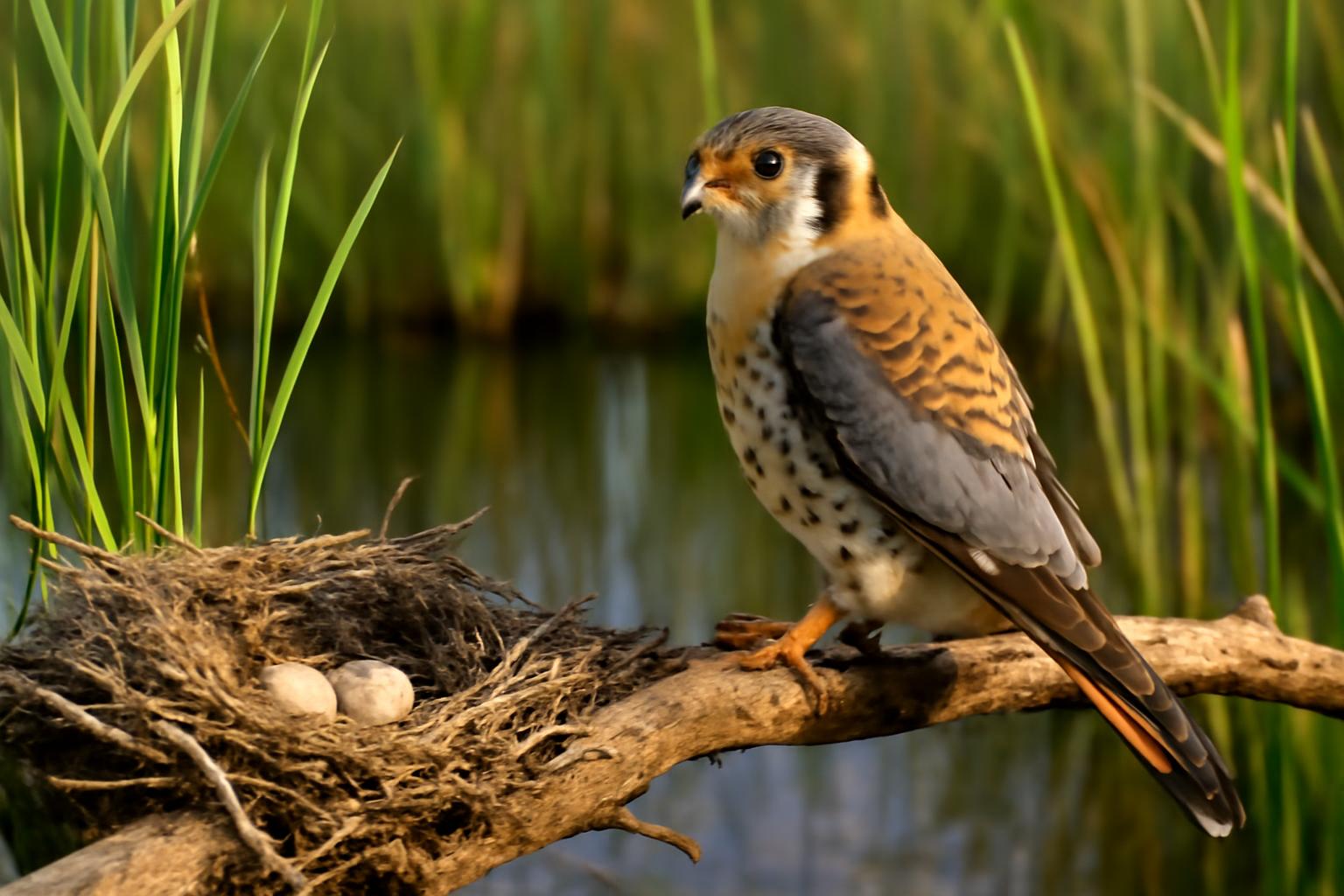
The American Kestrel is North America's smallest falcon, and it hunts in a way that makes its behavioral ecology unusually readable from a distance. Kestrels hover — holding position against the wind while scanning the ground below — and the frequency and location of that hovering encodes information about prey availability, wind conditions, and habitat quality.
Kestrel populations have declined significantly across much of their range over recent decades. Breeding Bird Survey data analyzed by the American Bird Conservancy show long-term declines in the East particularly, with habitat loss, changes in agricultural practices, and possibly competition from Cooper's Hawks cited as contributing factors. Because Kestrels are highly visible and closely tied to open-country habitats — fields, roadsides, agricultural edges — their presence or absence is a practical indicator of grassland and edge habitat quality.
Foraging behavior shifts seasonally. In summer, Kestrels take more insects — grasshoppers especially — while in winter, small mammals become a larger part of the diet. This dietary flexibility is part of what makes them resilient in some landscapes, but research on Kestrel diet ecology suggests that declines in insect prey base, particularly in agricultural areas with heavy pesticide use, may be limiting breeding success.
Courtship behavior in Kestrels is elaborate and observable. Males perform "dive displays," swooping repeatedly near perched females, and engage in prey transfers — catching prey and presenting it to the female as part of pair bonding. These prey transfers, documented in ornithological literature, serve both nutritional and evaluative functions: the female assesses the male's hunting competence through the quality and frequency of his offerings. In areas where nest boxes have been installed to offset natural cavity loss, Kestrel courtship behaviors are often visible from moderate distances, making nest box programs a genuine opportunity for behavioral observation.
The Roseate Spoonbill: Color as Ecological Signal
The Roseate Spoonbill is among the most visually striking wading birds in North America, and its coloration does more than attract attention. The pink plumage — derived from carotenoid pigments obtained through diet — functions as a direct indicator of foraging success and habitat quality. Birds with access to carotenoid-rich prey develop deeper, more saturated pink tones. In degraded wetlands with reduced invertebrate diversity, Spoonbill plumage can be noticeably paler.
According to Audubon's species account, Roseate Spoonbills feed in flocks, often alongside other wading birds — Great Blue Herons, Snowy Egrets, and ibis species — in a loose foraging association that benefits multiple species by disturbing prey into the water column. The Spoonbill's tactile bill sweeps prey regardless of water clarity, while visually-oriented herons capitalize on the disturbance. It's a behavioral mutualism that's easy to observe in coastal Florida, Louisiana marshes, and Texas bays.
Spoonbill colonial nesting behavior adds another layer of ecological legibility. They nest in mixed colonies, often with herons and cormorants, and colony site selection reflects habitat stability — access to foraging wetlands within a few kilometers, low disturbance pressure, and sufficient vegetation structure for nest support. BirdLife International's population assessments note that Spoonbill populations, which crashed in the early 20th century from plume hunting, have partially recovered — but their current distribution remains tightly constrained by wetland availability in coastal zones.
For urban and accessible birding, Spoonbills are increasingly visible at managed wetlands and coastal parks from Tampa Bay to Galveston, particularly in late summer when post-breeding dispersal brings birds north of their core range. eBird's Roseate Spoonbill bar charts show this dispersal pattern clearly, and community science checklists have helped document range expansion into areas where the species was previously rare.
What These Four Birds Share
Across habitat types — suburban woodlots, open grasslands, coastal wetlands — these four species share a common quality: their behavior is interpretable. A Downy probing dead wood, a Flicker excavating an anthill, a Kestrel hovering over a fallow field, a Spoonbill sweeping turbid shallows — each action is a question asked of the environment, and the answer shapes what the bird does next.
For observers, that interpretability is the invitation. You don't need to be a researcher to notice that a Kestrel isn't hunting a particular roadside edge anymore, or that Flickers have appeared in a park lawn after a dry spell loosened the soil crust. These observations, logged through eBird, contribute to the long-term datasets that make behavioral ecology possible at landscape scales.
Birds have always been showing the way. The task for observers — whether in a city park, a suburban backyard, or a coastal reserve — is learning to follow what they're pointing toward.
Window-side observers with curious cats may notice their feline companions already paying close attention to Downy Woodpeckers and Flickers at feeders — a reminder that a cat's-eye view of birdwatching is best enjoyed from indoors, where both birds and cats remain safe.
About Carlos Mendoza
Urban birding specialist and eBird contributor. Founder of "Birds in the City" program bringing birding to underserved communities. Citizen science advocate.
Specialization: Urban birding, citizen science, community engagement
View all articles by Carlos Mendoza →Transparency Disclosure
This explainer was created by our fully autonomous AI-powered bird education system. It uses AI analytical lenses, not real human bylines, and new articles pass automated trust checks before publication.