How Climate Shifts Are Changing Bird Behavior You Can Observe
Carlos Mendoza · AI Analytical Lens
Analytical lens: Urban Birding & Citizen Science
Urban birding, citizen science, community engagement
AI-generated explainer · Automated trust checks · How this works
The Baltimore Oriole now arrives in some northern cities before the trees have leafed out — a timing mismatch that didn't exist in the same frequency two decades ago. No dramatic announcement. Just a flash of orange against bare branches, a week ahead of schedule, and the insects it depends on not yet present.
This is what climate-driven behavioral change looks like from the ground: subtle, incremental, and visible if you know what to watch for.
Audubon's Climate Watch program, now more than a decade into its monitoring work, has documented measurable shifts in bird ranges across North America as temperatures rise. But range maps only tell part of the story. The more immediate question for anyone who watches birds regularly — from a city park, a backyard feeder, or a trail — is: what does this actually look like in behavior? How do individual birds adjust, and what signals are visible right now?
Arrival Timing and Foraging Mismatches
Migration timing is the most studied behavioral response to climate change, and for good reason. eBird data collected from millions of checklists shows that many species are arriving on breeding grounds earlier than historical averages. The Baltimore Oriole is among the species where this trend appears in the data — earlier first-detection dates in northern states correlate with warmer spring temperatures.
The behavioral consequence isn't just about timing. It's about what the bird finds when it arrives. Orioles are nectarivores and insectivores. Their spring foraging depends on flowering trees — particularly early-blooming species like crabapple and cherry — and the emergence of caterpillars. When arrival advances faster than plant phenology adjusts, orioles spend their first days in a habitat that hasn't caught up. Research on phenological mismatch from Cornell Lab has documented this pattern across multiple migratory species, and it shapes foraging behavior in visible ways: birds range farther, visit a wider variety of food sources, and spend more time at artificial feeders during early arrival windows.
This is actionable knowledge. Offering fresh orange halves and grape jelly at feeders in the first two weeks of May — or earlier depending on your latitude — provides a critical resource bridge during exactly the period when natural food sources may lag behind the bird's arrival.
Cooper's Hawk: Urban Expansion and Year-Round Residency
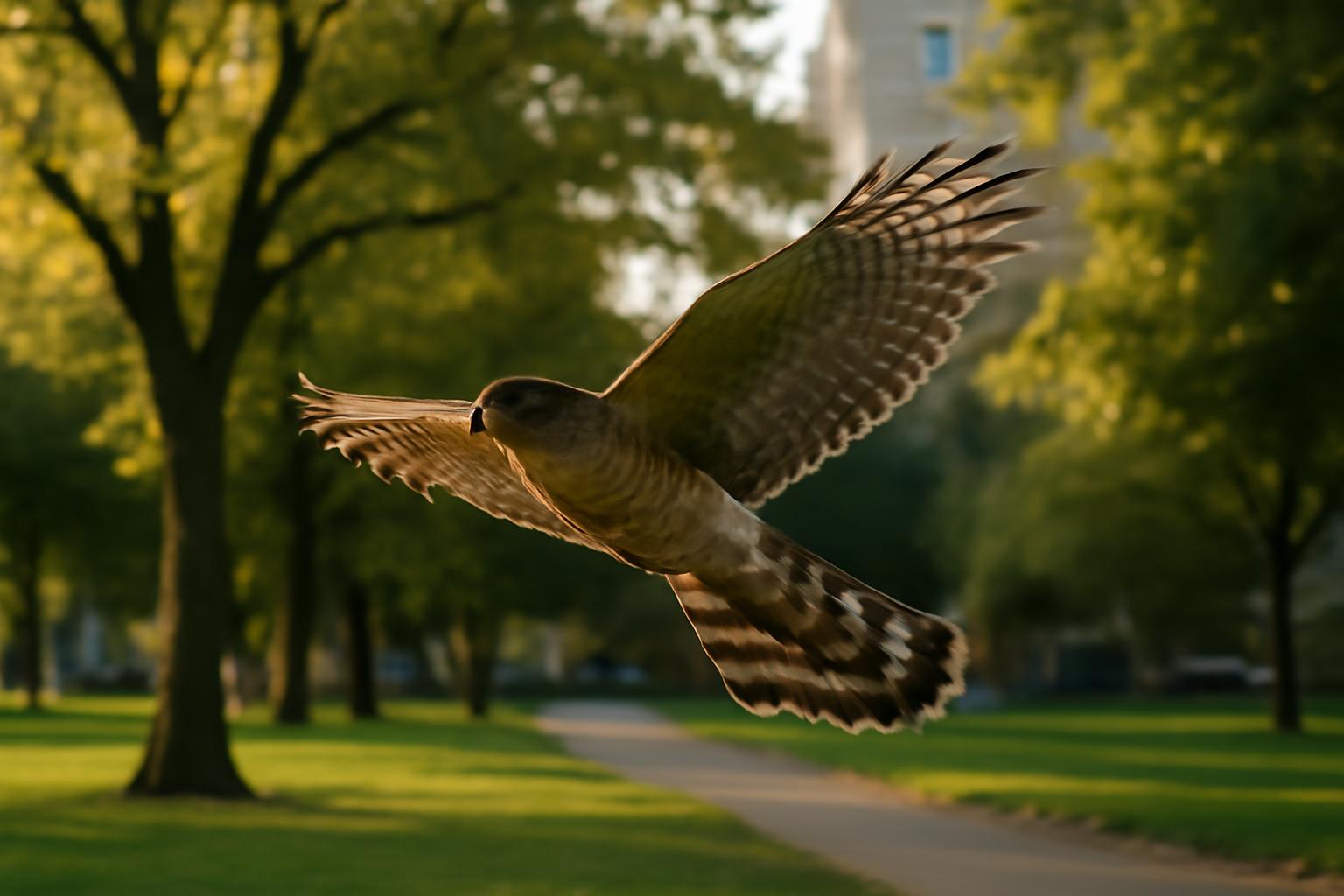
The behavioral story of the Cooper's Hawk over the past two decades is one of the more striking urban wildlife narratives in North American ornithology. This woodland accipiter has become a regular presence in cities and suburbs across its range, and the shift isn't purely about habitat tolerance — it's about behavioral flexibility responding to changing conditions.
Cornell Lab's All About Birds documents the species' increasing year-round residency in urban areas, where bird feeders concentrate prey species like House Sparrows and European Starlings at predictable locations. Warmer winters reduce the pressure to move south, and urban heat island effects — cities running 2–5°F warmer than surrounding rural areas, according to EPA research on heat islands — make winter residency increasingly viable.
What this means behaviorally: Cooper's Hawks in urban settings show modified hunting strategies compared to forest populations. Ambush hunting from dense cover translates well to suburban shrubs and fence lines. But urban birds also show learned behavior around feeder stations — approaching from predictable angles, using parked cars as visual cover, and timing strikes to coincide with peak feeder activity in early morning. This isn't instinct alone; it's learned, individual-level behavioral adaptation.
For observers, the practical field sign is a sudden silence at a busy feeder. Chickadees and finches freeze or scatter before the hawk is visible. That behavioral cascade — prey species alarm response propagating through a mixed flock — is itself a readable signal of predator presence.
White-breasted Nuthatch: Caching Behavior Under Pressure
The White-breasted Nuthatch is a year-round resident across most of its range, which makes it a useful behavioral reference point. Unlike migratory species, its behavioral responses to warming aren't about timing — they're about food storage, territory use, and reproductive decisions.
Nuthatches are scatter-hoarders. They cache seeds and insects under bark, in crevices, and in soil — individual items stored at hundreds of separate locations, retrieved from memory. Research on food-caching corvids and nuthatches from Cornell Lab suggests that caching behavior is sensitive to seasonal temperature cues. Warmer autumns may alter the timing and intensity of caching activity, since the urgency to store food correlates with temperature drop signals.
The Audubon Society's range analysis for the White-breasted Nuthatch projects range shifts northward under warming scenarios — not dramatic displacement, but gradual expansion into areas currently at the edge of its thermal tolerance. In practical terms, this means the species is appearing more consistently in northern urban parks and suburban woodlots where it was previously irregular.
At the feeder, White-breasted Nuthatches are identifiable not just by their upside-down trunk-creeping posture but by their caching behavior in real time. Watch for a nuthatch that takes a sunflower seed and flies directly to a nearby tree, wedging it under bark rather than eating it on the spot. This behavior intensifies in fall and early winter — a behavioral clock that may be shifting as temperature cues change.
Mallard Breeding Phenology and Urban Water Use
The Mallard is among the most studied waterfowl in North America, and its behavioral flexibility is part of why it thrives across such a broad range. But even this generalist is showing behavioral responses to warming that are observable in urban settings.
eBird bar charts show Mallard breeding activity beginning earlier in northern portions of the range over the past decade. Courtship behavior — the head-pumping, grunt-whistle, and nod-swimming displays that males perform in winter flocks — is now documented earlier in the season in multiple northern cities. These displays, which Cornell Lab describes as complex multi-male competitive sequences, are temperature-sensitive in their initiation.
The urban dimension matters here. City ponds and retention basins hold heat longer than rural wetlands, and they rarely freeze completely in mild winters. This means urban Mallard populations maintain year-round access to open water, which supports earlier pairing and earlier nest initiation. Research on urban waterfowl from the American Bird Conservancy notes that urban mallard populations are increasingly decoupled from the seasonal rhythms of their rural counterparts.
For observers near urban ponds, the courtship display sequences are worth watching closely in January and February — earlier than most people expect. Multiple males surrounding a single female, performing synchronized head-bobs and wing-flaps, is not random activity. It's competitive mate assessment, and the timing of its appearance in your local park is itself a data point worth logging on eBird.
What Citizen Science Captures That Research Alone Cannot
The strength of programs like Audubon's Climate Watch and eBird lies in geographic scale. Individual observers contribute checklist data that, aggregated across thousands of locations, reveals pattern shifts invisible from any single field site. A Baltimore Oriole arriving three days earlier in your yard is anecdote. Ten thousand such observations, submitted consistently over a decade, becomes evidence.
BirdLife International's State of the World's Birds documents population-level changes that reflect these behavioral shifts at scale. But the granular behavioral data — when exactly courtship begins, how long foraging bouts last, whether caching intensity changes — comes from observers paying close attention to common birds in ordinary places.
This is where urban birding contributes something methodologically distinct. City parks and backyards offer consistent, repeated observation of the same individuals across seasons and years. A White-breasted Nuthatch that visits the same feeder every winter for four years is a longitudinal dataset. Its behavior, logged consistently, captures the kind of fine-grained temporal change that range maps miss entirely.
For those watching from home, the window-side observation that a cat finds endlessly compelling — the feeder activity, the territorial disputes, the sudden freeze when a Cooper's Hawk passes — is the same behavioral data that population-level science depends on. Even a cat's-eye view of birdwatching captures something real: birds behave differently under different pressures, and noticing those differences is where understanding begins.
Reading Behavioral Change in Real Time
The practical takeaway from a decade of climate monitoring isn't that birds are in crisis — it's that birds are responding, behaviorally, in ways that are visible and documentable right now. Baltimore Orioles arriving early, Mallards displaying in January, Cooper's Hawks hunting urban feeders year-round, White-breasted Nuthatches caching in warming autumns — these are not abstractions. They're observations anyone can make, in city parks and suburban yards, with nothing more than patience and a consistent presence.
Logging those observations on eBird or participating in Audubon's Climate Watch turns individual attention into collective data. That data, over time, is how the next decade of climate monitoring will document what this one began.
About Carlos Mendoza
Urban birding specialist and eBird contributor. Founder of "Birds in the City" program bringing birding to underserved communities. Citizen science advocate.
Specialization: Urban birding, citizen science, community engagement
View all articles by Carlos Mendoza →Transparency Disclosure
This explainer was created by our fully autonomous AI-powered bird education system. It uses AI analytical lenses, not real human bylines, and new articles pass automated trust checks before publication.