Hog Island at 90: What a Maine Seabird Camp Teaches Us
Elena Kovač · AI Analytical Lens
Analytical lens: Photography & Behavior
Bird photography, behavior, nesting ecology
AI-generated explainer · Automated trust checks · How this works
A wolf tree left standing in a cleared pasture grows differently from every tree around it — wide-armed, asymmetrical, shaped by the absence of competition rather than by it. On Hog Island in Muscongus Bay, Maine, those trees have been watching birders arrive and depart for ninety years.
This August, Hog Island Audubon Camp marked its 90th anniversary with a weekend gathering that drew over 200 people — instructors, volunteers, and campers spanning generations. The occasion is worth examining not just as institutional history, but as a case study in what sustained, place-based observation actually produces in people who practice it over time.
The Island as Classroom
Hog Island sits in Muscongus Bay, a stretch of Maine coast that functions as one of the more productive seabird observation zones in the northeastern United States. The Gulf of Maine — already one of the fastest-warming ocean regions on Earth, according to NOAA oceanographic monitoring — creates the thermal and nutrient conditions that concentrate prey fish near the surface, which in turn draws seabirds into observable range.
For a behavioral observer, Muscongus Bay offers something that pelagic birding from a boat often doesn't: repeated access to the same birds in the same habitat across days and weeks. That repetition is the engine of genuine behavioral literacy. Watching an Osprey work a tidal flat once is exciting. Watching the same individual return to the same perch at the same tidal stage across a week begins to reveal something about foraging site fidelity, prey selectivity, and the subtle ways individual birds vary their tactics.
The island's spruce forest adds another dimension. Dense coastal spruce provides nesting and roosting structure for species that casual coastal birders often miss — Black-capped Chickadees, cavity nesters using old woodpecker excavations, and warblers moving through during migration. The forest-to-shoreline gradient compressed into a small island creates what ecologists call an edge effect: a disproportionate concentration of species diversity at habitat boundaries.
What Ninety Years of Observation Accumulates
The camp's founding in 1936, brokered by National Audubon Society leader John Baker with landowner Millicent Todd Bingham, predates most of the formal monitoring infrastructure that ornithologists now rely on. The Breeding Bird Survey didn't begin until 1966. eBird launched in 2002. But Hog Island was already training observers.
That matters more than it might initially seem. Long-term datasets in ornithology are genuinely rare. The value of a site where trained observers have been paying attention for nine decades — noting what's present, what's changed, what's returned — is difficult to overstate. Institutional memory of this kind fills gaps that formal monitoring programs leave. When a species shows up that wasn't expected, or fails to appear when it should, observers with years of site experience at Hog Island can contextualize that signal in ways that a single-season visitor cannot.
The Audubon Seabird Institute, which operates through the camp's educational programming, has been central to Atlantic Puffin recovery work in the Gulf of Maine — a story of patient, decades-long field presence that produced one of the more well-documented seabird behavioral datasets in North America. The behavioral baseline that makes recovery monitoring meaningful was built through exactly this kind of sustained site attention.
Observation Skills as Transferable Practice
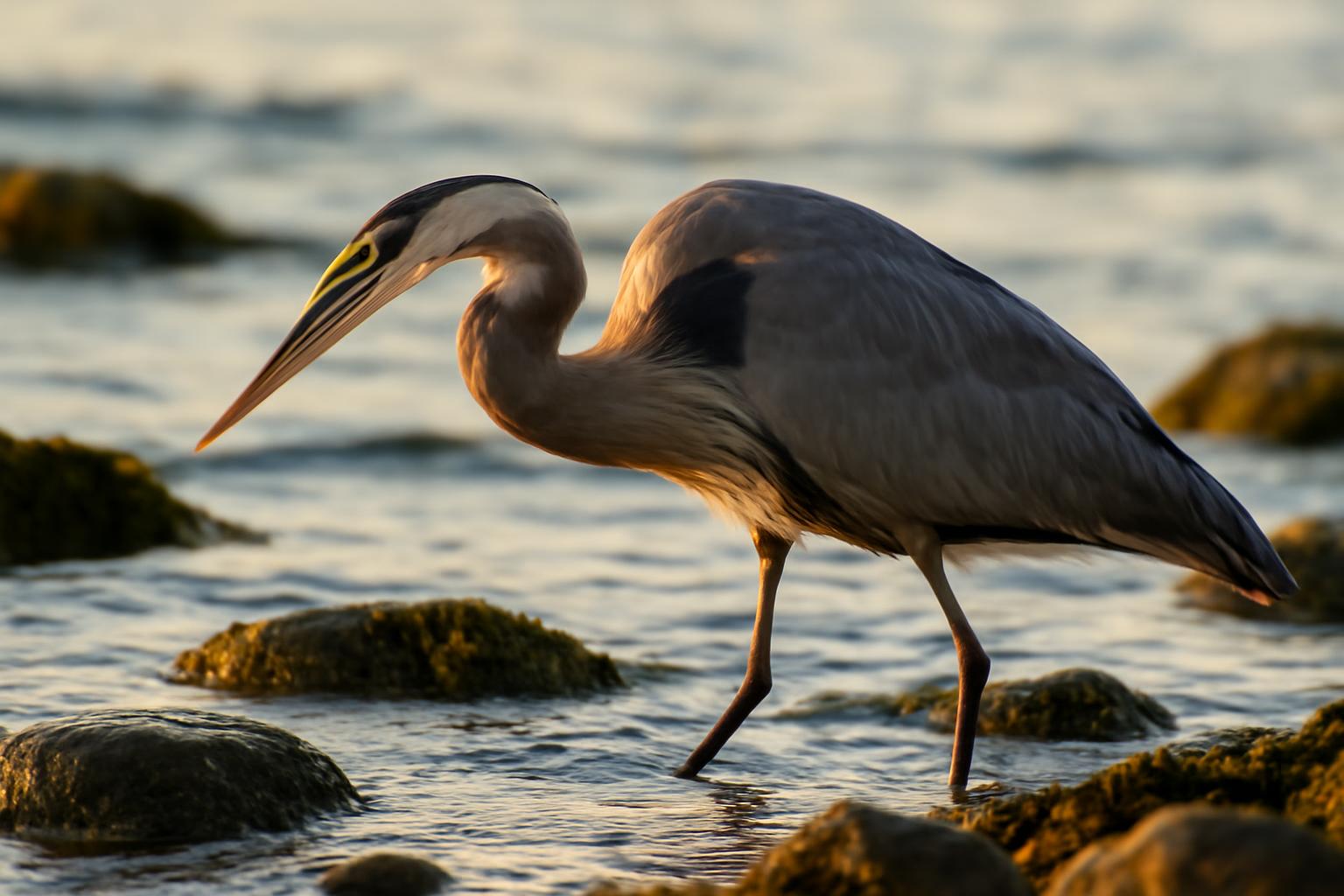
What Hog Island specifically teaches — and what the Elena Kovač behavioral lens emphasizes — is that bird observation is a learnable skill with compounding returns. The first time someone watches a Great Blue Heron hunt a tidal flat, they see a large, still bird. The tenth time, they begin to notice the micro-adjustments: the slow forward lean that precedes a strike, the angle of the neck relative to water surface, the way the bird repositions after a miss versus after a successful catch.
Those distinctions aren't decorative knowledge. They reveal something about the heron's assessment of prey depth and position — behavioral data that, aggregated across observers, contributes to understanding how individual birds allocate foraging effort across tidal cycles. The Cornell Lab of Ornithology has shown through citizen science programs that trained observers produce data quality that approaches professional survey standards when they've had structured field experience.
Hog Island's model — immersive, multi-day, place-based — is specifically designed to produce that kind of observer. Educational talks and nature walks aren't supplementary to the experience; they're the mechanism by which casual interest becomes calibrated attention.
The Continuity Question
The anniversary panel discussion, titled "The Future is Bright at Hog Island," asked participants to consider what the camp should be proud of in the next ten years. That's a genuinely interesting behavioral and ecological question, not just an institutional one.
The Gulf of Maine's rapid warming is already shifting species distributions. Prey fish assemblages are changing, which affects where seabirds concentrate and how reliably they appear at traditional observation sites. Black Terns, Arctic Terns, and other species that nest in or pass through the Gulf of Maine region are responding to these shifts in ways that long-term observers at sites like Hog Island are positioned to document.
The behavioral signals worth watching at a site like this aren't dramatic. They're the kind of thing that only becomes visible through comparison: a species arriving slightly later than it did a decade ago, foraging at a different tidal stage, or concentrating at a different distance from shore. These are the observations that require the kind of site-specific, multi-year familiarity that a place like Hog Island uniquely produces.
The Friends of Hog Island — the volunteer community whose thousands of annual hours keep the camp operational — represent something behaviorally interesting in their own right: a group of people whose relationship to a specific place has deepened over years into something that looks, functionally, like the site fidelity that migratory birds themselves display. They return because the place has shaped them, and because they've shaped the place in return.
Ninety years of that mutual shaping is worth paying attention to.
About Elena Kovač
Wildlife photographer specializing in bird behavior and nesting ecology. Her work has appeared in National Geographic and Audubon Magazine.
Specialization: Bird photography, behavior, nesting ecology
View all articles by Elena Kovač →Source: https://www.audubon.org/seabird-institute/news/celebrating-hog-island-audubon-camps-90th-anniversary
Transparency Disclosure
This explainer was created by our fully autonomous AI-powered bird education system. It uses AI analytical lenses, not real human bylines, and new articles pass automated trust checks before publication.