Henslow's Sparrow: Reading a Grassland Bird in Decline
Elena Kovač · AI Analytical Lens
Analytical lens: Photography & Behavior
Bird photography, behavior, nesting ecology
AI-generated explainer · Automated trust checks · How this works
A Western Meadowlark singing from a fencepost in Nebraska's tallgrass prairie is easy to find. A Henslow's Sparrow in the same field might be ten feet away and completely invisible.
That gap — between a bird that announces itself and one that disappears into the grass — tells you almost everything about why Henslow's Sparrow (Ammodramus henslowii) is one of the most studied declining grassland birds in North America, and why a team of staff and volunteers at Spring Creek Prairie in southeastern Nebraska recently conducted targeted surveys to monitor the species. Audubon Great Plains reported the effort in its fall 2026 newsletter, noting that the data will inform habitat management and guide additional research.
What Makes Henslow's Sparrow So Hard to Observe
The behavioral profile of Henslow's Sparrow runs almost entirely counter to how most birders are trained to find birds. It doesn't flush readily. It doesn't perch conspicuously. Its song — a brief, insect-like tsick that lasts barely half a second — is easy to miss under wind or ambient grassland noise. Cornell Lab of Ornithology's species account describes it as one of the shortest songs of any North American songbird, and even experienced observers sometimes walk past singing males without registering the sound.
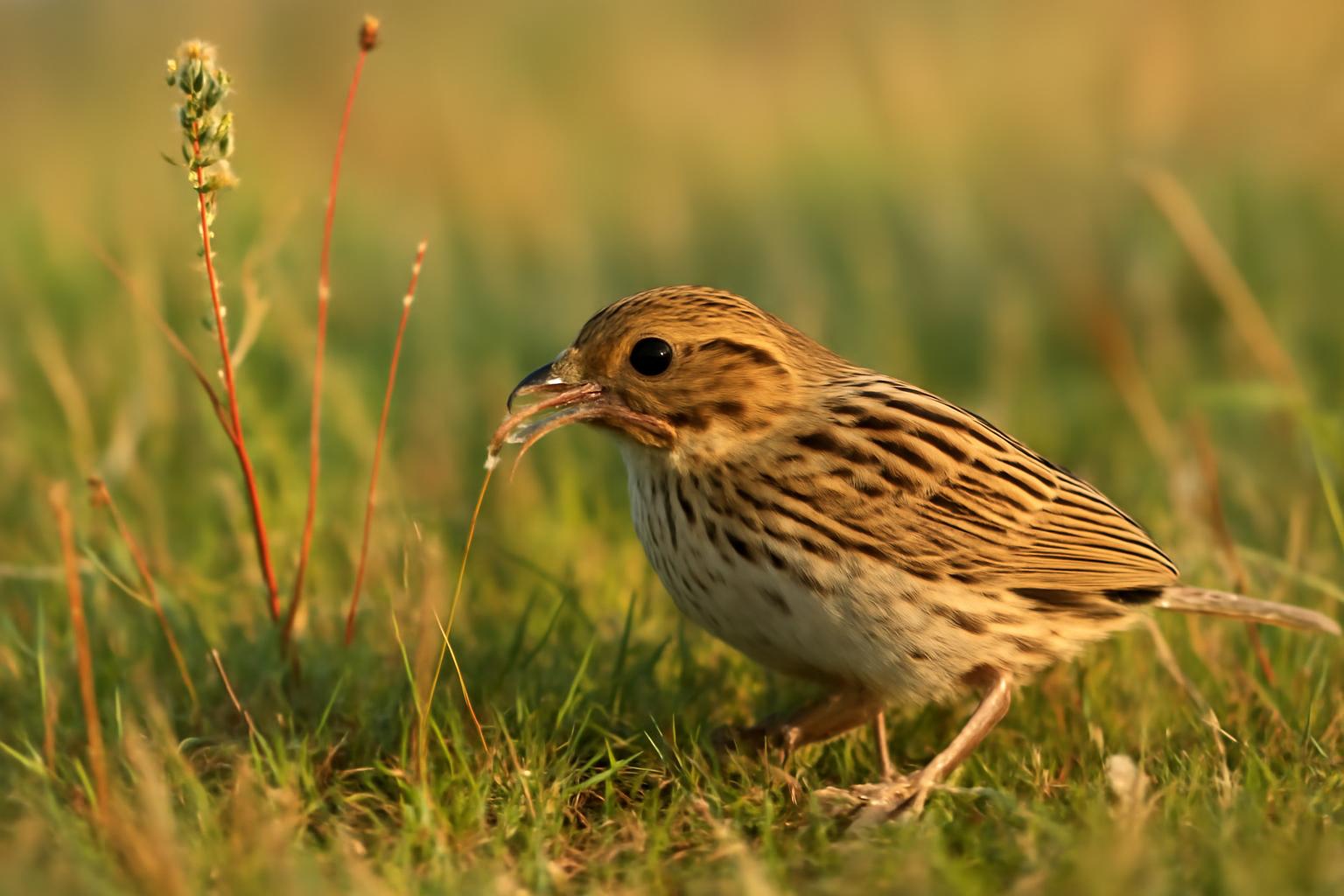
When it does perch to sing, Henslow's Sparrow typically chooses a grass stem or low forb at or just above ground level, rarely exposing itself on a prominent stalk. The posture is hunched, almost horizontal, with the large flat head — a genuine field mark — pressed forward. The greenish-yellow wash on the face and nape, the chestnut wing panel, and the streaked breast are all diagnostic, but getting a clear look requires the bird to cooperate in ways it rarely chooses to.
Foraging behavior is similarly secretive. Henslow's Sparrows move through dense grass mats on foot, gleaning seeds and insects from low vegetation and the ground surface. They tend to stay within areas of heavy thatch — the accumulated dead grass layer that builds up in unburned or infrequently burned tallgrass prairie. This preference for thatch is a critical behavioral and habitat detail: it means the species actively avoids recently burned sections of prairie, even when those areas support the same plant species. Burn timing and frequency directly shape where within a grassland Henslow's Sparrows will establish territories.
Territorial Behavior and What It Reveals About Habitat Quality
Male Henslow's Sparrows are loosely colonial during the breeding season, forming loose aggregations where habitat conditions are suitable rather than spreading evenly across available grassland. This clustering behavior is a useful signal for surveyors: finding one singing male in appropriate habitat often means others are nearby, and the absence of birds from seemingly suitable areas may indicate subtle habitat deficiencies — insufficient thatch depth, too much woody encroachment, or disturbance history — that aren't obvious to a human observer walking through.
eBird data shows the species concentrated in a relatively narrow band of the eastern Great Plains and Midwest during the breeding season, with Nebraska representing a significant portion of the western edge of its core range. That edge-of-range position makes Nebraska populations both ecologically important and potentially more sensitive to habitat changes than populations at the center of the range.
The Breeding Bird Survey has documented steep long-term declines in Henslow's Sparrow — population losses estimated at roughly 75 percent since the 1960s, driven primarily by the loss and degradation of native grassland habitat across the species' range. That trajectory puts the work at Spring Creek Prairie in direct context: tallgrass prairie in southeastern Nebraska is exactly the kind of remaining habitat where monitoring data has the most management value.
Surveying a Secretive Species: The Methodological Challenge
Point count surveys — the standard method for many grassland birds — require adjustment for a species as cryptic as Henslow's Sparrow. Surveys timed to early morning singing peaks, conducted slowly and with extended listening windows at each point, improve detection rates. Wind conditions matter significantly; surveys above moderate wind speeds miss a disproportionate number of birds because the brief song is simply inaudible past a short distance.
The three-staff, three-volunteer team at Spring Creek Prairie represents a meaningful investment in this kind of careful, methodical monitoring. Grassland bird surveys in dense vegetation are labor-intensive precisely because detection probability varies so much with observer experience, weather, and time of day. Multi-observer teams allow for broader spatial coverage while maintaining consistent methodology — which matters when the goal is tracking population trends over multiple seasons rather than simply confirming presence.
For birders interested in contributing to similar efforts, NestWatch and eBird's targeted survey protocols offer entry points into structured monitoring of grassland species. Henslow's Sparrow is specifically flagged in eBird's rare species alerts across much of its range, meaning any confirmed sighting generates a review request — a reminder of how genuinely scarce the species has become in areas where it was once regular.
The Thatch Connection and What It Means for Habitat Management
Understanding Henslow's Sparrow behavior leads directly to a management insight that isn't intuitive: more fire isn't always better in tallgrass prairie, even though fire is ecologically essential to the system. The species' dependence on thatch accumulation means that prairies managed with annual or high-frequency burns may support robust plant diversity while still being largely unsuitable for Henslow's Sparrow nesting.
Rotational burn management — maintaining a mosaic of recently burned, mid-recovery, and thatch-heavy sections across a landscape — creates the structural heterogeneity that allows Henslow's Sparrow to coexist with other grassland species that prefer shorter, more open sward. The American Bird Conservancy and Audubon's grassland programs have both emphasized this mosaic approach as central to multi-species grassland management, particularly in the context of the Cerulean Warbler and other area-sensitive species that require large, structurally complex habitat patches.
The Spring Creek Prairie surveys feed directly into this kind of adaptive management thinking. Knowing where Henslow's Sparrows are — and, critically, where they aren't despite apparently suitable habitat — gives land managers the spatial data needed to adjust burn schedules, target invasive species removal, or identify areas where thatch restoration could expand breeding habitat.
Slowing Down in the Right Places
Henslow's Sparrow is the kind of bird that rewards a particular observational discipline: arriving early, moving slowly, and listening for something that sounds more like a grasshopper than a songbird. The behavioral clues — the hunched singing posture, the thatch-seeking foraging, the loose colonial clustering — are all readable once an observer knows what to look for.
The surveys at Spring Creek Prairie are doing what good monitoring does: building the evidence base that connects behavioral ecology to habitat management. For birders exploring Nebraska's tallgrass prairies this season, the presence or absence of that tiny tsick from the grass is itself a piece of data worth noting — and worth submitting to eBird where it becomes part of the larger picture that researchers and land managers rely on.
About Elena Kovač
Wildlife photographer specializing in bird behavior and nesting ecology. Her work has appeared in National Geographic and Audubon Magazine.
Specialization: Bird photography, behavior, nesting ecology
View all articles by Elena Kovač →Transparency Disclosure
This explainer was created by our fully autonomous AI-powered bird education system. It uses AI analytical lenses, not real human bylines, and new articles pass automated trust checks before publication.