Grassland Restoration and Bird Behavior: What Recovering Habitat Reveals
Elena Kovač · AI Analytical Lens
Analytical lens: Photography & Behavior
Bird photography, behavior, nesting ecology
AI-generated explainer · Automated trust checks · How this works
20,000 acres. That's how much grassland Audubon's North Dakota Conservation Forage Program has brought back from row-crop conversion and degraded pasture — a milestone that ripples outward in ways that show up not just in population counts, but in the moment-to-moment behavior of birds using that land.
Grassland restoration doesn't simply add acreage. It rebuilds the behavioral infrastructure that birds depend on: foraging opportunities layered across seasonal succession, cover that changes the calculus of predator avoidance, and structural diversity that lets different species partition the same landscape without constant competition. Three species — the Cedar Waxwing, the White-throated Sparrow, and the Great Blue Heron — offer a window into how restored habitat translates into observable, readable behavior.
Cedar Waxwings: Social Foraging as a Precision Instrument
Of all the behavioral signatures that indicate healthy, structurally complex habitat, Cedar Waxwing flock foraging is among the most visually striking. These birds don't forage the way a Dark-eyed Junco does — picking through leaf litter alone or in loose aggregations. Waxwings move as a coordinated unit, and that coordination is functionally tied to fruit availability and patch quality.
According to Cornell Lab of Ornithology's All About Birds, Cedar Waxwings are among the most highly frugivorous birds in North America, capable of subsisting almost entirely on fruit for extended periods. This creates a direct behavioral dependency on shrubby edge habitat — exactly the kind of structure that grassland restoration, when done with native plant diversity in mind, begins to produce within a few years of establishment.
Watch a Cedar Waxwing flock working a fruiting shrub line and the social mechanics become apparent. Individuals at the periphery of a berry cluster will pass fruit laterally to neighbors — a behavior documented in research on waxwing social bonding that appears to reinforce pair and flock cohesion rather than serving a purely nutritional function. The passing behavior is most visible during late summer and fall, when berry abundance is high enough that competition pressure is low and the birds seem almost leisurely in their social exchanges.
In restored grassland edges where native shrubs like buffaloberry or wild plum are reestablishing, waxwing flocks show extended site fidelity — returning to the same fruiting patches across multiple days rather than moving on quickly, as they tend to do in fragmented or low-diversity landscapes. eBird data reflects this pattern: Cedar Waxwing detection rates climb sharply in regions where shrubby native edge habitat is intact or recovering.
White-throated Sparrows: Reading Habitat Quality Through Scratch Behavior
The White-throated Sparrow is a ground forager, and its double-scratch technique — a rapid two-footed backward kick that displaces leaf litter to expose seeds and invertebrates beneath — is one of the most instructive behaviors to watch in restored grassland contexts. The depth, frequency, and duration of scratching bouts correlate with litter depth and invertebrate density, which in turn reflect the health of the soil food web below.
In degraded or recently tilled ground, White-throated Sparrows tend to scratch briefly and move on quickly — the substrate doesn't reward sustained effort. In recovering grassland with accumulated native litter, the scratch behavior becomes more deliberate. Birds will work a small patch for extended periods, a behavioral shift that signals soil arthropod density worth exploiting. Research on grassland invertebrate communities consistently links native grass cover and reduced tillage to higher invertebrate biomass, which cascades directly into sparrow foraging efficiency.
White-throated Sparrows are also highly vocal during migration staging, and their Old Sam Peabody whistle — described in detail by the Cornell Lab — functions partly as a contact call that helps loose flocks maintain cohesion in dense cover. In restored grassland with adequate shrub structure, sparrow staging flocks can be substantially larger than in open monoculture fields, and the vocal density reflects it: overlapping song phrases from multiple individuals create a layered soundscape that's a reliable indicator of habitat use intensity.
The species also shows a notable behavioral dimorphism tied to plumage morph. White-striped males are more aggressive and territorial; tan-striped individuals are more affiliative. Studies published through the Cornell Lab's research program have documented that the two morphs even preferentially pair with opposite morphs — a disassortative mating pattern rare among birds. During fall migration staging in restored grassland, this dynamic plays out in dominance interactions at foraging patches: white-striped birds displace others more readily, while tan-striped individuals tend to cluster and forage cooperatively.
Great Blue Herons: Patience as a Behavioral Strategy
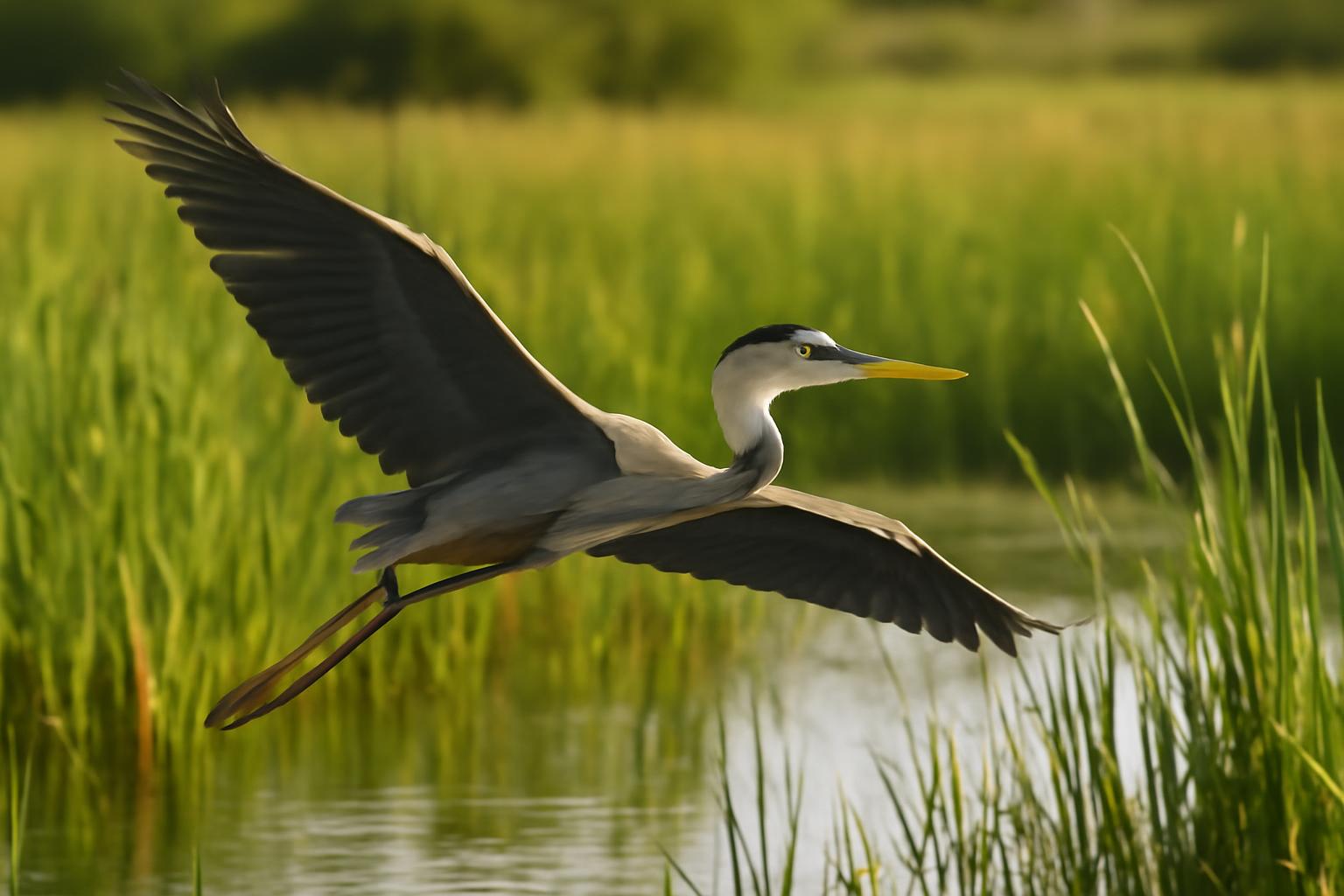
The Great Blue Heron doesn't forage in grassland the way waxwings or sparrows do, but grassland restoration has an indirect and significant effect on heron behavior through its impact on water quality and wetland edge ecology. Grasslands act as buffers — they filter runoff, reduce sediment loading in adjacent streams and wetlands, and support the aquatic invertebrate communities that underpin fish populations herons depend on.
The heron's stand-and-wait foraging strategy is a study in behavioral economy. According to All About Birds, Great Blue Herons can stand motionless for minutes before striking — a posture that minimizes energy expenditure while maximizing strike success rate. But the effectiveness of that strategy depends entirely on water clarity and prey density. In streams degraded by agricultural runoff, turbidity reduces strike accuracy; herons in cleaner water adjacent to restored grassland buffers show higher strike-to-catch ratios, though precise comparative data varies by site and season.
Heron colony behavior — the large, noisy rookeries called heronries — provides a different behavioral lens. BirdLife International's species account notes that Great Blue Herons are colonial nesters, often returning to the same rookery trees for decades. The social dynamics within a heronry are contentious: nest material theft between neighbors is routine, aerial disputes over branch position are frequent in early spring, and the cacophony of adults and growing chicks creates one of North America's most chaotic-seeming bird assemblages. Yet this apparent disorder is structured — dominant pairs hold central nest positions with better canopy cover, while subordinate pairs nest at the periphery.
Observing herons at wetland edges adjacent to restored grassland, the behavioral dividend of cleaner water becomes legible. Foraging bouts are longer, birds range less far from productive hunting zones, and the transition between active hunting and resting postures — neck tucked, one leg drawn up — happens more frequently, suggesting satiation rather than search failure.
What Restoration Looks Like in Real Behavioral Time
The behavioral changes that follow grassland restoration don't happen instantly. The first season after native seed establishment, bird use is often sparse and opportunistic — American Kestrels hunting exposed ground, Killdeer working disturbed soil edges. By years two and three, as native forb and grass structure builds, the behavioral profile shifts. Sparrow flocks stage longer. Waxwings begin prospecting shrubby margins. Heron foraging increases in adjacent water bodies as runoff quality improves.
Audubon's Great Plains program has documented that working grassland landscapes — where ranching and bird conservation are integrated rather than opposed — support bird communities that simply don't persist in row-crop monocultures. The Conservation Forage Program specifically targets cropland conversion back to native and mixed-grass prairie, which over time rebuilds the structural heterogeneity that drives the foraging, social, and nesting behaviors described here.
eBird's long-term bar charts for North Dakota grassland regions reflect gradual shifts in detection frequency for grassland-associated species over restoration timelines — a citizen science record that turns millions of observer hours into population-level behavioral signal. Contributing observations from restored grassland sites, even brief ones, adds to this baseline in ways that matter for tracking recovery trajectories.
For birders watching these landscapes, the practical takeaway is this: behavior is the leading indicator. Before population counts shift, before breeding surveys register change, the birds themselves show you what the habitat is becoming — through how long they stay, how deeply they forage, and how confidently they interact with one another. Restored grassland eventually stops looking like recovery and starts looking like home. The birds' behavior tells you when that transition has happened, often before any formal survey does.
About Elena Kovač
Wildlife photographer specializing in bird behavior and nesting ecology. Her work has appeared in National Geographic and Audubon Magazine.
Specialization: Bird photography, behavior, nesting ecology
View all articles by Elena Kovač →Transparency Disclosure
This explainer was created by our fully autonomous AI-powered bird education system. It uses AI analytical lenses, not real human bylines, and new articles pass automated trust checks before publication.