Farmland Birds: Foraging and Breeding Behaviors That Signal Habitat Health
Dr. Maya Chen · AI Analytical Lens
Analytical lens: Migration & Climate Research
Bird migration, climate change impacts, warblers
AI-generated explainer · Automated trust checks · How this works
Why do American Kestrels hunt from the same fence post day after day while Baltimore Orioles weave nests from a completely different patch of the same farm? The answer reveals how farmland birds partition a working landscape into overlapping behavioral territories — and why the quality of that landscape determines whether these species thrive or quietly disappear.
Farmland conservation has been gaining policy momentum in recent years. Audubon's recent statement on North Carolina's General Assembly investment in farmland conservation highlights a growing recognition that working agricultural lands are not separate from bird habitat — they are bird habitat, for dozens of species whose behavioral needs align precisely with the mix of open ground, hedgerows, tree lines, and wetland edges that well-managed farms provide. Understanding what those behavioral needs actually look like in the field makes the conservation case concrete.
The Kestrel's Hunting Logic
The American Kestrel is North America's smallest falcon, and its foraging strategy is a study in energy efficiency. Kestrels use elevated perches — utility lines, fence posts, dead snags at field edges — to scan open ground for large insects, small rodents, and occasionally small birds. This sit-and-wait hunting style is highly dependent on two things: clear sightlines across short vegetation, and perch availability within striking distance of that open ground.
Cornell Lab's All About Birds account for American Kestrel notes that kestrels are one of the few North American raptors capable of hovering in place over a target, a behavior that becomes more common when suitable perches are absent. Hovering is energetically expensive compared to perch-hunting, so a farm with intact fence lines and scattered snags directly supports more efficient foraging. Kestrel populations have declined significantly across much of the East — Breeding Bird Survey data tracked through USGS shows long-term negative trends in many regions — and habitat fragmentation that removes perch structures and reduces short-grass foraging areas is a primary driver.
During breeding season, kestrel pairs become highly territorial around nest cavities, which they don't excavate themselves. They depend on existing cavities in trees or structures, and males perform dramatic courtship flights — steep dives followed by upward swoops — near prospective nest sites. Farms with old wooden fence posts, hollow trees at field margins, or installed nest boxes can sustain breeding pairs where otherwise identical-looking land cannot.
Baltimore Orioles and the Architecture of Nesting
The Baltimore Oriole arrives on North American farmland in May, and within days the female is constructing one of the most structurally sophisticated nests in temperate bird life. The characteristic hanging pouch — woven from plant fibers, hair, and sometimes synthetic materials — is suspended from the outermost branches of tall deciduous trees, typically elms, cottonwoods, or sycamores along waterways and field edges.
The behavioral sequence matters here. Males arrive first and establish singing territories, advertising from canopy perches with a loud, fluty whistle that eBird range maps show concentrated along river corridors and tree-lined agricultural margins from the Great Plains east. Females inspect multiple males before choosing a mate, and the female alone does the nest construction — a process that can take one to two weeks. Research published through the Cornell Lab confirms that females show strong site fidelity, often returning to the same tree in successive years.
What this means for farmland management is specific: tall, mature riparian trees along farm waterways are not aesthetic amenities. They are functional nesting infrastructure. Conservation programs that protect or restore tree lines along drainage ditches and creek margins directly support oriole breeding density. Removing these trees — even selectively — can collapse local breeding populations that have used a site for years.
American Robins: Reading the Soil
The American Robin is so familiar that its foraging behavior rarely gets the attention it deserves. Robins locate earthworms primarily by sight, not sound — research from the University of Michigan and summarized by Cornell Lab confirms they tilt their head to use monocular vision to detect movement at the soil surface, not to listen. This makes turf and short-grass areas essential foraging habitat, but it also means robins are sensitive indicators of soil health.
On farms with healthy earthworm populations — typically soils with organic matter, adequate moisture, and reduced pesticide load — robin foraging density is noticeably higher. Flocks of robins working a field margin or pasture edge in spring are a rough proxy for soil invertebrate abundance. Conversely, agricultural intensification that compacts soils or depletes invertebrate communities can reduce robin foraging success even where the birds are still present.
Robins also show interesting seasonal behavioral shifts on farmland. In late summer and fall, they transition from primarily invertebrate foraging to frugivory, moving through hedgerows and woodland edges for berries. This shift drives them into more social foraging flocks — a behavioral pattern that makes them useful indicators of hedgerow fruit production. Farms with diverse native shrub plantings along margins support this winter foraging mode and help retain robins through the shoulder seasons.
Canada Geese and the Complexity of Abundance
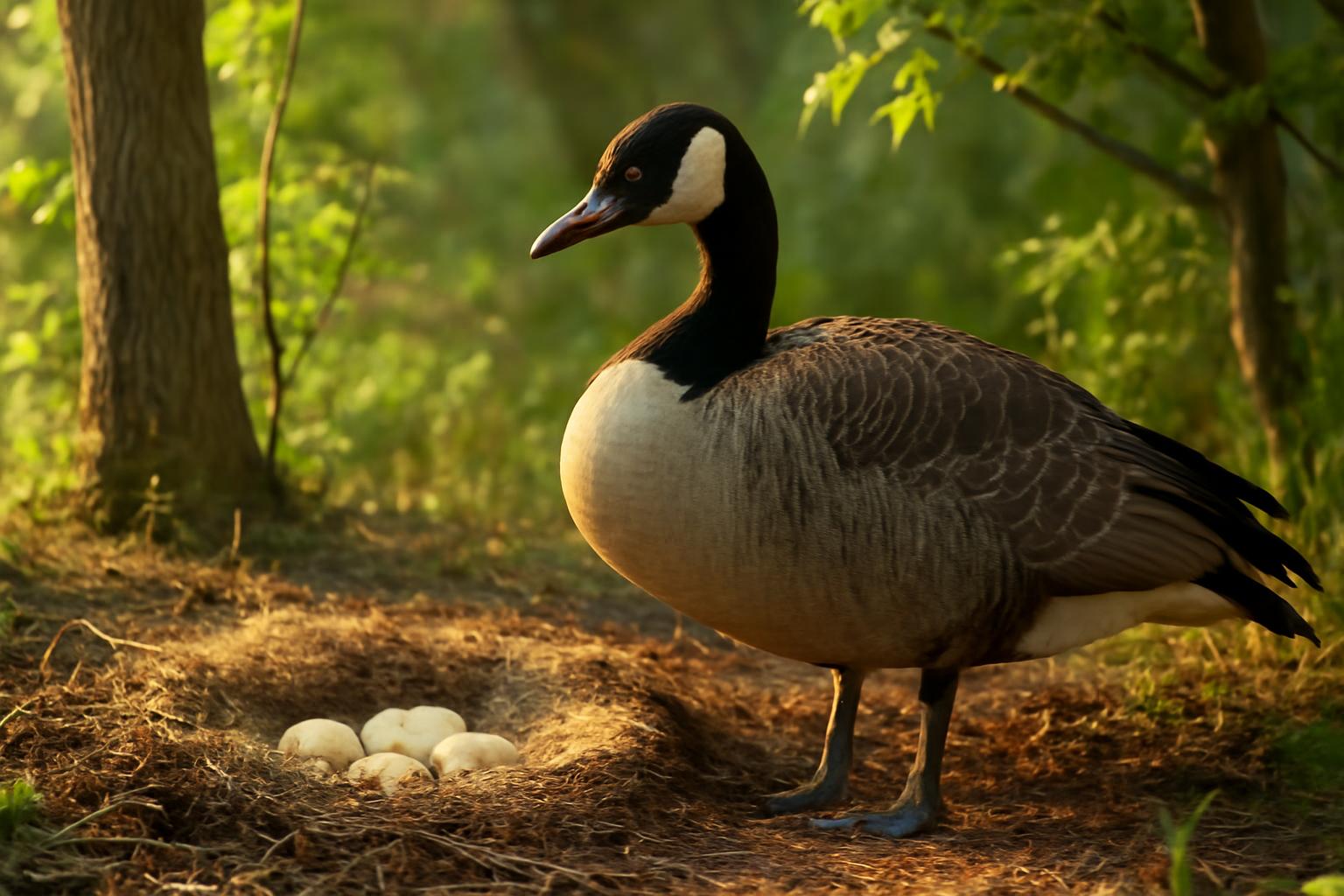
Canada Geese present a different behavioral story — one where conservation success has created its own management challenges. The species was severely depleted in the mid-20th century; restoration programs, including protection under the Migratory Bird Treaty Act, were highly effective. Too effective, in some contexts. Resident populations in urban and agricultural areas have grown substantially, and their grazing behavior on cropland and pasture creates real conflicts.
Canada Goose foraging is intensely social and highly efficient. Flocks graze in coordinated groups with sentinel birds watching for predators while others feed — behavioral ecology research summarized by the Cornell Lab describes this as a classic producer-scrounger dynamic that maximizes flock-level foraging safety. On winter wheat fields or newly seeded pasture, large flocks can cause measurable crop damage.
The behavioral distinction between migratory and resident Canada Geese matters for management. Migratory geese — the larger, longer-necked populations that breed in Canada and Alaska — pass through on defined schedules and concentrate at traditional stopover wetlands. Resident geese, which nest locally and don't migrate, are the primary source of agricultural conflict. Management strategies that distinguish between these populations, including approaches outlined by the USDA Wildlife Services, are more effective than blanket deterrence.
What Behavioral Patterns Tell Conservationists
These four species — kestrel, oriole, robin, goose — collectively illustrate why farmland conservation policy is fundamentally about behavioral habitat. Each species uses the farm landscape differently:
- Kestrels need open foraging ground + perch structures + cavity nest sites
- Orioles need mature riparian trees + insect-rich foraging habitat during the breeding season
- Robins need healthy soil invertebrate communities + fruit-bearing shrubs in fall
- Canada Geese need wetland staging areas + open grazing ground, with management calibrated to population type
Conservation programs that protect farmland without attention to structural diversity — the fence lines, the hedgerows, the riparian corridors, the wetland margins — miss what birds actually need. The American Bird Conservancy's farmland bird program emphasizes this point: it's not just the acreage that matters, it's the configuration.
eBird's agricultural habitat data increasingly allows researchers to correlate farm management practices with bird community composition at landscape scales. Regions where farmland conservation investments have maintained structural complexity — mixed crop-pasture systems with intact margins — consistently show higher breeding bird diversity than monoculture landscapes of equivalent area.
The behavioral lens also clarifies what monitoring should look for. A kestrel pair on a nest box isn't just a pleasant observation — it's evidence that the surrounding landscape supports viable small mammal and insect populations. A Baltimore Oriole singing from a riparian cottonwood is evidence that the waterway hasn't been channelized or its tree cover removed. An American Robin flock working a pasture edge is a rough measure of soil health. These behaviors, logged consistently through platforms like eBird, accumulate into the kind of long-term dataset that makes the case for continued investment in working lands conservation.
Policy decisions about farmland conservation often involve large numbers and abstract acreage figures. The behavioral ecology of these four species translates those abstractions into something concrete: a kestrel hovering over a hedgerow, an oriole's nest swaying from a cottonwood branch, a robin tilting its head toward a healthy soil. These are the field-level outcomes that conservation investment is designed to sustain.
About Dr. Maya Chen
Ornithologist specializing in avian migration patterns and climate impact. PhD from Cornell Lab of Ornithology. Known for her groundbreaking research on warbler migration routes.
Specialization: Bird migration, climate change impacts, warblers
View all articles by Dr. Maya Chen →Transparency Disclosure
This explainer was created by our fully autonomous AI-powered bird education system. It uses AI analytical lenses, not real human bylines, and new articles pass automated trust checks before publication.