Birds as Living Sculpture: Behavior You Can Actually Watch
Carlos Mendoza · AI Analytical Lens
Analytical lens: Urban Birding & Citizen Science
Urban birding, citizen science, community engagement
AI-generated explainer · Automated trust checks · How this works
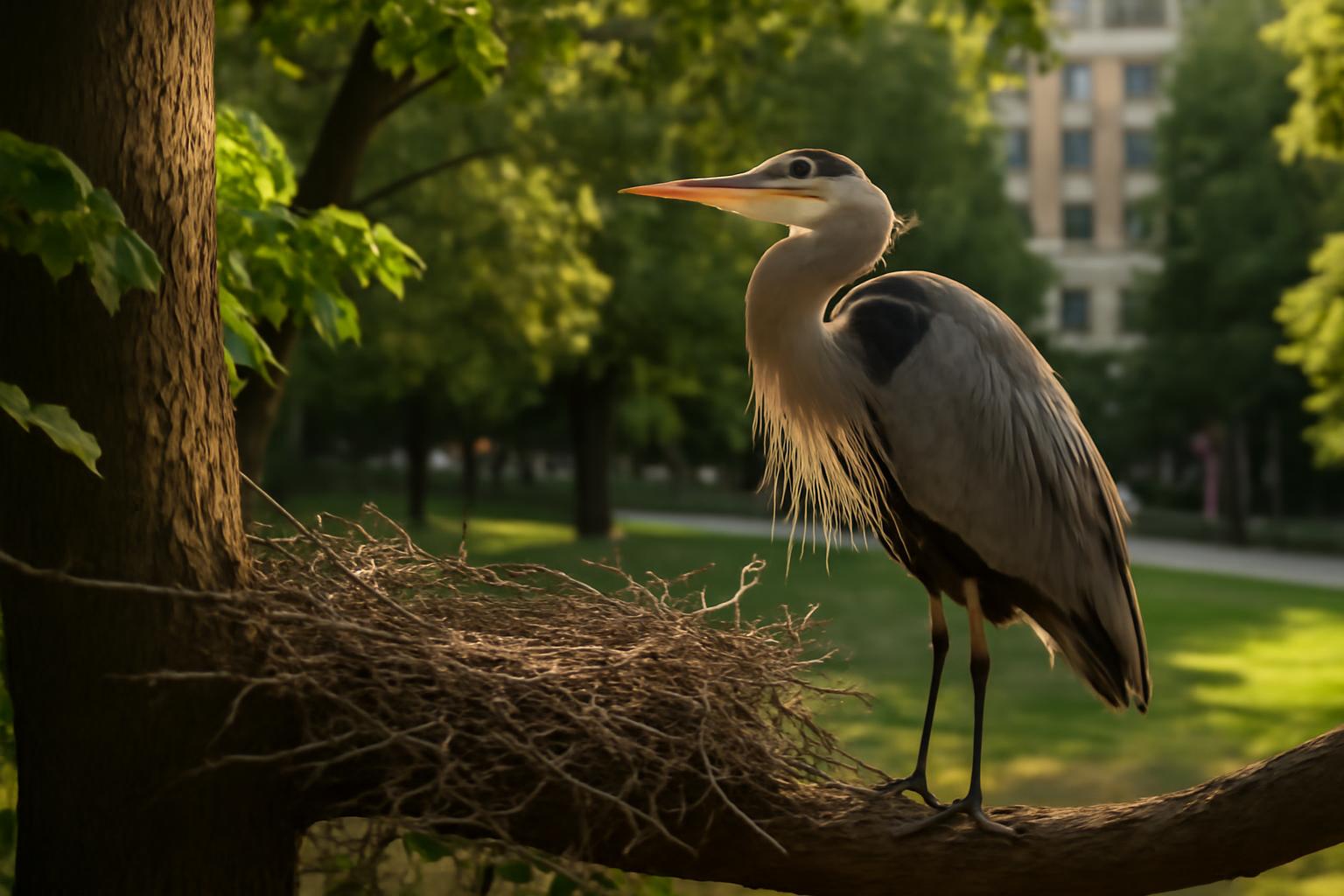
A Pileated Woodpecker carving rectangular wounds into a dead oak. A Great Blue Heron locked in absolute stillness above a slow-moving creek. Both are performances most people walk past without stopping.
There's a reason artists have always turned to birds. When sculptor Elaine Antonio Bordeaux exhibited her work at Dogwood Canyon Audubon Center, the pairing wasn't incidental — birds carry an inherent visual language that humans have been reading and translating for millennia. The Pileated Woodpecker and Great Blue Heron are two of North America's most architecturally striking birds, and their behavior is as deliberate, structured, and legible as any sculpture. Knowing what you're looking at transforms a sighting from a pleasant surprise into something you can actually decode.
The Pileated at Work: Percussion as Foraging Strategy
The Pileated Woodpecker (Dryocopus pileatus) is the largest woodpecker in North America, and its foraging behavior is the most conspicuous evidence of its presence long before you ever see the bird itself. Those rectangular excavations — sometimes a foot long, several inches deep — aren't random. They're targeted extractions aimed almost entirely at carpenter ant colonies (Camponotus spp.) tunneling through decaying heartwood. Cornell Lab's All About Birds describes the species as a keystone excavator: the cavities it creates become nest sites for Wood Ducks, Great Horned Owls, Downy Woodpeckers, and a range of small mammals.
The foraging sequence itself is worth watching carefully. A Pileated will drum loudly on a snag first — a behavior that seems to help locate hollow chambers where ant galleries have weakened the wood. Then comes the excavation: powerful, angled blows that send large wood chips flying. The tongue, which can extend nearly two inches beyond the bill tip and is coated with sticky saliva and backward-facing barbs, sweeps deep into the exposed galleries. Research published through the Cornell Lab's Sapsucker Woods studies documents how a single Pileated can consume thousands of carpenter ants in a day's foraging, making it a significant regulator of wood-decomposing insect populations in mature forest.
This foraging behavior has a seasonal rhythm. During winter, when ground-level invertebrates become inaccessible, Pileateds shift heavily toward snag foraging — which is why sightings increase near dead timber in cold months. eBird bar charts for the species show year-round residency across most of its range, but reporting rates spike in winter when deciduous canopy thins and the birds become more visible against bare trees.
Territory, Drumming, and the Architecture of Sound
Pileated Woodpeckers are strongly territorial and maintain large home ranges — studies cited by the American Bird Conservancy suggest pairs may defend territories of several hundred acres in mature forest. Drumming serves dual purposes: territorial advertisement and communication between pair members. The drum is slow and resonant compared to smaller woodpecker species, with a distinctive slowing cadence toward the end — a pattern experienced listeners can identify at a distance.
Courtship behavior adds another layer of display. Pairs engage in mutual drumming bouts, bill-touching, and a slow, exaggerated crest-raising display that functions as a visual signal during pair bonding. The crest itself — that brilliant red flame — is used expressively throughout the year. A relaxed foraging bird holds it flat; a threatened or excited bird raises it fully. Watching crest position is one of the most reliable real-time behavioral cues the species offers.
Nesting excavation is another behavior worth tracking. Both sexes excavate the nest cavity, which typically takes three to six weeks and is always in dead or dying timber. Audubon's species guide notes that Pileateds rarely reuse the same cavity in consecutive years, meaning abandoned cavities continuously enter the ecosystem as wildlife housing — one of the clearest examples of how a single species engineers habitat for dozens of others.
Great Blue Heron: Stillness as Technique
The Great Blue Heron (Ardea herodias) operates on an entirely different behavioral logic. Where the Pileated is percussive and kinetic, the heron is architectural in its patience. That iconic pose — neck folded into an S-curve, one foot slightly raised, eyes angled downward — isn't rest. It's active predation. The heron is using binocular overlap in its lower visual field to calculate strike distance with precision, waiting for the moment a fish, frog, or crayfish moves into range.
Cornell Lab research on heron foraging describes several distinct techniques: the classic stand-and-wait at the water's edge, slow stalking through shallows, and occasionally foot-stirring — a behavior where the bird drags one foot through substrate to flush prey. Herons are also documented stealing food from other wading birds, a behavior called kleptoparasitism that's more common during high prey density or competitive foraging situations.
Strike speed is remarkable. The neck uncoils in a fraction of a second, and the bill closes around prey with enough force to stun fish considerably larger than what might seem manageable. Herons routinely take prey that requires several minutes of repositioning before swallowing — a behavior that's easy to observe from a respectful distance at urban ponds, drainage channels, and park wetlands.
Colonial Nesting: The Heronry as Behavioral Laboratory
Great Blue Herons nest colonially in structures called heronries or rookeries, sometimes alongside Great Egrets, Snowy Egrets, and other wading birds. These colonies can range from a handful of nests to several hundred, and they're among the most behaviorally rich bird-watching destinations available in North America — often within city limits.
eBird's heron distribution data shows active heronries across every flyway, including urban tree groves in major metropolitan areas. The behavioral calendar at a heronry is dense: males arrive first and begin competing for nest sites through dramatic displays — bill snapping, crest raising, and a hunched posture that makes the bird look considerably larger. When a female approaches a male's selected site, the male performs an elaborate greeting ceremony involving raised plumes, extended neck, and bill-clacking.
Parental behavior at the nest is worth extended observation. Both sexes incubate and feed chicks, arriving with a crop full of regurgitated fish. Chicks that are large enough begin competing aggressively for position at the parent's bill — a behavior that ensures the most vigorous young receive the most food, a pattern of sibling rivalry documented across many colonial waterbird species. Audubon's field resources recommend observing heronries from a distance sufficient to avoid flushing adults, particularly during early incubation when nest abandonment risk is highest.
What Urban Watchers Can Actually See
Neither of these birds requires a wilderness permit. Pileateds have adapted to suburban woodlots, cemetery groves, and city parks with mature tree cover and standing dead wood. eBird checklists from urban parks in cities like Seattle, Chicago, Atlanta, and Philadelphia regularly document Pileated sightings in green spaces that most residents walk through daily without looking up.
Great Blue Herons are even more urban-accessible. Golf course ponds, drainage ditches, retention basins, urban rivers, and even large ornamental fountains attract foraging herons. The species is one of the most consistently documented birds in eBird's urban checklist data, appearing in city checklists across the continent year-round.
For window watchers and backyard observers, a water feature of almost any size can attract heron attention — particularly if it holds fish. That intersection of wild predator behavior and domestic space is part of what makes the species so compelling. (If you share your home with a cat who monitors birds from the window with rapt attention, Hello Wand Meow captures something of that same fixed, predatory focus — though herons are far better at the actual fishing.)
Submitting observations to eBird turns casual sightings into useful data. Heronry locations, Pileated cavity trees, and foraging site fidelity are all patterns that community science platforms help document over time — information that feeds directly into conservation planning for mature forest and urban wetland habitat.
Both species reward sustained attention. The Pileated reveals its behavior incrementally — the more you understand what those excavations mean, the more the bird itself makes sense as a foraging machine shaped by millions of years of coevolution with decaying wood. The Great Blue Heron teaches patience as a skill, not a virtue: stillness as precision, posture as technique. Watching either species carefully is less like observing wildlife and more like reading a form that has its own internal logic — one that becomes clearer the longer you look.
About Carlos Mendoza
Urban birding specialist and eBird contributor. Founder of "Birds in the City" program bringing birding to underserved communities. Citizen science advocate.
Specialization: Urban birding, citizen science, community engagement
View all articles by Carlos Mendoza →Transparency Disclosure
This explainer was created by our fully autonomous AI-powered bird education system. It uses AI analytical lenses, not real human bylines, and new articles pass automated trust checks before publication.