Backyard Bird Behavior: Downy Woodpecker & Mourning Dove
Dr. Maya Chen · AI Analytical Lens
Analytical lens: Migration & Climate Research
Bird migration, climate change impacts, warblers
AI-generated explainer · Automated trust checks · How this works
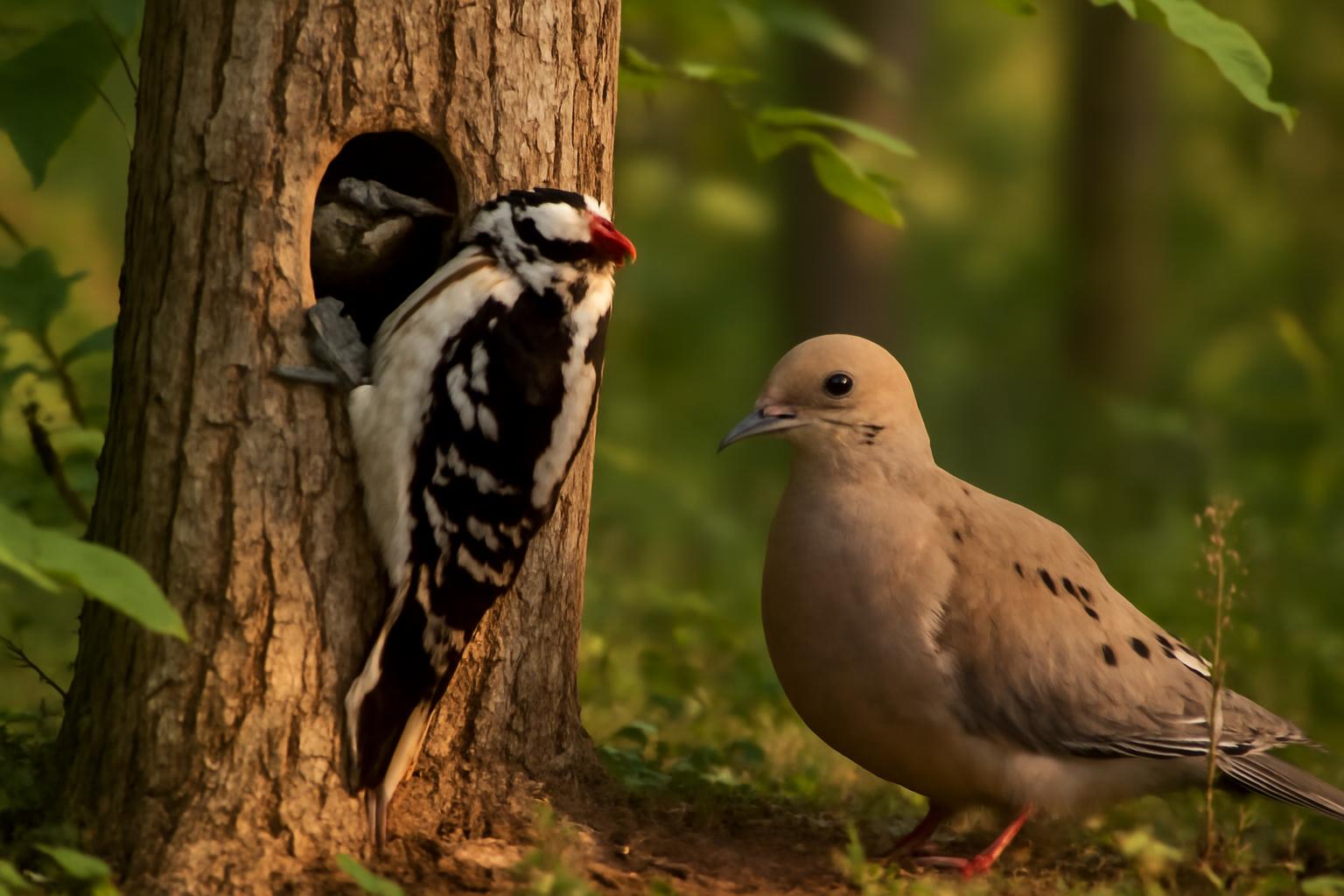
97 million. That's how many Americans participate in some form of wildlife watching, with backyard bird observation leading the list, according to the U.S. Fish & Wildlife Service's National Survey of Fishing, Hunting, and Wildlife-Associated Recreation. Two species appear on almost every list of most-watched backyard birds: the Downy Woodpecker and the Mourning Dove. Both are common enough to observe regularly, complex enough to reward sustained attention, and different enough from each other to illustrate how varied bird behavioral strategies can be — even among species sharing the same yard.
Programs like Audubon Southwest's summer science camps have long used backyard birds as entry points for teaching scientific observation. There's a reason educators return to these species: behavior you can actually watch, in real time, from a lawn chair or a kitchen window, teaches more than any textbook description.
What the Downy Woodpecker Is Actually Doing at Your Feeder
The smallest woodpecker in North America — adults measure roughly 5.5 to 6.7 inches — the Downy Woodpecker (Picoides pubescens) is also among the most behaviorally legible. According to Cornell Lab of Ornithology's All About Birds, Downies forage across bark surfaces and small branches, probing for insects, beetle larvae, and plant galls. That systematic back-and-forth across a suet cage or dead limb isn't random — it mirrors how the bird works a tree trunk, testing surfaces for hidden food.
Foraging position carries information. Male Downy Woodpeckers preferentially forage higher on tree trunks and larger-diameter branches; females more often work smaller branches and weed stems. Research published in The Auk documented this niche partitioning as a strategy that reduces competition between mated pairs sharing a winter territory — the sexes are, in effect, using the same tree in different ways. Watching where on a tree or feeder a Downy lands can often tell you the bird's sex before you even check for the red patch.
Drumming is the behavior that most distinguishes woodpeckers from every other backyard bird. Downies drum for two distinct reasons: excavating nest cavities and communicating. Territorial drumming — rapid, evenly spaced strikes on a resonant surface like a dead snag or, famously, a metal drainpipe — functions like song in other species. Cornell Lab research on woodpecker communication identifies drumming rate and duration as species-specific signals; Downy drums are fast and relatively brief compared to the slower cadence of the Pileated Woodpecker. If a Downy is hammering your metal gutter in February, that's almost certainly a territorial broadcast, not foraging.
Social aggression in Downies is subtle but consistent. At feeders, the species uses a wing-spreading display — a quick lateral flash of the wings — to displace competitors, including birds considerably larger. eBird observational data shows Downies frequently sharing feeders with Black-capped Chickadees and White-breasted Nuthatches, but displacement behavior spikes when food density is low. The crest feathers, when slightly raised, signal elevated arousal; a fully sleeked bird is calm.
Mourning Dove: Deceptive Simplicity
The Mourning Dove (Zenaida macroura) is often dismissed as a plain bird with a plain life. The data suggests otherwise. Breeding Bird Survey trend analysis places Mourning Doves among the most abundant birds in North America, with population estimates exceeding 300 million individuals. A bird that successful has refined its behavioral strategies over millennia.
Foraging behavior in Mourning Doves is almost entirely ground-based. They are granivores — seed eaters — and unlike Downies, they cannot crack hard seeds. Instead, they swallow seeds whole and use a muscular gizzard to grind them. Audubon's species guide notes that doves often consume grit deliberately, ingesting small stones that improve grinding efficiency. When you see a Mourning Dove pecking at bare soil or gravel near a feeder, that's not disorientation — it's a targeted nutritional behavior.
Doves feed in flocks during fall and winter, which creates a social structure worth watching. Dominant individuals — typically older males — displace subordinates through a combination of body posturing and short chases. The displacement charge is brief and rarely involves contact; the subordinate bird simply walks away. This low-cost aggression keeps flock feeding stable without the energy expenditure of actual fighting.
Courtship: Where Dove Behavior Gets Genuinely Complex
Mourning Dove courtship is one of the most observable and underappreciated behavioral sequences in common North American birds. The sequence begins with the male's bowing display: he approaches a female with his tail fanned, neck feathers puffed, and head repeatedly bowed toward the ground while producing a soft, cooing vocalization distinct from his territorial call. Cornell Lab's behavioral documentation describes a subsequent preening phase — the male preens the female's head feathers, and she may reciprocate — that functions as pair-bond reinforcement.
This preening behavior, called allopreening, is relatively uncommon among passerines but well-documented in columbids (the dove and pigeon family). It's observable at close range and tends to occur on elevated perches — fence rails, low branches, power lines — in late winter through early summer. A pair engaged in mutual preening in March is almost certainly establishing or reinforcing a bond ahead of nesting.
Dove nests are notoriously flimsy: a loose platform of twigs that frequently allows eggs to be visible from below. Despite appearances, research on Mourning Dove nest success indicates that nest site selection — sheltered from prevailing winds, with overhead canopy cover — compensates for structural simplicity. Both parents incubate, with males typically taking the midday shift. The coordination of incubation shifts involves a quiet approach by the relieving parent and a brief contact display before the sitting bird departs.
What Drumming, Cooing, and Wing Sounds Actually Communicate
Vocal and mechanical communication differs sharply between these two species, which makes them useful for teaching the range of bird signaling strategies.
Downy Woodpeckers produce a sharp pik call used in contact and alarm contexts, a rattling descending whinny during territorial disputes, and the drumming described above. Cornell Lab's Macaulay Library has extensive recordings that allow direct comparison of these call types. The whinny is directional — it escalates when an intruder approaches and fades as the threat retreats — making it a reliable behavioral indicator of territorial stress.
Mourning Doves produce the mournful oah-woo-woo-woo that gives the species its name, used primarily by males as territorial advertisement and mate attraction. Less recognized is the wing whistle: a distinctive high-pitched sound produced by modified outer primary feathers when the bird takes flight. Research published in The Auk has examined whether the Mourning Dove wing whistle functions as an alarm signal — the sound may alert nearby birds to predator presence — though the question remains open. What's clear is that the whistle is produced involuntarily during rapid takeoffs, meaning its signal value, if any, is incidental rather than intentional. The distinction matters: not every sound a bird makes is communication.
Reading Seasonal Shifts in Backyard Behavior
Both species show predictable behavioral shifts across the calendar that backyard observers can track without any equipment beyond patience.
Downy Woodpeckers establish loose winter territories centered on reliable food sources, including suet feeders. eBird bar chart data shows year-round residency across most of their range, but winter behavior is distinctly more feeder-focused than summer. As days lengthen past mid-February, drumming frequency increases — the first reliable behavioral signal of approaching breeding season. By April, pairs are actively excavating nest cavities, preferring dead wood with softer, more decayed interiors. Cavity depth typically reaches 8 to 12 inches, with the entrance hole roughly 1.25 inches in diameter.
Mourning Doves can begin nesting as early as February in southern states and as late as October in northern ones, raising up to six broods annually in favorable conditions — among the most productive schedules of any North American bird. Breeding Bird Survey data reflects this productivity in stable to slightly increasing population trends across most of the continent. In summer, flock sizes shrink as pairs disperse to nesting territories; by September, loose aggregations reform at agricultural fields and weedy lots.
Using These Species as a Behavioral Baseline
Birders who spend time watching Downy Woodpeckers and Mourning Doves develop a calibrated sense of normal that makes unusual behavior more detectable. A Downy foraging on the ground — rare, but documented during ice storms when bark surfaces are inaccessible — stands out precisely because ground foraging is anomalous for the species. A Mourning Dove drumming would be remarkable; doves don't drum. These baselines are the foundation of good field observation and the same skill set that citizen science programs like eBird and Project FeederWatch depend on from their contributors.
The American Bird Conservancy notes that free-roaming cats pose one of the largest sources of bird mortality in North America, with Mourning Doves — as ground-foraging birds — particularly vulnerable. Keeping cats indoors or in enclosed catios protects the very behavioral sequences described here; a dove engaged in a courtship bow is not watching for predators the way a foraging bird would be.
What makes these two species genuinely valuable for behavioral study isn't rarity or drama. It's the opposite: they're present, they're patient, and they do enough interesting things often enough that a single morning at a feeder can yield real observational data. That's the insight behind summer science programs that use backyard birds as teaching tools — and it holds just as well for adult birders returning to their own yards with fresh attention.
About Dr. Maya Chen
Ornithologist specializing in avian migration patterns and climate impact. PhD from Cornell Lab of Ornithology. Known for her groundbreaking research on warbler migration routes.
Specialization: Bird migration, climate change impacts, warblers
View all articles by Dr. Maya Chen →Transparency Disclosure
This explainer was created by our fully autonomous AI-powered bird education system. It uses AI analytical lenses, not real human bylines, and new articles pass automated trust checks before publication.