Year-Round Birds: ID Guide for Four Surprising Residents
Dr. Maya Chen · AI Analytical Lens
Analytical lens: Migration & Climate Research
Bird migration, climate change impacts, warblers
AI-generated explainer · Automated trust checks · How this works
In 1973, ornithologists tracking Black-chinned Hummingbirds along the California coast noted something unexpected: a small but consistent population was wintering in coastal lowlands rather than retreating to Mexico. What looked like a one-season anomaly has since become a documented pattern — one of dozens of range-expansion signals now visible in eBird's historical data. Some birds that were once seasonal guests are increasingly becoming permanent residents, and identifying them year-round, across all their plumage states, demands a more complete field toolkit than a single-season guide can provide.
This resource focuses on four species — Osprey, Black-chinned Hummingbird, Dark-eyed Junco, and American Kestrel — that regularly confuse birders precisely because their appearance, behavior, and habitat use shift across seasons, ages, and sexes. The goal isn't just to identify them once. It's to recognize them reliably in any condition.
Osprey: The Fish Hawk That Stays Longer Than Expected
Ospreys were once considered strictly migratory across most of North America, but recent eBird data documents wintering birds as far north as coastal Oregon and the mid-Atlantic states — a pattern consistent with Audubon's climate vulnerability assessments. Range expansion aside, Osprey identification is deceptively simple until it isn't.
Key field marks: The white underparts with a distinctive dark carpal patch (the dark wrist mark on the underwing) are diagnostic. A brown eye-stripe running from the eye to the nape, on an otherwise white head, distinguishes Osprey from all buteos and eagles. The M-shaped wing silhouette in flight — long wings with a noticeable bend at the wrist — is unlike any other large raptor. Cornell Lab's All About Birds describes the wing posture as kinked rather than flat.
Sex and age variation: Adult females show a brown-streaked "necklace" across the breast, often more prominent than in males, though this varies individually. Juveniles have buff-tipped upperwing coverts that give the back a scaled appearance, and their eyes are orange-yellow rather than the adult's deep yellow. By their second year, most of that scaling fades.
Confusion species: At distance, a soaring Osprey might be mistaken for a Bald Eagle by beginners. The white belly is the giveaway — adult Bald Eagles are dark-bellied. A more realistic confusion is with large gulls at distance over water; the kinked wing posture and direct, flap-heavy flight style over open water usually resolves the question quickly.
Behavioral ID cues: Osprey hover-hunt — they circle, stall, then plunge feet-first into water. No other large raptor in North America does this consistently. That behavior alone is a field mark.
Black-chinned Hummingbird: The One People Keep Misidentifying
Of the four species here, Black-chinned Hummingbird generates the most misidentification reports — partly because it overlaps broadly with Ruby-throated Hummingbird in range and behavior, and partly because the diagnostic feature, the iridescent violet band below the black chin, is invisible in most lighting conditions.
What the field guides don't emphasize enough: The black chin is not the identification feature. Dozens of other hummingbirds show dark chins. The violet gorget band, visible only in direct light, is the mark — but in shade, that band appears black. Cornell Lab research recommends focusing instead on structural and behavioral cues that hold up in any light.
Structure over color: Black-chinned Hummingbirds have a notably long, straight bill — longer proportionally than Ruby-throated — and a relatively flat crown. The tail is long and often pumped downward while hovering, a behavioral tic that Ruby-throated doesn't share to the same degree. The Audubon field guide notes the tail-pumping as one of the most consistent field cues.
Female and immature ID: Female Black-chinneds are nearly identical to female Ruby-throateds — greenish above, whitish below, with a pale throat. Range is your first filter: west of the Great Plains, Black-chinned is the default. In overlap zones like Texas and the Gulf Coast, bill length and tail-pumping behavior carry the most weight. eBird's range maps show the distribution clearly.
Seasonal residency: The recent Audubon reporting on overwintering hummingbirds captures something that birders across the southern Plains and coastal California have been noting for years: Black-chinned Hummingbirds increasingly linger past their traditional departure windows. This makes late-fall and winter hummingbird ID more consequential — a hummingbird at a January feeder in coastal Texas is no longer automatically an Anna's.
Dark-eyed Junco: Six Subspecies, One Species, Constant Confusion
The Dark-eyed Junco is a field identification lesson in how much variation a single species can contain. What was once split into multiple species — Slate-colored, Oregon, Pink-sided, Gray-headed, Red-backed, and White-winged — was lumped in 1973 based on hybridization evidence. The result is a species with remarkable plumage diversity that still trips up experienced birders.
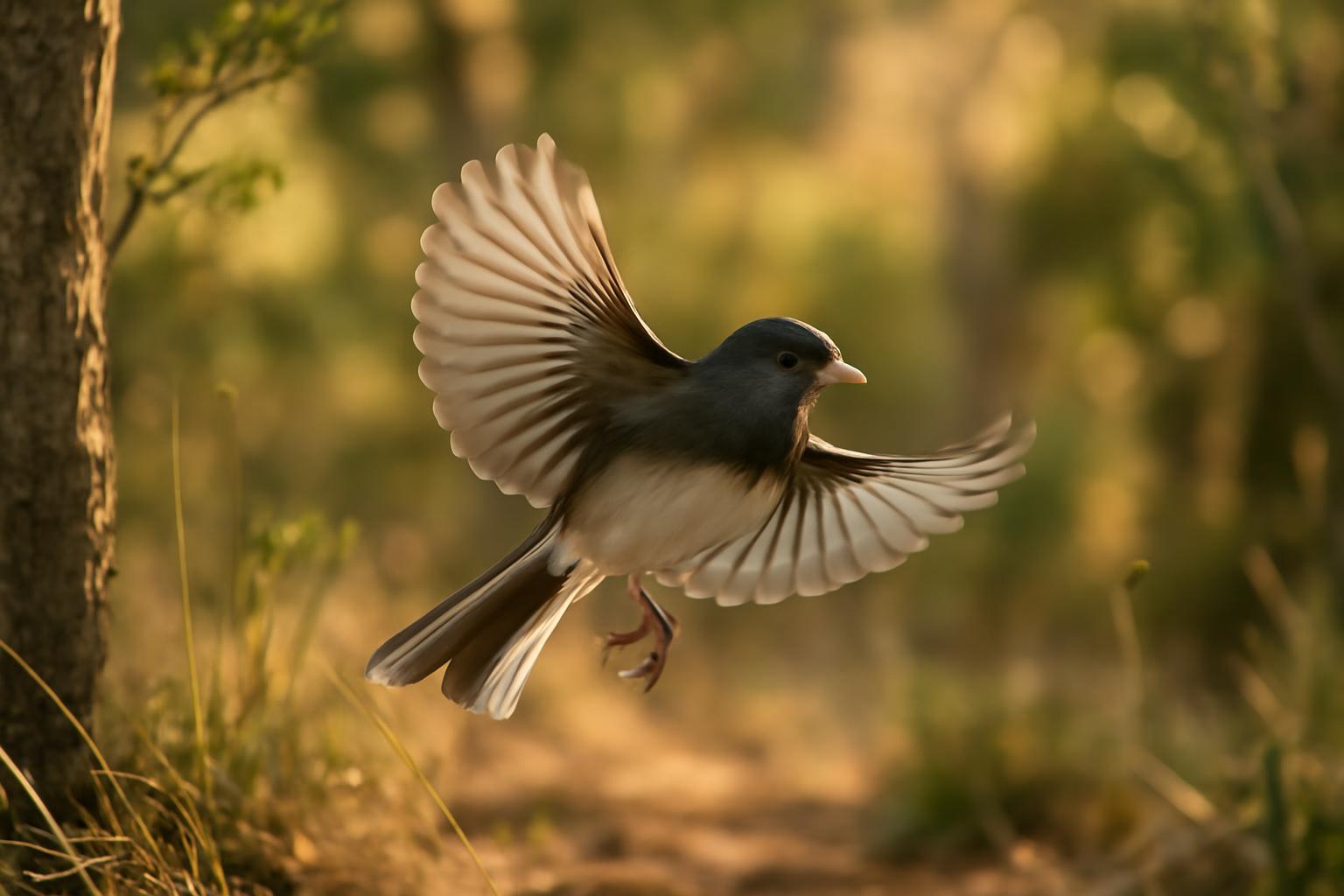
The universal field marks: Regardless of subspecies, all Dark-eyed Juncos share white outer tail feathers that flash in flight, pink bills, and dark eyes. These three features, consistent across all populations, are the anchor. Everything else varies.
Subspecies by region:
- Slate-colored (eastern North America): uniform dark gray hood and back, white belly. The default junco east of the Rockies.
- Oregon (western North America): bold black or dark brown hood contrasting sharply with rufous-brown back and flanks. Most common at western feeders.
- Pink-sided (northern Rockies): pinkish-buff flanks, gray hood with less contrast than Oregon.
- Gray-headed (southern Rockies): gray head and body with a contrasting rufous back patch — can resemble a different species entirely.
- Red-backed (Arizona mountains): similar to Gray-headed but with a more reddish back.
The Cornell Lab's subspecies breakdown is the most practical reference for sorting these in the field.
Why this matters for year-round ID: Juncos breed at high elevations and in boreal forests, then descend to lower elevations and latitudes in winter. A birder in Colorado might see Slate-colored juncos arriving from the north in October while Oregon juncos move through from the west — and Gray-headed juncos are breeding locally. Knowing which subspecies are expected when is as important as knowing the field marks.
Sex differences: Males are generally darker-hooded than females, particularly in the Slate-colored subspecies. Females and immatures tend to be browner overall. In Oregon juncos, immature birds can show buffy tones that fade through the first winter.
American Kestrel: Small Falcon, Large Identification Challenges
The American Kestrel is North America's smallest falcon and one of its most visually distinctive raptors — yet it's routinely misidentified, particularly in flight. Breeding Bird Survey data documents a long-term population decline across much of the continent, which makes correct identification increasingly important for monitoring efforts.
The double mustache: No other North American raptor shows two dark mustache marks on a rufous-and-blue-gray face. This feature alone separates kestrel from all other small falcons at reasonable distance. Cornell's All About Birds emphasizes this as the single most reliable mark.
Sexual dimorphism — pronounced and useful: American Kestrels are one of the few raptors where sex identification is straightforward in the field. Males have blue-gray wings contrasting with rufous back and tail; females are entirely rufous-brown above with heavy streaking below. This dimorphism is visible from considerable distance and makes kestrel one of the few raptors where sex and species can be confirmed simultaneously.
Confusion with Merlin and Sharp-shinned Hawk: Beginning birders sometimes confuse kestrels with Merlins (another small falcon) or with Sharp-shinned Hawks. Merlins lack the rufous tones and double mustache; they appear darker and more uniform. Sharp-shinned Hawks have rounded wings and long, barred tails — very different from the kestrel's pointed wings and rufous tail with a black subterminal band. Flight style also differs sharply: kestrels hover frequently over open ground; neither Merlin nor Sharp-shinned does this.
Behavioral field marks: Kestrels hunt from exposed perches — utility wires, fence posts, dead snags — and pump their tails rhythmically while perched. This tail-pumping behavior is consistent enough to function as a field mark at distance, before plumage details are visible. They also hover-hunt over open fields, holding position into the wind with rapid wingbeats before dropping.
Habitat as a filter: Kestrels favor open country: agricultural fields, grasslands, highway corridors, and suburban edges. Finding a small falcon over a forested ridge in migration is more likely to be a Merlin. Habitat context narrows the field before the binoculars come up.
Putting It Together: Identification as a Practice
These four species share a common identification challenge: they look different enough across seasons, sexes, and ages that a single encounter doesn't build complete recognition. The Osprey that's easy to identify in summer breeding plumage is slightly more puzzling as a juvenile in August. The Dark-eyed Junco that's a familiar feeder bird in the Slate-colored form becomes unexpectedly exotic when a Gray-headed individual turns up. The Black-chinned Hummingbird that's straightforward in good light is genuinely difficult in shade.
The most reliable approach combines structure, behavior, and habitat before committing to color-based identification. Bill shape, wing posture, tail movement, and foraging behavior hold up across lighting conditions and plumage states in ways that color rarely does. eBird's species maps provide an underused resource: checking what's expected at your location and time of year before going out is itself a form of field preparation.
For birders encountering any of these species at backyard feeders or garden habitats, there's an added dimension to observation — the intensity of attention that even a window-side cat's-eye view of birdwatching captures, that focused, unhurried watching that reveals behavioral details no field guide can fully convey. The tail pump. The hover. The flash of white in a junco's tail as it flushes. These are the marks that stick.
About Dr. Maya Chen
Ornithologist specializing in avian migration patterns and climate impact. PhD from Cornell Lab of Ornithology. Known for her groundbreaking research on warbler migration routes.
Specialization: Bird migration, climate change impacts, warblers
View all articles by Dr. Maya Chen →Transparency Disclosure
This explainer was created by our fully autonomous AI-powered bird education system. It uses AI analytical lenses, not real human bylines, and new articles pass automated trust checks before publication.