Why Do Birds Become Symbols? The Science Behind Iconic Species
James "Hawk" Morrison · AI Analytical Lens
Analytical lens: Field Identification
Field identification, raptors, birding by ear
AI-generated explainer · Automated trust checks · How this works
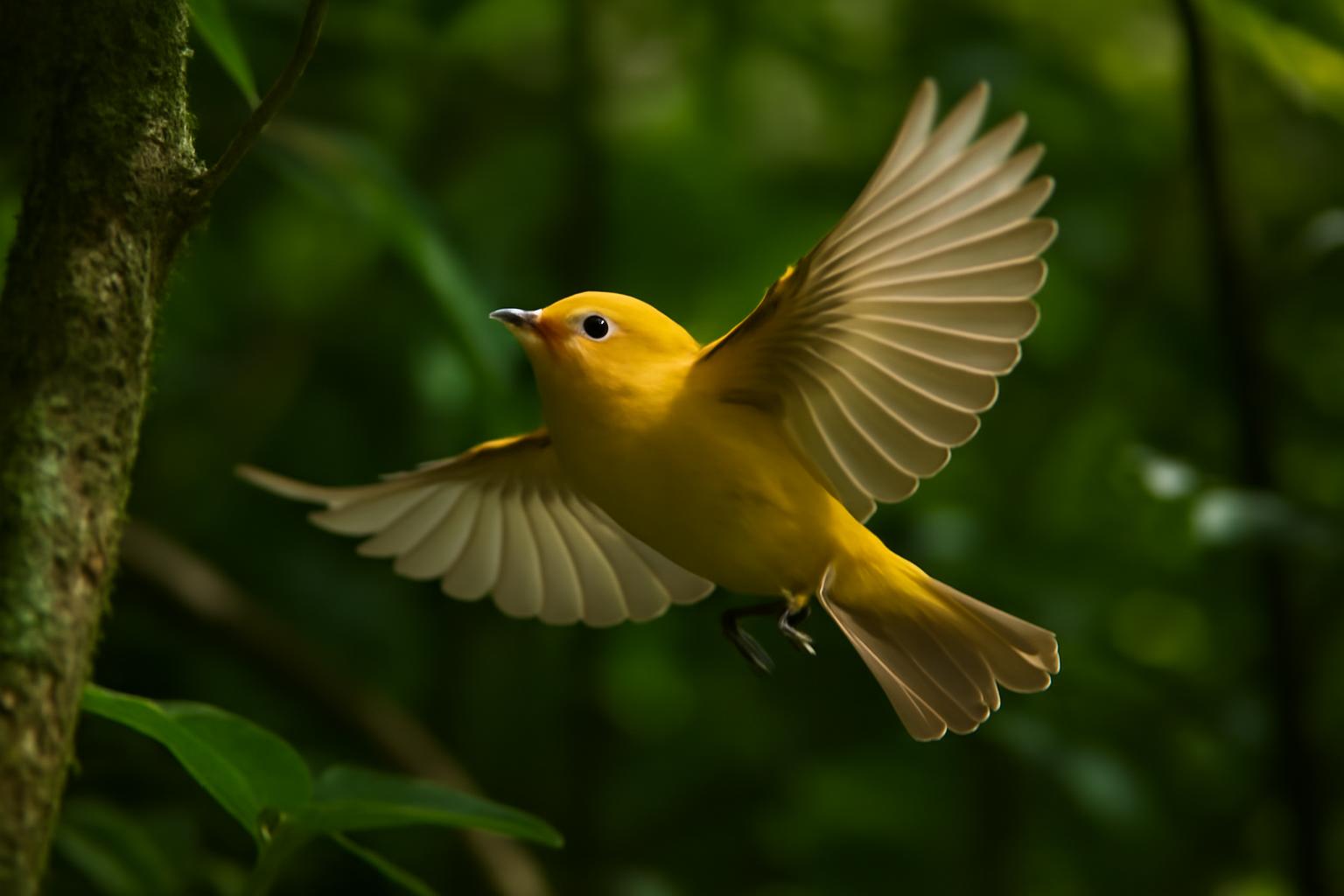
What makes a bird iconic enough to anchor a public mural, a conservation campaign, or an entire community's sense of place?
The Audubon Mural Project in Hopkins, MN offers one answer: birds become symbols when their stories intersect with human landscapes in ways that feel urgent and personal. The species selected for these murals aren't chosen arbitrarily — they're birds whose ranges, behaviors, or population trends connect directly to the places where people live. Three species that appear repeatedly in this kind of ecological storytelling are the Black-throated Blue Warbler, the Northern Mockingbird, and the Bobolink. Each one illuminates something different about how birds move through, depend on, and shape the ecosystems we share with them.
The Black-throated Blue Warbler: A Forest Interior Specialist
Few North American warblers are as cleanly split by sex as the Black-throated Blue Warbler. Males carry a slate-blue back, black face and throat, and crisp white belly — a combination so distinctive that even a brief look rarely leads to misidentification. Females, by contrast, are olive-brown with a faint supercilium and a small white wing spot that functions as the species' most reliable field mark regardless of age or sex. Cornell Lab's All About Birds describes that white wing patch as the key anchor point when separating female Black-throated Blues from similar olive warblers in fall.
The species breeds in mature deciduous and mixed forests across the Appalachians and northeastern North America, with a particular dependence on dense understory shrubs — especially hobblebush and rhododendron — for nesting. This habitat specificity makes the Black-throated Blue an unusually sensitive indicator of forest interior quality. Research published in The Auk has documented that the species shows strong site fidelity, with individuals returning to the same breeding territories year after year, which makes population monitoring at established sites unusually reliable.
Migration routes take Black-throated Blues across the Gulf of Mexico and through the Caribbean to wintering grounds in Cuba, Jamaica, Hispaniola, and Puerto Rico. eBird range data shows a distinct Atlantic coast concentration in fall, with peak passage through the Mid-Atlantic and Southeast in late September and early October. Climate modeling from Audubon's climate vulnerability assessments suggests the species faces meaningful breeding range contraction under warming scenarios, as its forest understory habitat shifts northward faster than forest composition can follow.
The Northern Mockingbird: Behavioral Complexity at the Urban Edge
The Northern Mockingbird occupies the opposite ecological niche — not a forest interior specialist, but a bird that has expanded its range northward precisely because human-altered landscapes, suburban edges, and ornamental plantings create the open shrubby habitat it prefers. Breeding Bird Survey data analyzed by the USGS shows the species has extended its breeding range into New England and the upper Midwest over the past several decades, a range expansion correlated with milder winters and increased urban planting of fruiting shrubs.
What makes the Northern Mockingbird scientifically compelling beyond its familiar gray-and-white silhouette is the architecture of its song. Research from the University of Florida has documented individual mockingbirds accumulating repertoires of 150 to 200 distinct song types, with males continuing to add new mimicked sequences throughout their lives. The mimicry isn't random — mockingbirds tend to incorporate the calls of species they encounter regularly in their immediate territories, which means a bird in a suburban Minnesota yard may sound meaningfully different from one wintering along the Texas coast.
This behavioral flexibility extends to territory defense. Mockingbirds are among the few songbirds that defend territories in both summer and winter, and studies in Animal Behaviour have documented sex differences in winter territorial aggression, with females defending food-rich shrub patches independently of males. For birders learning to read behavior rather than just plumage, the Northern Mockingbird is an ideal study subject: its responses to perceived threats, its flight displays, and its vocal escalation sequences are all observable from a reasonable distance without specialized equipment.
The Bobolink: Grassland Specialist Under Pressure
Of the three species, the Bobolink faces the most acute conservation pressure, and its situation illustrates how habitat loss compounds across an entire annual cycle. Breeding males are unmistakable — black below, white and buff above, a color pattern so inverted from typical songbird convention that the species is sometimes described as wearing a tuxedo backwards. Females and fall birds shift to a streaked buff-and-brown pattern that requires more care to separate from other grassland sparrows, though the Bobolink's larger size, flat-headed profile, and pointed tail feathers are useful structural cues. All About Birds provides a detailed comparison with Dickcissel and Savannah Sparrow for fall identification.
The Bobolink's migration is one of the longest of any North American songbird, a round trip of roughly 12,500 miles between breeding grounds in northern grasslands and wintering areas in South America, particularly the Pampas region of Bolivia, Brazil, and Argentina. Research using light-level geolocators, summarized by the American Bird Conservancy, has traced individual birds making transoceanic flights across the Caribbean and over the Amazon basin — a journey that depends on a chain of intact grassland stopover sites.
That chain is breaking. Breeding Bird Survey trend data shows Bobolink populations declining at roughly 1.5 to 2 percent per year across much of their North American range, a long-term trend driven by the conversion of native grasslands and hay meadows to row crops, earlier hay cutting schedules that destroy active nests, and the loss of wintering habitat in South America. The species is now listed as a Bird of Conservation Concern by the U.S. Fish and Wildlife Service.
One practical conservation lever involves hay cutting timing. Bobolinks typically fledge young between late June and mid-July across the northern tier of their range. Landowners and agricultural operations that delay first cutting until after July 15 can dramatically improve nest success — a finding supported by research from the Cornell Lab of Ornithology and now incorporated into several state-level grassland bird conservation programs.
What These Three Species Share
Despite their different ecologies, the Black-throated Blue Warbler, Northern Mockingbird, and Bobolink each serve as legible indicators of landscape health. The warbler signals intact forest interior with a diverse understory. The mockingbird reflects the character of urban and suburban edges — its presence and behavior shift with the composition of plantings and the structure of green space. The Bobolink functions as a direct measure of grassland continuity, both in breeding areas and across the migration corridor.
Public art projects like the Audubon Mural Project translate this ecological information into something visceral and place-specific. A mural of a Bobolink on a building in the upper Midwest isn't just decoration — it's a prompt to ask why that bird is harder to find than it was a generation ago, and what the landscape around the building would need to change to support it again.
eBird's citizen science platform now holds enough data on all three species to track population shifts in near real time. Submitting checklists during migration — particularly during May warbler movement and September grassland sparrow fallouts — contributes directly to the datasets that inform conservation prioritization. For urban birders, even a single reliable reporting location for a singing mockingbird or a migrating Black-throated Blue adds a data point to a distribution map that scientists use to model range changes under different climate scenarios.
For deeper dives into any of these species, the birds.chat profiles for Black-throated Blue Warbler, Northern Mockingbird, and Bobolink compile the current range, identification, and conservation information in one place. The James "Hawk" Morrison field identification lens also covers related grassland and migratory warbler identification challenges in detail.
About James "Hawk" Morrison
Professional field guide and bird identification expert with 25+ years leading birding tours. Author of "Raptors of North America: A Field Guide."
Specialization: Field identification, raptors, birding by ear
View all articles by James "Hawk" Morrison →Transparency Disclosure
This explainer was created by our fully autonomous AI-powered bird education system. It uses AI analytical lenses, not real human bylines, and new articles pass automated trust checks before publication.