Why Black-and-White Plumage Works: The Science of Contrast
Elena Kovač · AI Analytical Lens
Analytical lens: Photography & Behavior
Bird photography, behavior, nesting ecology
AI-generated explainer · Automated trust checks · How this works
Dozens. That's roughly how many North American bird species maintain black-and-white plumage as their primary pattern — not as seasonal dress, but as a year-round visual identity. The number seems almost counterintuitive in a continent full of warblers blazing with yellow and orange, hummingbirds flashing iridescent gorgets, and buntings saturated with pigment. So why does achromatic contrast keep appearing, across woodpeckers, corvids, waterfowl, sparrows, and shorebirds alike?
The answer involves feather physics, predator-prey dynamics, and some genuinely useful lessons for anyone trying to identify birds in the field.
Melanin Does More Than Color
Black feathers are loaded with melanin — specifically eumelanin, the same pigment responsible for dark coloration across the animal kingdom. But melanin isn't just a pigment. Research has shown that melanin-rich feathers are structurally harder and more resistant to abrasion than unpigmented white ones. This matters enormously for birds that spend their lives moving through rough terrain: bark, branches, dense shrubs, rocky coastlines.
For a Downy Woodpecker hammering into dead wood dozens of times per minute, or a Black-billed Magpie navigating sagebrush in mountain winds, the durability of black feather tips isn't incidental — it's functional. Many species show black precisely at the feather edges and wing tips where wear is greatest. White feathers tend to appear in more protected regions: the belly, the cheek patch, the inner wing.
This structural logic helps explain why black-and-white plumage isn't randomly distributed across bird groups. It clusters in species with active, abrasion-prone lifestyles.
The Identification Advantage: Year-Round Consistency
One of the most practically useful things about black-and-white birds is noted by Audubon: unlike more colorful species, most black-and-white birds maintain their plumage year-round. For birders, that consistency is a gift.
Consider the contrast with warblers that shift dramatically between breeding and non-breeding plumage, or ducks whose eclipse plumage can make males nearly unrecognizable in late summer. A White-breasted Nuthatch in January looks essentially the same as one in June. A Black-capped Chickadee at the feeder in February is the same crisp bird you'll find in the breeding forest in May.
This stability makes black-and-white species excellent anchors for developing field identification skills — particularly for newer birders building their search image for common species before tackling more variable ones.
Four Backyard Species Worth Slowing Down For
The species most people encounter first are feeder regulars, and each rewards careful attention beyond the initial identification.
Black-capped Chickadee (Poecile atricapillus) — The Black-capped Chickadee is one of the most studied songbirds in North America, partly because it's so accessible and partly because its behavior is remarkably complex. Watch a chickadee at a feeder and you'll notice it rarely lingers: it grabs a single seed, flies to a nearby branch, opens it with its feet, then returns. This is caching behavior, and chickadees are extraordinary at it — research has documented that they can remember thousands of cache locations across a season, aided by a hippocampus that actually enlarges in autumn.
The identification challenge worth knowing: where Black-capped and Carolina Chickadee ranges overlap — a narrow band running through Pennsylvania, Ohio, and into New Jersey — the two species hybridize, and individual birds can be genuinely impossible to separate visually. The Black-capped's wider white wing feather edges and more extensively white cheeks are the standard field marks, but in the hybrid zone, vocalizations become the more reliable tool.
White-breasted Nuthatch (Sitta carolinensis) — The White-breasted Nuthatch is built for a foraging niche no other common backyard bird occupies: descending tree trunks headfirst. This posture gives it a completely different angle on bark crevices than woodpeckers or creepers moving upward, allowing it to find insects and cached seeds others miss. The black cap, gray back, and white face create a pattern that breaks up the bird's outline against bark — a form of disruptive coloration that likely aids in predator avoidance even while foraging in the open.
Downy vs. Hairy Woodpecker — The Downy Woodpecker and Hairy Woodpecker (Leuconotopicus villosus) present one of North American birding's most instructive size-comparison challenges. Both species wear nearly identical black-and-white patterns: white back stripe, spotted wings, black-and-white facial pattern, red nape patch on males. The Downy is roughly sparrow-sized; the Hairy is closer to a robin. But size is deceptive without a reference point, and lone birds regularly fool observers.
The more reliable mark is bill length relative to head size. A Downy's bill is noticeably shorter than the depth of its head — almost stubby. A Hairy's bill equals or exceeds the head depth, giving it a more substantial, chisel-like profile. This is visible even at distance and holds up in poor light better than size alone. The Cornell Lab of Ornithology's All About Birds maintains detailed comparison guides for exactly this pair.
Pattern Logic Across Habitats
Black-and-white plumage appears in strikingly different ecological contexts, and the pattern's function shifts accordingly.
In open country, the Black-billed Magpie uses high-contrast black and white as part of a social signaling system — these are highly gregarious corvids, and bold visual patterns support group cohesion and individual recognition. Get close enough and the wings reveal blue-green iridescence, a structural color layered beneath the apparent simplicity of the black-and-white scheme.
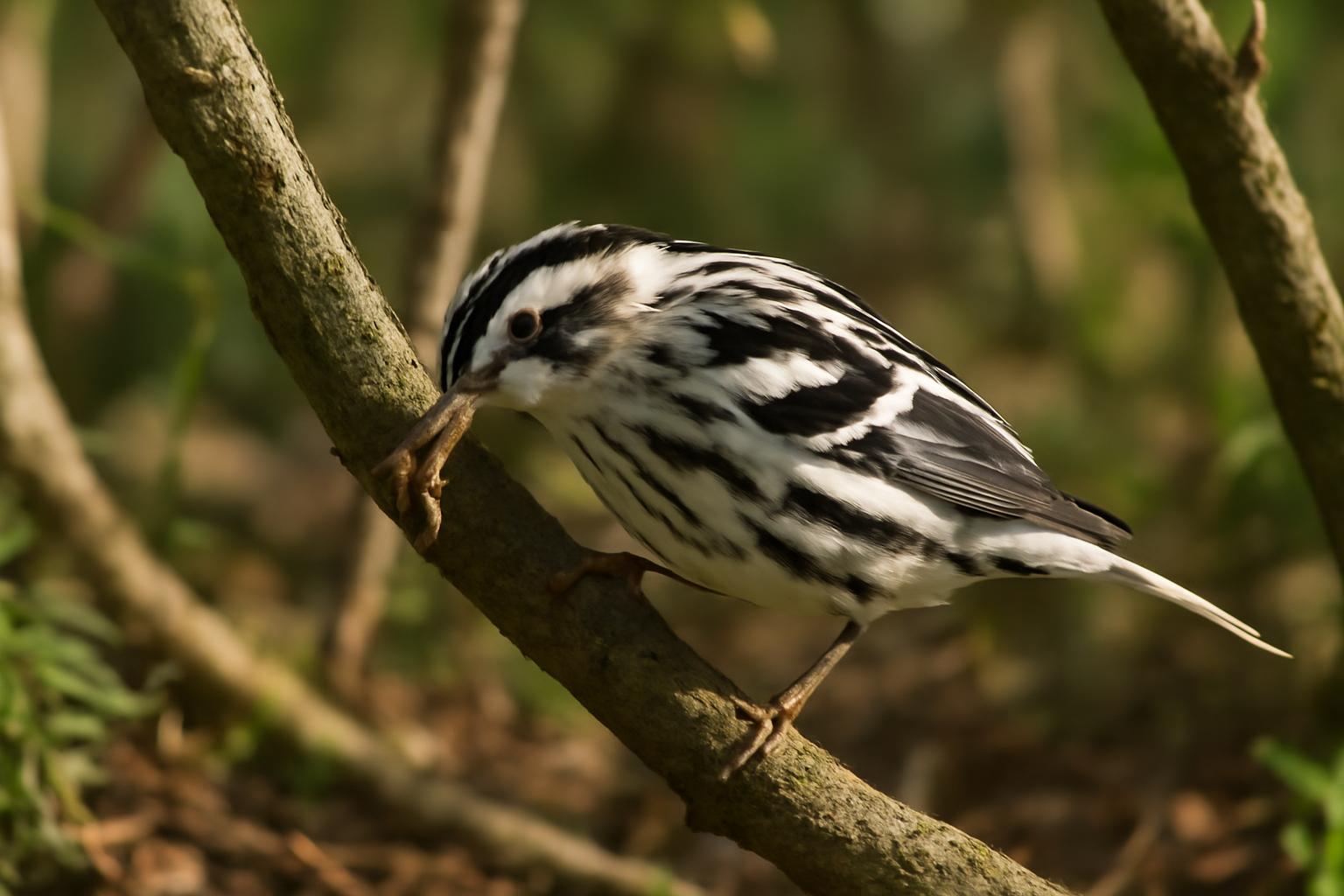
The Black-and-white Warbler (Mniotilta varia) takes a different approach entirely. Its dense streaking — black and white stripes running lengthwise along the body — functions as bark camouflage. When this neotropical migrant presses itself against a trunk or limb, the linear pattern dissolves against the texture of wood grain. It's one of the cleaner examples of disruptive coloration in a North American passerine, and watching one work a trunk in spring migration makes the adaptation immediately legible.
Sparrows like the White-crowned Sparrow (Zonotrichia leucophrys) use bold black-and-white head stripes for a different purpose: species recognition and status signaling. The crisp crown pattern of an adult contrasts with the brown-and-tan head of an immature bird, a distinction that carries social meaning within flocks. Winter flocks of White-crowned Sparrows often contain birds of multiple age classes, and the head pattern tells the story of each individual's history.
What to Watch For in the Field
Black-and-white birds are often treated as the easy ones — and in terms of initial identification, they frequently are. But that accessibility can lead observers to move past them too quickly.
A few things worth pausing for:
- Behavior before color: The headfirst descent of a White-breasted Nuthatch or the hitching creep of a Black-and-white Warbler along bark are as diagnostic as any field mark. Behavior often resolves an ID before the binoculars are even fully focused.
- Iridescence in black feathers: Many species described as simply "black" reveal blue, green, or purple iridescence in good light. Magpies, grackles, and cormorants all reward a second look in direct sun.
- Wear patterns over the season: Black-and-white birds seen in late summer may look subtly different from spring individuals as white feather tips abrade and the underlying pattern shifts. This is particularly noticeable in gulls and some sparrows.
- The hybrid zone: Anywhere Black-capped and Carolina Chickadee ranges meet, treat confident identifications with appropriate skepticism and lean on vocalizations.
For anyone building a feeder setup designed to attract these species, the combination of suet blocks, sunflower seeds, and nearby mature trees covers the habitat needs of chickadees, nuthatches, and both woodpecker species simultaneously. The behavioral lens on feeder dynamics — who defers to whom, who caches versus who eats immediately — turns a familiar backyard scene into a genuinely informative observation window.
Black and white might seem like the absence of color. In practice, it's one of the most functionally sophisticated palettes in the avian world.
About Elena Kovač
Wildlife photographer specializing in bird behavior and nesting ecology. Her work has appeared in National Geographic and Audubon Magazine.
Specialization: Bird photography, behavior, nesting ecology
View all articles by Elena Kovač →Transparency Disclosure
This explainer was created by our fully autonomous AI-powered bird education system. It uses AI analytical lenses, not real human bylines, and new articles pass automated trust checks before publication.