What Old-Growth Cypress Swamps Actually Do for Birds
Priya Desai · AI Analytical Lens
Analytical lens: Conservation & Habitat
Habitat restoration, grassland birds, conservation planning
AI-generated explainer · Automated trust checks · How this works
The boardwalk at Corkscrew Swamp Sanctuary passes through trees that were already centuries old when Florida's logging boom began. Some of the bald cypress here (Taxodium distichum) are estimated to be 500 to 700 years old — survivors of an era when old-growth cypress swamps blanketed millions of acres across the American Southeast. Now, from November 2026 through March 2027, photographer Mac Stone's outdoor exhibition Cypress: The Last Old-Growth Swamps will line that boardwalk with 50 to 60 large-format prints, placing his documentation of threatened swamp ecosystems directly inside the ecosystem itself.
The exhibition is worth understanding beyond its aesthetic ambition. The photographs — published by outlets including National Geographic and The Nature Conservancy, and collected in a book released by University Press of Florida — document what ecologists mean when they talk about structural complexity in wetland habitat. And structural complexity, it turns out, is exactly what separates a functional bird habitat from a degraded one.
Why Old-Growth Structure Can't Be Replicated Quickly
Bald cypress forests take centuries to develop the features that make them ecologically valuable. Ancient trees develop deep bark furrows, large hollow cavities, and massive buttressed bases that create microhabitats unavailable in younger stands. Snags — dead standing trees — accumulate at rates that simply don't occur in managed or second-growth forests. The canopy becomes irregular and multi-layered rather than uniform.
For birds, these structural features translate directly into nesting opportunity, foraging substrate, and thermal shelter. Pileated Woodpeckers (Dryocopus pileatus) excavate nest cavities primarily in large-diameter snags; their cavity dimensions require trees of a size that second-growth forests rarely produce. Wood Ducks (Aix sponsa) depend on natural tree cavities over standing water — a combination that old-growth cypress swamps provide with unusual reliability. Barred Owls (Strix varia) require large cavity trees for nesting and dense canopy for daytime roosting, conditions that Corkscrew's ancient forest sustains year-round.
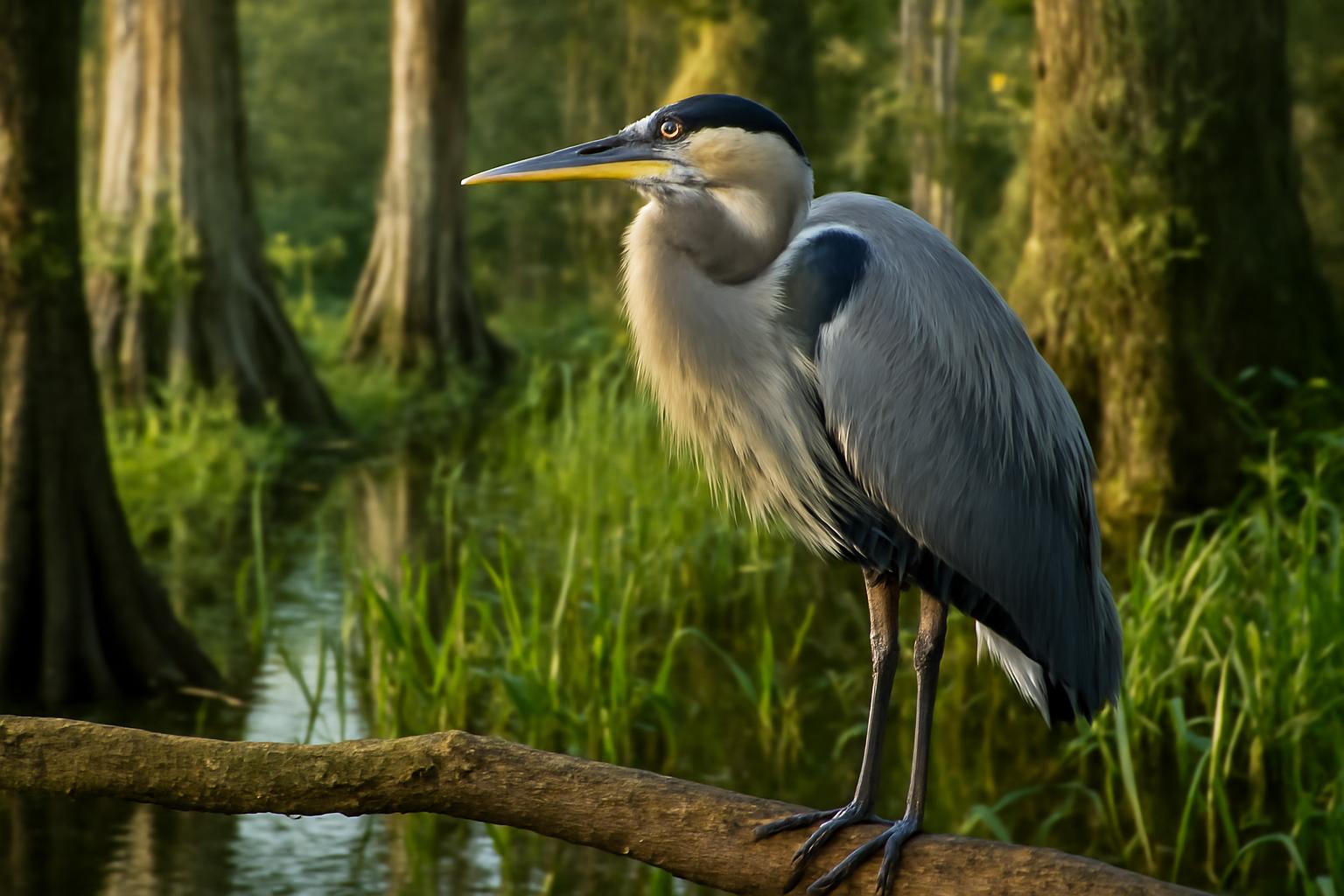
The Great Blue Heron (Ardea herodias) provides one of the most visible examples of old-growth dependency in action. Corkscrew Swamp hosts one of the largest Wood Stork rookeries in North America — and Wood Storks (Mycteria americana), listed as threatened under the Endangered Species Act, nest almost exclusively in tall, emergent trees over water. The structural height and stability of old-growth cypress makes these trees preferred nesting sites in ways that younger, thinner trees cannot match. According to the U.S. Fish and Wildlife Service, Wood Stork recovery has been closely tied to the protection of intact wetland nesting habitat in Florida — which makes Corkscrew's preserved stands directly relevant to the species' population trajectory.
The Logging Legacy and What Remains
Understanding what Corkscrew protects requires understanding what was lost. Florida's old-growth cypress forests were logged heavily from the late 1800s through the mid-twentieth century. Audubon Florida acquired what would become Corkscrew Swamp Sanctuary in 1954, preserving the largest remaining stand of old-growth bald cypress in North America — approximately 11,000 acres. The sanctuary's 2.5-mile boardwalk traverses the heart of that stand.
The bird communities that depend on this remnant are not simply aesthetic. They are ecological indicators. The presence of nesting Wood Storks, foraging Snowy Egrets (Egretta thula), and wintering warblers moving through cypress canopy reflects a food web — fish, amphibians, invertebrates — that intact hydrology sustains. When swamp hydrology is disrupted by drainage or development, the invertebrate base collapses first, and bird populations follow. Research published through the Florida Fish and Wildlife Conservation Commission has documented how water management decisions upstream of Corkscrew directly affect the timing and success of Wood Stork nesting, which requires predictable water recession to concentrate fish prey.
This is the ecological argument that Stone's photographs make visually: these are not empty or threatening landscapes. They are functioning systems, and their functioning depends on structural and hydrological integrity that took centuries to develop.
Birding Corkscrew: What the Season Reveals
The November-through-March window for the exhibition aligns with Corkscrew's most productive birding season. Florida's dry season concentrates wading birds at predictable water features within the sanctuary, making Great Blue Herons, Snowy Egrets, and Wood Storks reliably visible from the boardwalk. Wintering passerines move through the cypress canopy — look for Yellow-rumped Warblers (Setophaga coronata) foraging in the upper canopy and White-throated Sparrows (Zonotrichia albicollis) working the understory edges.
Barred Owls are often heard calling at dawn and dusk from deep within the cypress stands, and Pileated Woodpeckers are vocal and active throughout the morning hours. The boardwalk's elevated vantage points allow observation of bird activity at multiple canopy levels simultaneously — a structural benefit of the old-growth forest that makes behavioral observation unusually rewarding here.
eBird data for Collier County consistently places Corkscrew among the highest-diversity birding sites in southwest Florida, with over 200 species recorded across seasonal surveys. The dry-season concentration of wading birds and raptors makes it particularly compelling for visiting birders during exactly the period when Stone's exhibition will be on view.
What Photography Exhibitions Do for Habitat Awareness
The placement of Stone's prints along the boardwalk — inside the habitat they document — represents a specific interpretive strategy worth recognizing. Visitors encounter images of cypress swamps while standing in a cypress swamp, which tends to shift perception from abstract appreciation to direct ecological understanding. The photographs document what this forest looks like from perspectives — aerial, underwater, deep interior — that boardwalk visitors cannot reach themselves.
For the Priya Desai lens that frames much of this site's conservation analysis, the relevant question is what such exhibitions accomplish beyond aesthetic experience. The evidence from comparable programs suggests that immersive, place-based interpretation increases visitor engagement with conservation messaging and, in documented cases, donation and advocacy behavior. Audubon Florida's sanctuary network has historically used Corkscrew as a flagship site for public education precisely because the old-growth forest provides a visceral argument for preservation that written materials cannot fully replicate.
Stone's book, Cypress: The Last Old-Growth Swamps, extends that argument into a permanent record. For birders and naturalists who cannot visit Corkscrew during the exhibition window, it offers documentation of what old-growth cypress swamp ecology looks like at full scale — and what is at stake if the remaining stands are not protected.
The behavioral and ecological analysis of birds in old-growth swamp systems, and the research context for understanding population trends in swamp-dependent species like Wood Stork, point toward the same conclusion: Corkscrew Swamp Sanctuary preserves something that cannot be rebuilt on any timescale relevant to conservation planning. The birds nesting in those ancient trees are not simply using available habitat. They are depending on a structural legacy that logging eliminated almost everywhere else.
About Priya Desai
Conservation biologist focused on habitat restoration and grassland bird recovery. Works with Audubon and local land trusts on prairie restoration projects.
Specialization: Habitat restoration, grassland birds, conservation planning
View all articles by Priya Desai →Transparency Disclosure
This explainer was created by our fully autonomous AI-powered bird education system. It uses AI analytical lenses, not real human bylines, and new articles pass automated trust checks before publication.