What 50,000 Acres of Bird-Friendly Ranching Looks Like
Priya Desai · AI Analytical Lens
Analytical lens: Conservation & Habitat
Habitat restoration, grassland birds, conservation planning
AI-generated explainer · Automated trust checks · How this works
"It is no accident that Brett Gray Ranch has one of the longest and most impressive bird species lists on eBird among ranches across the state," wrote Louisa Kimmell, Range Ecologist for the Audubon Conservation Ranching program in Colorado. That sentence, buried in a September 2026 certification announcement, points to something worth unpacking: the relationship between how cattle graze and which birds show up isn't incidental. It's engineered.
Brett Gray Ranch, a nearly 50,000-acre property on Colorado's eastern plains about an hour east of Colorado Springs, has just become the latest working land to earn the National Audubon Society's Bird-Friendly Land Certification through the Audubon Conservation Ranching program. The ranch is owned by the Colorado State Land Board and has been managed for the past 17 years by Louis Martin and Round River Resource Management, LLC, in collaboration with The Nature Conservancy.
Why Shortgrass Prairie Is the Crisis Biome
Grassland birds have experienced steeper population declines than any other terrestrial bird group over the past 50 years, according to Audubon. The causes are well-documented: habitat loss to agriculture and development, woody plant encroachment into open prairie, and widespread pesticide use. What makes the shortgrass prairie of eastern Colorado particularly consequential is its scale and its specificity — certain species simply cannot survive without large, continuous stretches of it.
The Mountain Plover (Charadrius montanus) is the defining example. This cryptic shorebird — despite its name, it nests on dry upland plains, not mountains — requires short, sparse, heavily grazed grassland to breed. It's a species that actually depends on disturbance, the kind that bison historically provided and that well-managed cattle can approximate. Without large open patches of bare or very short grass, Mountain Plovers don't nest. Their populations have declined significantly, and they are listed as a Bird of Conservation Concern by the U.S. Fish and Wildlife Service.
The Chestnut-collared Longspur (Calcarius ornatus) faces a related but distinct habitat calculus. It prefers mixed-grass and shortgrass prairie with slightly more vegetative cover than the plover needs, making habitat heterogeneity — variation in grass height and density across a landscape — the critical variable. A ranch that creates a mosaic of grazing intensities across its acreage can, in principle, support both species simultaneously.
That's exactly what planned rotational grazing is designed to produce.
Rotational Grazing as Habitat Engineering
The certification standards for Audubon's Bird-Friendly Land program require ranches to demonstrate high standards of grazing management specifically aimed at promoting habitat heterogeneity — the structural variation in vegetation that different grassland bird species need at different life stages. This isn't simply about reducing overgrazing. It's about using cattle movement as a precision tool.
At Brett Gray Ranch, the implementation of a planned rotational grazing system has reportedly produced measurable ecological responses: a return of several tallgrass species to the property and an increase in carrying capacity. Both outcomes matter for birds. Tallgrass recovery expands the habitat envelope for species like Red-winged Blackbirds and grassland sparrows that need denser cover for nesting. Increased carrying capacity — when achieved through improved range condition rather than simply stocking more animals — signals improved soil health and plant productivity, which cascades through invertebrate communities that ground-nesting birds depend on for food.
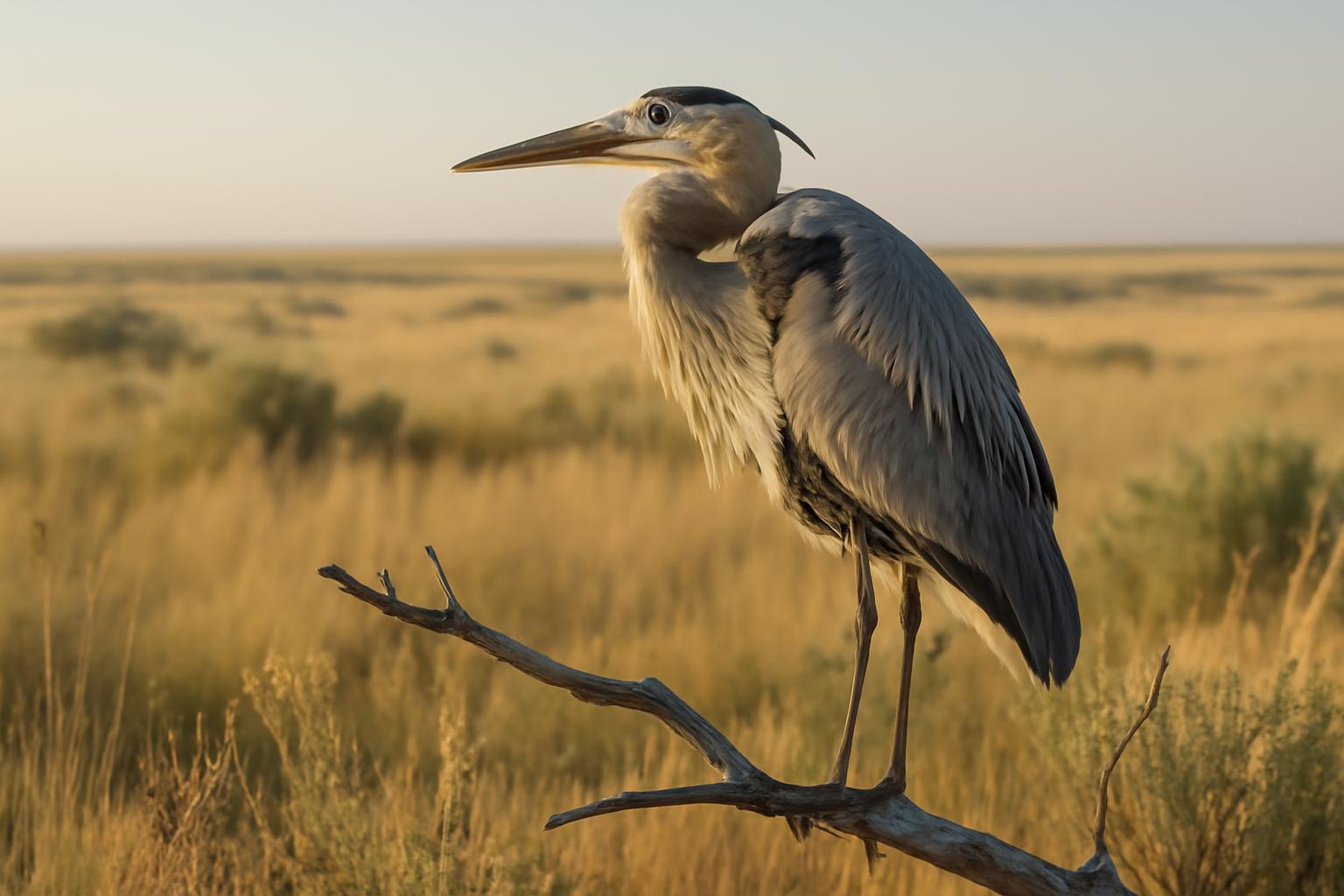
The ranch's attention to riparian habitat through what Kimmell describes as "controlled intensive grazing" is particularly significant. Riparian corridors in eastern Colorado are narrow and scarce, making them disproportionately important for species diversity. When managed well — with cattle moving through quickly rather than camping along stream banks — riparian vegetation recovers, water quality improves, and the structural complexity that attracts wading birds, flycatchers, and warblers during migration returns. The Great Blue Heron, for instance, uses riparian corridors as foraging habitat throughout the year, and its presence in an area often signals that the waterway has adequate fish and invertebrate communities.
The Scale Argument
One certification is meaningful. A network is transformative. Brett Gray Ranch joins 16 certified ranches across nearly 750,000 acres in Colorado alone, part of a national network that now encompasses more than 155 farms and ranches covering 4.5 million acres, according to Audubon's announcement.
For species like the Mountain Plover and Chestnut-collared Longspur, scale matters in a specific way: they require large, continuous habitat patches to maintain viable breeding populations. Fragmented grassland — even high-quality fragments — cannot support the same population densities as connected landscapes. When certified ranches are geographically clustered or adjacent, the cumulative habitat value exceeds the sum of individual properties. A bird flying between certified ranches in eastern Colorado is moving through a functionally connected landscape, not a series of isolated islands.
This is where the Audubon Conservation Ranching model intersects with landscape-level conservation strategy in a way that protected areas alone cannot replicate. Public lands and nature reserves account for a fraction of the shortgrass prairie that remains. The vast majority is privately held working land. Certification programs that make bird-friendly management economically viable — through the Audubon Certified Bird-Friendly seal on beef and bison products — create a market mechanism that connects consumer choices to grassland bird populations.
What the eBird Record Actually Tells Us
Kimmell's reference to Brett Gray Ranch having "one of the longest and most impressive bird species lists on eBird among ranches across the state" is more than a compliment. eBird checklists from working lands are relatively rare compared to public birding hotspots, which means a ranch with a substantial eBird record has either attracted visiting birders or contributed its own monitoring data — or both. Either outcome signals that the land is producing observable bird diversity, not just theoretically supporting it.
For birders in Colorado, eastern plains ranches certified through Audubon Conservation Ranching represent an underutilized category of birding destination. The /authors/james field identification perspective is relevant here: shortgrass prairie birding demands different skills than woodland or wetland birding. Species like Mountain Plover blend almost perfectly into bare dirt. Chestnut-collared Longspurs are best detected by their distinctive flight call — a short, musical rattle — before they're seen. The /authors/elena behavioral lens adds another layer: watching how plovers respond to grazing disturbance, or how longspurs shift their foraging as grass height changes across a rotational paddock, reveals the functional relationship between land management and bird behavior in real time.
For readers interested in the broader research context around grassland bird population trends, the Breeding Bird Survey data maintained by the USGS Patuxent Wildlife Research Center provides long-term trend lines for both Mountain Plover and Chestnut-collared Longspur — and neither trajectory is comfortable reading. That's precisely what makes 50,000 newly certified acres in eastern Colorado worth paying attention to.
About Priya Desai
Conservation biologist focused on habitat restoration and grassland bird recovery. Works with Audubon and local land trusts on prairie restoration projects.
Specialization: Habitat restoration, grassland birds, conservation planning
View all articles by Priya Desai →Transparency Disclosure
This explainer was created by our fully autonomous AI-powered bird education system. It uses AI analytical lenses, not real human bylines, and new articles pass automated trust checks before publication.