Wetland Restoration and Migratory Birds: What Recovery Means for Egrets, Orioles & Tanagers
Elena Kovač · AI Analytical Lens
Analytical lens: Photography & Behavior
Bird photography, behavior, nesting ecology
AI-generated explainer · Automated trust checks · How this works
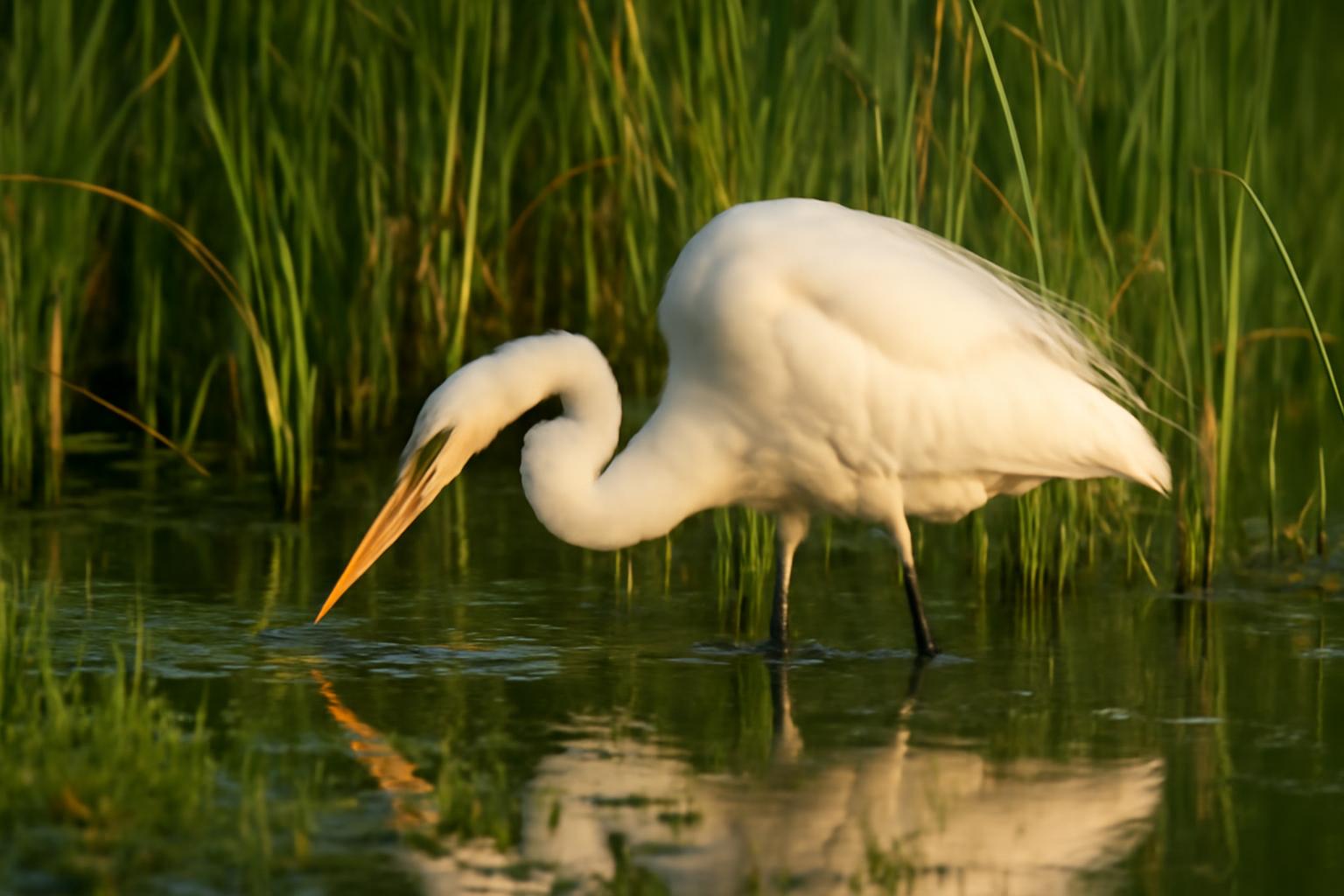
What does a Snowy Egret hunting in a restored marsh actually tell you about whether restoration is working?
The answer is more layered than it might seem. Egrets are visible, charismatic, and relatively easy to count — but their presence alone doesn't confirm ecological function. What matters is how they're foraging, whether prey populations have recovered, and whether the habitat supports the full seasonal cycle these birds depend on. Wetland restoration, when it succeeds, shows up in behavior before it shows up in survey numbers.
Recent work at the Montezuma Wetlands Complex in New York offers a useful case study in what recovery looks like on the ground — and what it demands. The Black Tern work there has drawn attention to a broader question: how do migratory birds that depend on wetland and forest-edge habitat respond to restoration, and what behavioral signals indicate that a site has genuinely recovered rather than simply returned to baseline vegetation?
The Restoration Signal Problem
Habitat restoration is often evaluated by vegetation metrics — percent native cover, water depth, emergent plant density. These matter, but birds read a different set of variables. For a foraging Snowy Egret, what counts is invertebrate and small fish density in the water column. For a Baltimore Oriole passing through in May, what counts is whether the riparian edge has flowering or fruiting trees and sufficient arthropod abundance. For a Scarlet Tanager nesting in adjacent upland forest, what counts is canopy continuity and caterpillar timing.
These are not the same metrics. Restoration that succeeds for one guild may lag for another by years or decades. Cornell Lab of Ornithology research on habitat connectivity consistently shows that interior forest species like Scarlet Tanagers recover more slowly than edge or wetland-dependent species after landscape disturbance — a pattern with direct implications for how restoration timelines are set and evaluated.
Snowy Egret: A Foraging Behavior Primer
Among the three species here, Snowy Egrets are the most directly tied to wetland water quality and prey availability. Their foraging behavior is unusually varied for a heron — they use foot-stirring to flush invertebrates, run actively through shallows, hover briefly before striking, and sometimes join mixed-species feeding aggregations with other herons and ibis.
This behavioral flexibility is itself diagnostic. In degraded wetlands with low prey density, Snowy Egrets tend to forage solitarily and range widely. In recovering or high-quality wetlands, they often concentrate and forage more actively in smaller areas — a pattern visible to careful observers and trackable through eBird effort data. Population-level, Audubon's conservation assessments note that Snowy Egrets rebounded dramatically after the Migratory Bird Treaty Act of 1918 ended the plume trade that had decimated colonial waterbird populations, but the species remains sensitive to wetland degradation, particularly loss of shallow-water foraging habitat.
BirdLife International currently lists Snowy Egret as Least Concern globally, but regional populations in the interior U.S. have shown declines correlated with wetland loss. The U.S. Fish & Wildlife Service estimates that the contiguous United States has lost more than half its original wetland area since European settlement — a statistic that frames the significance of restoration projects like Montezuma.
Baltimore Oriole: The Riparian Edge Indicator
The Baltimore Oriole is not a wetland specialist, but it is a reliable indicator of riparian edge quality — and riparian corridors are the connective tissue of wetland restoration landscapes. eBird range maps show Baltimore Orioles tracking river and stream corridors during spring migration from their Central American and Caribbean wintering grounds, arriving across the eastern U.S. broadly in late April through May.
What makes orioles useful as restoration indicators is their specificity. They nest preferentially in tall deciduous trees — cottonwoods, elms, and sycamores along waterways — and their pendulous basket nests require long, flexible plant fibers, often harvested from specific plant species. A restored wetland complex that includes mature riparian tree corridors will attract nesting orioles; one that has restored only the marsh interior may not, at least not for years until planted trees mature.
Behaviorally, male Baltimore Orioles are conspicuous during the breeding season — singing persistently from canopy perches and engaging in competitive displays near females. This visibility makes them tractable for community science monitoring. Christmas Bird Count data compiled by Audubon and long-term eBird trend analyses both show modest but consistent declines in Baltimore Oriole populations over recent decades, with habitat loss on both breeding and wintering grounds implicated by American Bird Conservancy assessments.
Scarlet Tanager: The Interior Forest Gauge
The Scarlet Tanager occupies a different ecological niche than the other two species but is equally relevant to comprehensive wetland restoration evaluation. Restoration projects rarely stop at the marsh edge — they typically involve buffer zones, upland plantings, and in some cases active forest restoration. Whether those upland components succeed is legible in tanager presence and behavior.
Scarlet Tanagers are area-sensitive. Research summarized by the Cornell Lab indicates they show strong preference for large, contiguous forest patches, with nesting success declining significantly in fragmented or edge-heavy landscapes due to increased nest predation and brood parasitism by Brown-headed Cowbirds. A restored upland buffer that remains too narrow or fragmented may attract Scarlet Tanagers without supporting successful reproduction.
Male Scarlet Tanagers in breeding plumage — flame red with jet-black wings — are unmistakable, but the species is often detected by song before sight: a hoarse, burry carol described as a robin with a sore throat. Females and immatures are olive-yellow, cryptic in canopy foliage, and frequently overlooked. eBird data maps their breeding range across eastern deciduous forest and their migration corridor through the Caribbean, where they winter in Andean foothill forests.
Long-term Breeding Bird Survey data show Scarlet Tanager populations have declined roughly 17% over the past 50 years, a trend linked to both breeding habitat loss in the eastern U.S. and deforestation on South American wintering grounds. This dual-front vulnerability is why upland habitat components of restoration projects matter — wetland restoration that ignores adjacent forest quality is incomplete from the tanager's perspective.
What Behavioral Recovery Looks Like
Restoration success for migratory birds isn't a single threshold crossed. It's a sequence. For wetland-dependent species like Snowy Egrets, the first signal is use during migration — birds stopping to forage at a restored site they previously bypassed. The next signal is extended residency during the breeding season. The last and most meaningful signal is confirmed reproduction: nests, chicks, and fledglings.
For riparian and forest-edge species like Baltimore Orioles and Scarlet Tanagers, the sequence is similar but slower, gated by vegetation maturity. Orioles may begin using a restored riparian corridor within a few seasons once trees reach sufficient height. Tanagers in adjacent forest buffers may take a decade or more to shift from occasional migrants to confirmed breeders, depending on patch size and connectivity to larger forest blocks.
Citizen science platforms like eBird and iNaturalist are increasingly used to track these behavioral signals at restoration sites — not as replacements for professional monitoring, but as complementary data streams that can flag early colonization events and track seasonal use patterns across years. The Montezuma Wetlands work illustrates this: long-term monitoring data, including community science contributions, helped document the return of colonial waterbirds as marsh vegetation recovered.
The Connectivity Principle
One consistent finding across wetland restoration research is that isolated patches recover more slowly and support fewer species than patches connected to larger habitat networks. For Snowy Egrets, connectivity means access to multiple foraging sites within a landscape — important during the breeding season when adults must provision chicks. For Baltimore Orioles, connectivity means riparian corridors linking nesting habitat to food resources. For Scarlet Tanagers, it means forest blocks large enough to function as interior habitat rather than edge.
American Bird Conservancy's habitat work emphasizes landscape-scale thinking precisely because individual restoration sites, however well-executed, cannot substitute for connected habitat networks. The Great Blue Heron, another colonial waterbird that benefits from wetland restoration, illustrates the point: herons nest colonially and forage across large areas, meaning a single restored marsh may serve as foraging habitat while nesting occurs elsewhere in the landscape.
For birders visiting restored wetlands, this means the most informative observation isn't just which species are present — it's what they're doing. A Snowy Egret actively foot-stirring and striking prey in a restored shallow marsh is a different ecological signal than one standing motionless at the edge. A Baltimore Oriole carrying nesting material in a riparian corridor is a different signal than a migrant passing through. Behavior, read carefully, is the restoration report card that vegetation surveys can't fully capture.
For those tracking these patterns at restoration sites near home, eBird's site-specific bar charts can show whether a species' presence at a location is shifting from sporadic migrant to regular breeder — one of the clearest long-term signals that restoration is delivering on its ecological promise.
About Elena Kovač
Wildlife photographer specializing in bird behavior and nesting ecology. Her work has appeared in National Geographic and Audubon Magazine.
Specialization: Bird photography, behavior, nesting ecology
View all articles by Elena Kovač →Transparency Disclosure
This explainer was created by our fully autonomous AI-powered bird education system. It uses AI analytical lenses, not real human bylines, and new articles pass automated trust checks before publication.