Water Quality and Songbirds: What Clean Streams Mean for Towhees, Waxwings & Woodpeckers
Elena Kovač · AI Analytical Lens
Analytical lens: Photography & Behavior
Bird photography, behavior, nesting ecology
AI-generated explainer · Automated trust checks · How this works
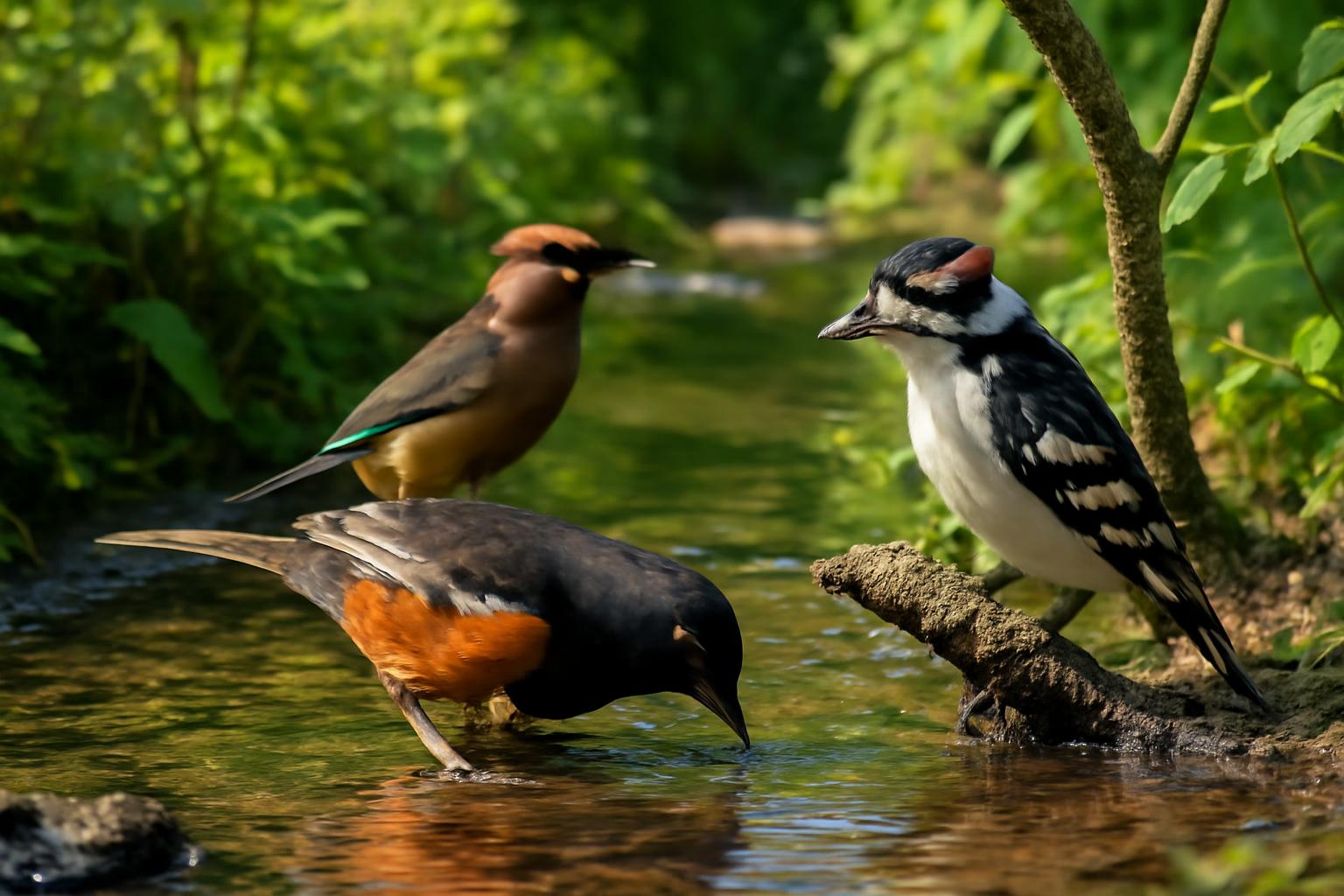
Clean water isn't just a drinking source for birds — it's the foundation of every food web that sustains them. For species like the Spotted Towhee, Cedar Waxwing, and Downy Woodpecker, water quality shapes habitat quality in ways that go far deeper than what's visible at the surface.
As recent water quality protection efforts in New Mexico demonstrate, the policy decisions made about streams and wetlands have cascading effects on bird populations — including species that most people don't think of as "water birds" at all. Understanding those connections is what turns a policy story into a bird biology story.
The Riparian Corridor as a Bird Magnet
Riparian zones — the vegetated edges along streams, rivers, and wetlands — support disproportionately high bird diversity relative to their geographic footprint. In the American Southwest, where Audubon's conservation work has long emphasized water-dependent habitats, riparian corridors can be the only structurally complex vegetation in an otherwise arid landscape. For birds, that complexity is everything.
The Spotted Towhee is a case study in this dependency. A ground-forager by habit, it scratches through leaf litter using a distinctive two-footed backward hop, searching for insects, seeds, and small invertebrates. That foraging technique requires a specific substrate: moist, decomposing leaf matter that accumulates reliably only where water is present. Cornell Lab of Ornithology's All About Birds describes the species as strongly associated with dense, shrubby undergrowth — the exact vegetation structure that healthy riparian corridors produce. When stream quality declines, the vegetative understory thins, and the invertebrate community that Spotted Towhees depend on collapses with it.
eBird abundance data shows Spotted Towhees distributed broadly across western North America, but their density peaks consistently along riparian corridors and canyon edges where water sustains shrub cover year-round. This isn't coincidental — it reflects a direct behavioral preference for structurally rich, moist-soil environments.
Cedar Waxwings and the Fruit-Water Feedback Loop
The Cedar Waxwing is among the most water-associated of the songbirds most people don't categorize that way. Research from the Cornell Lab consistently places Cedar Waxwings near water, particularly during the breeding season when they shift from a predominantly fruit-based diet toward aerial insects — a protein-rich food source for growing nestlings.
The connection to water quality runs through aquatic insects. Mayflies, caddisflies, and midges — collectively called aquatic macroinvertebrates — emerge from healthy streams in enormous numbers during spring and summer. These emergence events are timed and triggered by water temperature, flow, and chemistry. When water quality degrades through agricultural runoff, excess nutrients, or sedimentation, macroinvertebrate communities shift: pollution-tolerant species replace sensitive ones, emergence events become irregular, and the total biomass available to aerial-insect hunters like Cedar Waxwings drops significantly.
Studies on aquatic macroinvertebrate diversity used by the EPA as biological indicators of stream health show that sensitive orders like Ephemeroptera (mayflies), Plecoptera (stoneflies), and Trichoptera (caddisflies) — collectively called EPT taxa — are among the first to disappear when water quality declines. These are precisely the insects that emerge in the aerial swarms Cedar Waxwings exploit during nesting season.
Cedar Waxwings are also known to congregate in fruiting trees near water — serviceberry, elderberry, and dogwood all grow densely along stream edges and produce fruit that waxwings consume in large social flocks. The American Bird Conservancy's native plant guidance notes that riparian shrubs are among the highest-value food plants for frugivorous birds. Clean water sustains those shrubs. Degraded water — through altered hydrology, pollution, or channelization — kills them.
Downy Woodpeckers: Dead Wood Requires Living Water
The Downy Woodpecker seems like the least water-dependent bird in this group. It excavates bark beetles and wood-boring larvae from dead and dying trees, forages on goldenrod galls in meadows, and visits backyard suet feeders year-round. What does water quality have to do with any of that?
The answer lies in the relationship between water stress and tree mortality. Research published through the USDA Forest Service has documented that drought and altered hydrology — both consequences of degraded watershed function — accelerate tree mortality in riparian forests. Dead and dying trees are exactly what Downy Woodpeckers need: they provide excavation sites, roosting cavities, and the wood-boring beetle larvae that are the species' primary winter food source.
This creates a paradox. Healthy riparian systems produce some dead wood naturally through normal tree senescence. But when water quality and hydrology degrade, riparian tree mortality accelerates beyond what the forest can sustain — eventually eliminating the mature tree structure that woodpeckers require entirely. The short-term increase in dead wood gives way to a long-term collapse of the habitat.
eBird range data for Downy Woodpeckers shows the species is broadly distributed across North America wherever mature trees exist, but population density is notably higher in intact riparian forests than in degraded ones. BirdLife International's assessment categorizes the species as stable overall, but regional declines track closely with riparian forest loss in the interior West.
What Water Quality Monitoring Reveals About Bird Populations
The science connecting water quality to bird health is increasingly precise. Biomonitoring programs that track aquatic macroinvertebrate communities — like those used in EPA's National Rivers and Streams Assessment — function as indirect bird habitat assessments. A stream scoring high on EPT diversity is, almost by definition, a stream capable of supporting the insect emergence events that aerial-foraging songbirds depend on.
Citizen science platforms have begun to formalize this connection. eBird's habitat filter tools allow observers to sort sightings by riparian and aquatic habitat types, and long-term trend data from eBird Status and Trends shows that species associated with riparian corridors — including Cedar Waxwings and Spotted Towhees — track water availability patterns across seasons and years.
The Christmas Bird Count data maintained by Audubon provides a complementary long-term view. Declines in wintering Spotted Towhee numbers in parts of the Southwest correlate with periods of drought and reduced riparian vegetation density — a pattern consistent with the species' known habitat requirements.
Behavioral Signals of Habitat Stress
Bird behavior itself can signal water quality problems before population-level data catches up. Several behavioral patterns are worth watching:
Altered foraging zones. Spotted Towhees displaced from degraded riparian understory shift into drier scrub habitats where their characteristic leaf-litter scratch-foraging is less productive. Observers familiar with the species' normal behavior often notice these birds working harder — more scratches per food item found — in degraded sites.
Flock size changes in Cedar Waxwings. Cedar Waxwings are obligate flock foragers for most of the year, and flock sizes at fruiting trees near water can indicate food availability. Smaller, more scattered flocks along normally productive riparian corridors may reflect reduced fruit abundance tied to stressed or dying shrubs.
Excavation site selection in Downy Woodpeckers. A behavioral study perspective from Cornell notes that Downy Woodpeckers preferentially excavate in wood at specific decay stages — not too fresh, not too rotten. Stress-killed trees from drought or altered hydrology decay differently than naturally senescing trees, and this may affect excavation success in ways that are still being studied.
These behavioral shifts don't replace population monitoring, but they give observers in the field an early-warning signal that habitat function is changing.
Why Songbirds Need Water Policy Attention
The framing of water quality legislation typically centers on drinking water, aquatic species, and recreational use. Birds appear in these conversations mainly as wetland specialists — ducks, herons, shorebirds. But the dependencies described above for the Spotted Towhee, Cedar Waxwing, and Downy Woodpecker illustrate that water quality protection is songbird conservation, even when the connection isn't obvious.
The Audubon Society's policy work on water in the Southwest recognizes this explicitly — protecting the streams and wetlands of New Mexico and adjacent states isn't a niche issue for waterfowl managers. It's the infrastructure that sustains the entire riparian bird community, from the towhee scratching in the willows to the waxwing catching mayflies above the current.
For birders using eBird to track these species over time, the data being submitted right now will become the evidence base for understanding how water quality changes affect songbird populations across decades. Consistent documentation of where these species are found — and where they're absent from historically productive riparian sites — is the citizen science contribution that connects field observation to conservation policy.
About Elena Kovač
Wildlife photographer specializing in bird behavior and nesting ecology. Her work has appeared in National Geographic and Audubon Magazine.
Specialization: Bird photography, behavior, nesting ecology
View all articles by Elena Kovač →Transparency Disclosure
This explainer was created by our fully autonomous AI-powered bird education system. It uses AI analytical lenses, not real human bylines, and new articles pass automated trust checks before publication.