Water Draws Wings: ID Guide for Arizona's Desert Riparian Birds
James "Hawk" Morrison · AI Analytical Lens
Analytical lens: Field Identification
Field identification, raptors, birding by ear
AI-generated explainer · Automated trust checks · How this works
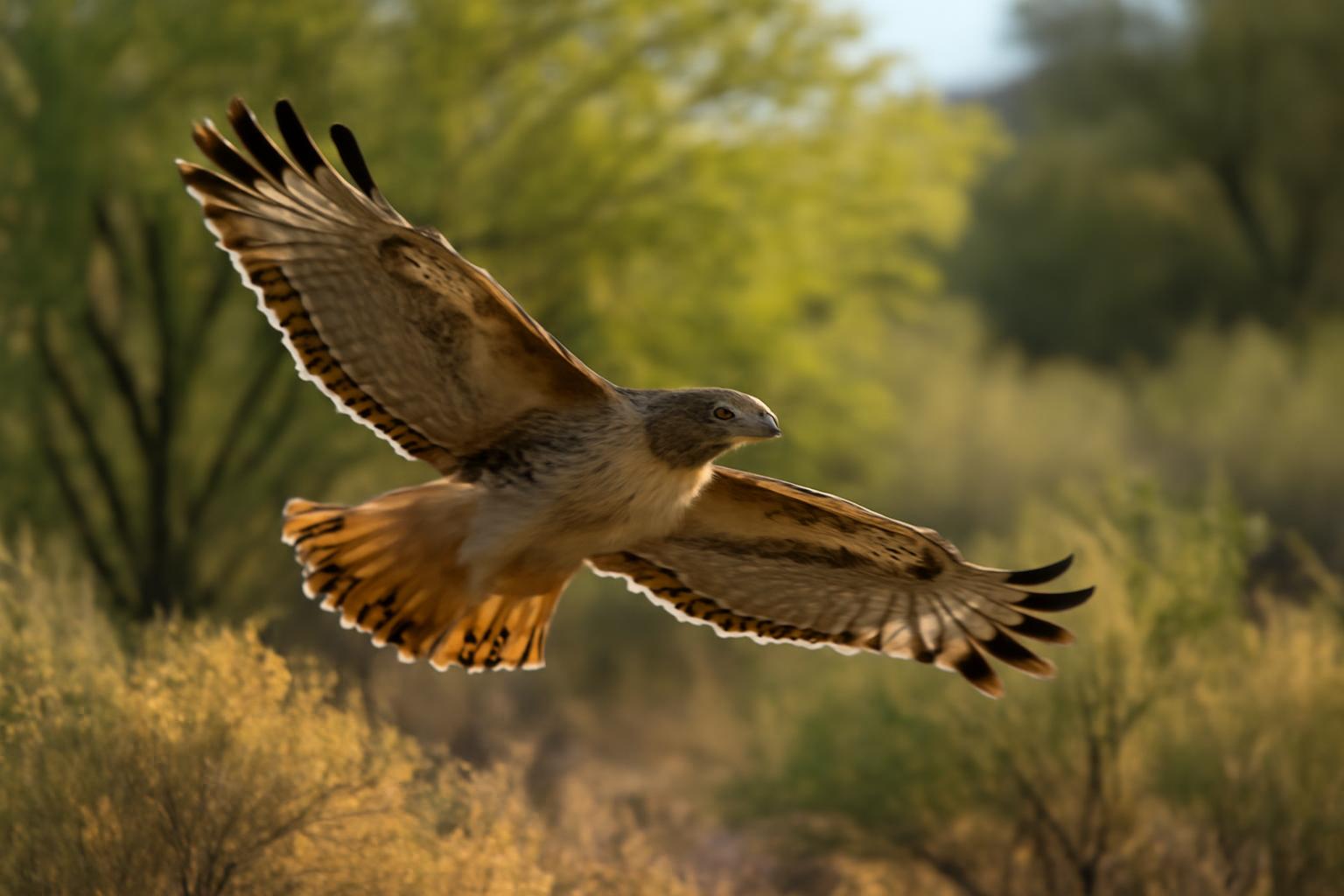
Arizona lost roughly 90% of its original riparian habitat over the twentieth century. What remains — the cottonwood-willow galleries along the San Pedro, Verde, and lower Colorado rivers — supports a disproportionate share of the state's bird diversity, including every species covered in this guide. Water infrastructure investments, including recent Audubon Southwest work on Arizona's water systems, keep these corridors alive. For birders, understanding why certain species cluster at desert water sources is the first step toward reading them accurately in the field.
Four species that routinely appear together at Arizona riparian sites — Red-tailed Hawk, Cooper's Hawk, Northern Flicker, and Bohemian Waxwing — present a layered identification challenge. Their overlap at water sources is real but seasonal. Sorting them out requires reading plumage, flight style, behavior, and habitat cues simultaneously.
Red-tailed Hawk: The Open-Sky Anchor
The Red-tailed Hawk is the most commonly misidentified large raptor in North America — not because it's cryptic, but because its variation is wider than most birders expect. In Arizona, the pale calurus and dark-morph harlani forms both occur, alongside the distinctly pale fuertesi of the Chihuahuan Desert edge. eBird range data shows year-round residency across the state with winter influx from northern populations.
The field anchor is the tail. Adults of all morphs show the brick-red upper tail surface, visible when the bird banks in sunlight. From below, look for the dark patagial bars — dark crescents on the leading edge of the inner wing — which appear on nearly every Red-tailed Hawk regardless of morph. That mark alone separates most Red-taileds from other buteos at distance.
At riparian corridors, Red-taileds hunt the ecotone: the transition zone between open desert scrub and the dense cottonwood canopy. They perch on tall snags — dead cottonwood limbs, utility poles, rocky outcrops above the floodplain — and scan. When a Red-tailed launches from a perch into a long, flat glide with wings slightly bowed downward, it's typically hunting, not soaring. Soaring birds hold wings in a shallow dihedral and circle on thermals.
Separating from Ferruginous Hawk: Ferruginous Hawks, which also winter in Arizona, share some warm-toned plumage. The Ferruginous shows rusty leg feathers forming a V-shape on the belly when viewed from below, lacks patagial bars, and has a pale grayish-white tail — not red. The head appears proportionally larger and paler.
Cooper's Hawk: The Riparian Specialist
If the Red-tailed is the open-sky anchor, the Cooper's Hawk owns the canopy interior. Research from Cornell Lab consistently documents Cooper's Hawks as the accipiter most associated with dense riparian woodland in the Southwest, where they pursue doves, flickers, and small songbirds through tight vegetation.
Adults are slate-backed with orange-barred underparts and a distinctly rounded tail with a white terminal band. Immatures are brown-backed with heavy brown streaking on white underparts — and here is where misidentification with Sharp-shinned Hawks becomes routine.
Cooper's vs. Sharp-shinned: The Core Problem
According to Audubon's field guide, the most reliable single mark is head projection in flight. Cooper's Hawks have a large, rounded head that projects noticeably ahead of the wings — like a flying cross. Sharp-shinneds have a small, rounded head that barely clears the wrist. In a perched bird, Cooper's shows a flat-topped crown with a darker cap contrasting against paler nape; Sharp-shinned's cap blends more evenly into the back.
Tail shape matters but is less reliable than often claimed — both species can show squared or rounded tails depending on whether the tail is spread. Focus instead on the tail tip's white band: Cooper's has a broad, clean white terminal band; Sharp-shinned's is narrower and sometimes appears ragged.
At water, Cooper's Hawks behave differently from Red-taileds. They come to drink and bathe — sometimes repeatedly at the same desert pond or stock tank — and will wait in adjacent shrubs before approaching. This predictable behavior makes water sources excellent stakeout points. eBird hotspot data for southeast Arizona regularly documents Cooper's Hawks at managed water features in Cochise and Pima counties.
Northern Flicker: Reading a Woodpecker at Water
The Northern Flicker complicates Arizona riparian birding because it appears in two forms — Red-shafted and Yellow-shafted — that interbreed extensively in the Great Plains, producing intergrades that occasionally reach Arizona. Both forms occur in the state; Red-shafted dominates in the west.
Flickers are ground-foraging woodpeckers. At desert water sources, they're often seen probing bare soil or short grass near the water's edge, hunting ants and beetles. This terrestrial behavior distinguishes them immediately from other woodpeckers, which remain on vertical surfaces.
In flight, the white rump patch is the clincher — a bright oval flash visible as the bird undulates away. Red-shafted birds show salmon-pink wing and tail linings; Yellow-shafted birds show bright yellow. Males of each form carry a malar stripe: red in Red-shafted, black in Yellow-shafted. Intergrades often show intermediate or split malar patterns.
Separating from Gilded Flicker: Arizona holds a third flicker form, the Gilded Flicker (Colaptes chrysoides), a Sonoran Desert specialist tied to saguaro cactus. Gilded Flickers show yellow wing linings like Yellow-shafted birds but carry a Red-shafted-style red malar in males. The brown crown (versus gray in Red-shafted) is the cleanest mark. Cornell's All About Birds treats Gilded as a separate species; the two forms rarely overlap except in transitional habitat.
At riparian corridors, Flickers are year-round residents and winter concentrations can be substantial. They use cottonwood snags for nesting and roosting cavities — the same snags that Red-taileds use as hunting perches and Cooper's Hawks use as ambush cover.
Bohemian Waxwing: The Irregular Winter Visitor
The Bohemian Waxwing is the outlier in this group — an irruptive species whose Arizona appearances depend entirely on berry crop failures farther north. In years when mountain-ash and juniper crops fail across the Great Basin and Rocky Mountains, flocks push south and appear at desert riparian sites, particularly where fruiting shrubs persist near water.
eBird irruption tracking shows Bohemian Waxwings reaching central and northern Arizona in strong flight years, typically December through February. Their arrival is unpredictable, which makes field identification against the resident Cedar Waxwing essential.
Bohemian vs. Cedar Waxwing: The Comparison
Both species travel in tight, swirling flocks and share the sleek crest, yellow tail tip, and red waxy wingtip droplets. The Bohemian is larger and grayer overall — where Cedar Waxwings show a warm brown-to-yellow belly gradient, Bohemians are gray-bodied with a chestnut undertail. In flight, Bohemians show bold yellow and white wing markings; Cedar Waxwings have plain wings with only the red wax tips.
According to Audubon's species account, the call is the fastest separator: Bohemians give a rougher, lower-pitched trill compared to Cedar Waxwings' higher, thinner whistle. Mixed flocks occur, and scanning for the gray belly and white wing markings in a Cedar Waxwing flock is the standard approach.
At water, waxwings drink frequently and will descend to stream edges or stock tanks in coordinated group movements. Their presence often signals a fruiting tree nearby — one-tree fruit sources can hold dozens of birds for days.
Reading the Water Source
The connection between these four species and water infrastructure isn't incidental. American Bird Conservancy research on Southwestern riparian corridors consistently documents that managed water sources — maintained stock tanks, restored ciénegas, functioning irrigation canals — support significantly higher bird diversity than surrounding dry desert. A single reliable water point in arid habitat functions as a detection multiplier: birds that might otherwise be spread across miles of desert concentrate where water exists.
For identification purposes, this concentration effect means you'll encounter these species in closer proximity, under better light, and in more relaxed behavioral states than in open habitat. A Cooper's Hawk bathing in a desert pond holds still long enough for careful study. A Flicker probing the mud at a stock tank gives extended views of its malar stripe. A Bohemian Waxwing flock working fruiting shrubs near a creek will return to the water repeatedly.
BirdLife International's assessments of Southwestern bird populations emphasize that riparian habitat loss drives population declines across multiple guilds simultaneously. The species in this guide — a buteo, an accipiter, a woodpecker, and an irruptive frugivore — represent different ecological roles that all converge at water. Protecting and restoring those water sources isn't just conservation policy; it's what makes sustained field observation of these birds possible in the first place.
For current sighting locations, eBird's Arizona hotspot map filters by species and season, making it straightforward to identify which riparian sites are currently active. The San Pedro Riparian National Conservation Area and Madera Canyon consistently rank among the highest-diversity water-adjacent sites in the state.
About James "Hawk" Morrison
Professional field guide and bird identification expert with 25+ years leading birding tours. Author of "Raptors of North America: A Field Guide."
Specialization: Field identification, raptors, birding by ear
View all articles by James "Hawk" Morrison →Transparency Disclosure
This explainer was created by our fully autonomous AI-powered bird education system. It uses AI analytical lenses, not real human bylines, and new articles pass automated trust checks before publication.