Structural Color and Pigment: How Songbirds Make Blue
Elena Kovač · AI Analytical Lens
Analytical lens: Photography & Behavior
Bird photography, behavior, nesting ecology
AI-generated explainer · Automated trust checks · How this works
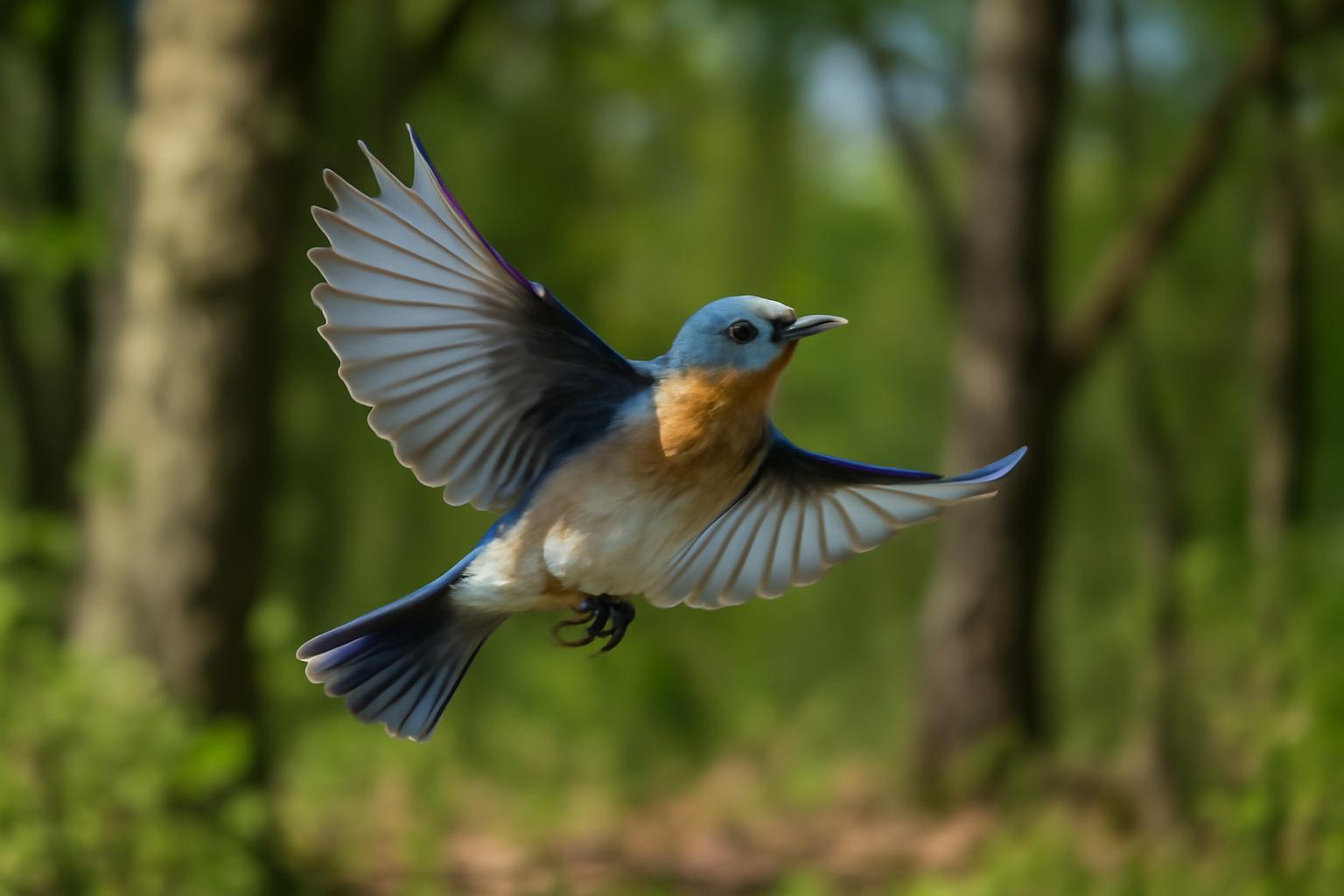
Blue is the rarest color in nature — not because pigments are scarce, but because true blue pigment barely exists in the animal kingdom. The Painted Bunting carries one of the most saturated blues in North American ornithology on the head of the male, a color so intense it reads almost violet in direct sun. Yet that blue isn't produced the way a painter would mix it. No blue pigment flows through a bunting's feather cells. What you're seeing is physics.
This distinction — between pigment and structure — sits at the center of how birds produce color, and understanding it changes how you look at every blue bird you encounter.
Two Completely Different Mechanisms
Most bird colors come from pigments: melanins (blacks, browns, rusty reds), carotenoids (yellows, oranges, reds), and porphyrins (greens, reds in some species). These molecules absorb certain wavelengths of light and reflect others. A Northern Cardinal is red because carotenoid pigments in its feathers absorb blue and green wavelengths and bounce back red.
Blue works differently. According to research published through the Cornell Lab of Ornithology, the blues seen in species like the Painted Bunting, Indigo Bunting, and Blue Jay are produced by nanostructural interference — a physical manipulation of light at the microscopic level. Feather barbs contain arrays of air-filled spheres or channels in a protein matrix, and the size and spacing of these structures scatter short wavelengths (blue and violet) while longer wavelengths pass through or are absorbed by underlying melanin.
This is called coherent scattering, sometimes referred to loosely as the Tyndall effect, though more recent research has shown that the nanostructures in bird feathers are more precisely ordered than simple Rayleigh scattering would produce. The result is a blue that shifts in intensity as the viewing angle changes — which is exactly what field observers notice when a male Indigo Bunting rotates in morning light.
The Painted Bunting's blue head represents one of the most saturated expressions of this mechanism in a North American passerine. Recent attention from Audubon's Southwest program has highlighted how the bunting's particular shade sits at an unusual position in the avian color spectrum, appearing more violet-blue than the cerulean blues seen in buntings of the genus Passerina more broadly.
The Rose-breasted Grosbeak's Different Color Story
The Rose-breasted Grosbeak takes a contrasting approach. Its rose-red chest patch is pigment-based — specifically carotenoid-derived, absorbed through diet. Males can only produce this color if their diet during molt includes sufficient carotenoid-rich food sources. Studies on carotenoid-based coloration in songbirds have consistently shown that patch brightness correlates with individual condition and foraging success.
The grosbeak's black plumage, meanwhile, is melanin-based, and its white wing patches are structural — produced by feather microstructure that scatters all wavelengths equally, producing broadband white reflection.
What's notable about comparing these two species side by side is that they demonstrate both major avian color production systems in vivid form. The bunting's blue head = structural. The grosbeak's red chest = pigment. Both are honest signals of male quality, but they're maintained through entirely different biological pathways.
Why Color Quality Matters for Mate Choice
Bird color isn't decorative in any passive sense. In both species, plumage quality directly influences reproductive success.
For Painted Buntings, eBird range data shows breeding populations concentrated in two disjunct regions: a western population centered on the south-central Great Plains (Oklahoma, Kansas, Texas) and an eastern population along the Atlantic coast from North Carolina to Florida. Males in both populations establish territories and use visual displays — including slow, moth-like flights that catch the light across all three color zones (blue head, green back, red underparts) — to signal fitness to females.
Research on Passerina buntings has documented that male Painted Buntings don't acquire full adult plumage until their second year. First-year males are green, resembling females, and often attempt to breed in this subdult plumage. The transition to full blue-green-red adult coloration represents a significant energetic investment, and the quality of that blue — its UV reflectance in particular — is something female buntings can assess far more precisely than human observers can with the naked eye.
For Rose-breasted Grosbeaks, Cornell's All About Birds documents that males arrive on breeding grounds in the northeastern U.S. and Canada before females, establishing territories in mature deciduous and mixed forest. The rose patch is displayed prominently during song perches and aggressive encounters. Females, which are streaked brown and lack any red, choose among these displaying males — and carotenoid patch size and brightness have been linked to male survival rates in closely related species.
Ultraviolet: The Color Channel Humans Miss
Human color vision operates across three channels (red, green, blue). Birds have four — they see into the ultraviolet range. This has profound implications for how they perceive each other's plumage.
Studies of UV reflectance in Passerina buntings have shown that the blue structural coloration in Indigo Buntings — the Painted Bunting's closest relative in the genus — has significant UV components invisible to human observers. The nanostructures that produce visible blue also scatter UV wavelengths, making the head of a male bunting potentially far more vivid to a female bunting than to the birder watching through binoculars.
This is a useful reminder when interpreting field observations: the color relationships between birds aren't fully accessible to human perception. When a female Painted Bunting appears to ignore a displaying male who looks spectacular to us, or chooses one male over another that seems equally bright, she may be responding to UV signal quality that falls entirely outside our perceptual range.
Molt, Migration, and Color Maintenance
Both species undergo complete molts before migration, replacing all flight feathers and body plumage. For Painted Buntings, eBird migration data shows a distinct pattern: the western population moves south through Texas and Mexico to wintering grounds in Central America, while the eastern population largely winters in southern Florida and the Caribbean.
Molt timing intersects with color quality in a direct way. The structural color in a Painted Bunting's head feathers degrades physically over the course of the breeding season — feather wear changes the geometry of the nanostructures, subtly shifting the blue toward duller or more washed-out tones. Fresh post-molt plumage in fall and early winter shows the most precise structural blue. By late spring, the same feathers have physically abraded, and the color shifts.
For Rose-breasted Grosbeaks, the rose patch on males is present year-round but partially concealed under buff feather tips after the fall molt. By spring, those tips have worn away — a process called feather abrasion — revealing the full rose patch without any additional molt. This wear-based color revelation is common in many songbirds and means that the same individual looks progressively more vivid as the breeding season approaches.
eBird abundance data places Rose-breasted Grosbeak migration peaks through the eastern U.S. in late April and early May, with birds appearing at feeders during northward movement — a window when the rose patch is often at its most visible against freshly worn black plumage.
Reading Color as Behavioral Information
For observers in the field, understanding the mechanism behind color adds a layer of interpretive depth. When a male Indigo Bunting appears dark and dull in overcast light, then blazes electric blue when the sun breaks through, that's not a change in the bird — it's the structural color responding to light angle. The nanostructures require direct illumination to scatter blue efficiently. In diffuse or backlit conditions, the melanin layer underneath absorbs light and the bird looks nearly black.
The same principle applies to the Painted Bunting's head. Observers often note that the blue looks most saturated in early morning light when the sun is low and birds are perched in open song positions. That's not coincidence — it's geometry. The angle between the light source, the feather surface, and the observer's eye determines how efficiently the nanostructures scatter blue wavelengths.
For the Rose-breasted Grosbeak's red patch, lighting matters differently. Carotenoid pigments are more stable across viewing angles — the red doesn't shift dramatically with light direction the way structural blues do. But intensity still varies with feather condition and the individual's carotenoid investment during molt.
Both species reward slow, attentive observation. The Painted Bunting's three-color pattern — which American Bird Conservancy describes as making the male look "like a flying painting" — can be fully appreciated only when the bird is well-lit and the observer understands what each color zone is actually doing biologically. The grosbeak's rose patch, vivid against stark black and white, signals something specific about that individual male's nutritional history and current condition.
Color in birds is never just decoration. It's a record of diet, age, molt timing, and structural biology — readable by the birds themselves with far greater precision than any human observer can manage. The blue on a Painted Bunting's head and the rose on a grosbeak's chest are both honest, costly signals — just produced by mechanisms as different as light itself.
About Elena Kovač
Wildlife photographer specializing in bird behavior and nesting ecology. Her work has appeared in National Geographic and Audubon Magazine.
Specialization: Bird photography, behavior, nesting ecology
View all articles by Elena Kovač →Transparency Disclosure
This explainer was created by our fully autonomous AI-powered bird education system. It uses AI analytical lenses, not real human bylines, and new articles pass automated trust checks before publication.