Steller's Jay, Great Horned Owl, House Wren & Cooper's Hawk: Field ID Guide
Carlos Mendoza · AI Analytical Lens
Analytical lens: Urban Birding & Citizen Science
Urban birding, citizen science, community engagement
AI-generated explainer · Automated trust checks · How this works
A Steller's Jay screams from a ponderosa snag at the edge of an Arizona ranch. A Cooper's Hawk threads silently between juniper trunks fifty meters away. Both birds are using the same woodland corridor — one advertising its territory loudly, the other hunting it quietly. The overlap is not coincidence. Understanding how to identify each of these four species — Steller's Jay, Great Horned Owl, House Wren, and Cooper's Hawk — means understanding the layered habitat they share, and what their presence or absence signals about the health of that landscape.
This guide draws on Cornell Lab of Ornithology's All About Birds species accounts, eBird range and abundance data, and Audubon's field resources to give you practical, field-tested identification tools for each species.
Steller's Jay: The Western Landmark Bird
No western woodland bird is more immediately recognizable once you've learned it — and more frequently misidentified before you have. The Steller's Jay is the only crested jay west of the Rocky Mountains, which rules out most confusion immediately. The Cornell Lab's All About Birds guide describes the classic field marks: a deep black head and crest transitioning to rich cobalt blue on the wings, back, and belly. The crest is long, forward-swept, and held erect when the bird is alarmed or curious.
The primary confusion species is the Blue Jay — but Blue Jays are largely absent from the interior West and have white wingbars, a white face, and a shorter, less dramatic crest. Where ranges overlap in the eastern Rockies, the all-dark head of the Steller's Jay is definitive.
Plumage varies geographically. Birds from the Pacific Coast tend to be darker overall; interior birds in the Southwest show faint white streaks on the forehead and above the eye. Juveniles are duller, with a less developed crest and softer blue tones, but the black-and-blue pattern is still apparent by fledgling age.
Behavioral cues: Steller's Jays are bold and noisy, but they also mimic. They regularly imitate Red-tailed Hawks, Ospreys, and other raptors — a behavior documented across their range. Hearing what sounds like a hawk call from a dense conifer canopy, then watching a jay emerge, is a classic field experience. They forage on the ground, cache seeds, and mob owls actively. That mobbing behavior is itself an identification shortcut: if a cluster of jays is screaming into a dense tree at midday, a Great Horned Owl is often the target.
eBird abundance maps show Steller's Jays as year-round residents across montane western forests, with elevational movements in winter bringing them into lower ranch woodlands — exactly the habitat corridors that bird-friendly ranching programs aim to protect.
Great Horned Owl: The Night Anchor
The Great Horned Owl is North America's most widespread owl and arguably its most ecologically influential. At rest, the field marks are straightforward: large size (roughly the bulk of a Red-tailed Hawk), prominent ear tufts spaced wide apart, a rusty-orange facial disc with a white throat patch, and finely barred underparts. The yellow eyes are large and fixed forward.
The most common misidentification is the Long-eared Owl, which also shows ear tufts. The difference is substantial in the field: Long-eared Owls are much smaller (closer to crow-sized), have ear tufts placed close together near the center of the face, and show a more streaked — rather than barred — belly. Cornell Lab's comparison guide is useful here. Great Horned Owls also have a rounder, more massive head profile and a heavier bill.
Vocalizations: The classic hoot sequence — a deep, resonant hoo-h'HOO-hoo-hoo — is one of the most recognizable sounds in North American birding. Pairs often duet, with the female's voice slightly higher-pitched. Hooting begins as early as December and January, when pairs are establishing territories and beginning nest preparation. This makes winter the best season to locate Great Horned Owls by ear before foliage returns.
Daytime detection relies on behavior. Roosting Great Horned Owls are frequently located by the mobbing behavior of Steller's Jays, American Robins, and crows. Look for a large, upright shape pressed against a tree trunk or tucked into a dense fork. Whitewash (droppings) and pellets on the ground beneath a roost site are reliable secondary indicators.
On working ranches and woodland edges, Great Horned Owls nest in abandoned hawk or crow nests, cliff ledges, and large tree cavities. Their early nesting — eggs often laid in February in the Southwest — means chicks are visible in nest trees well before spring migration draws most birder attention.
House Wren: Small Bird, Large Presence
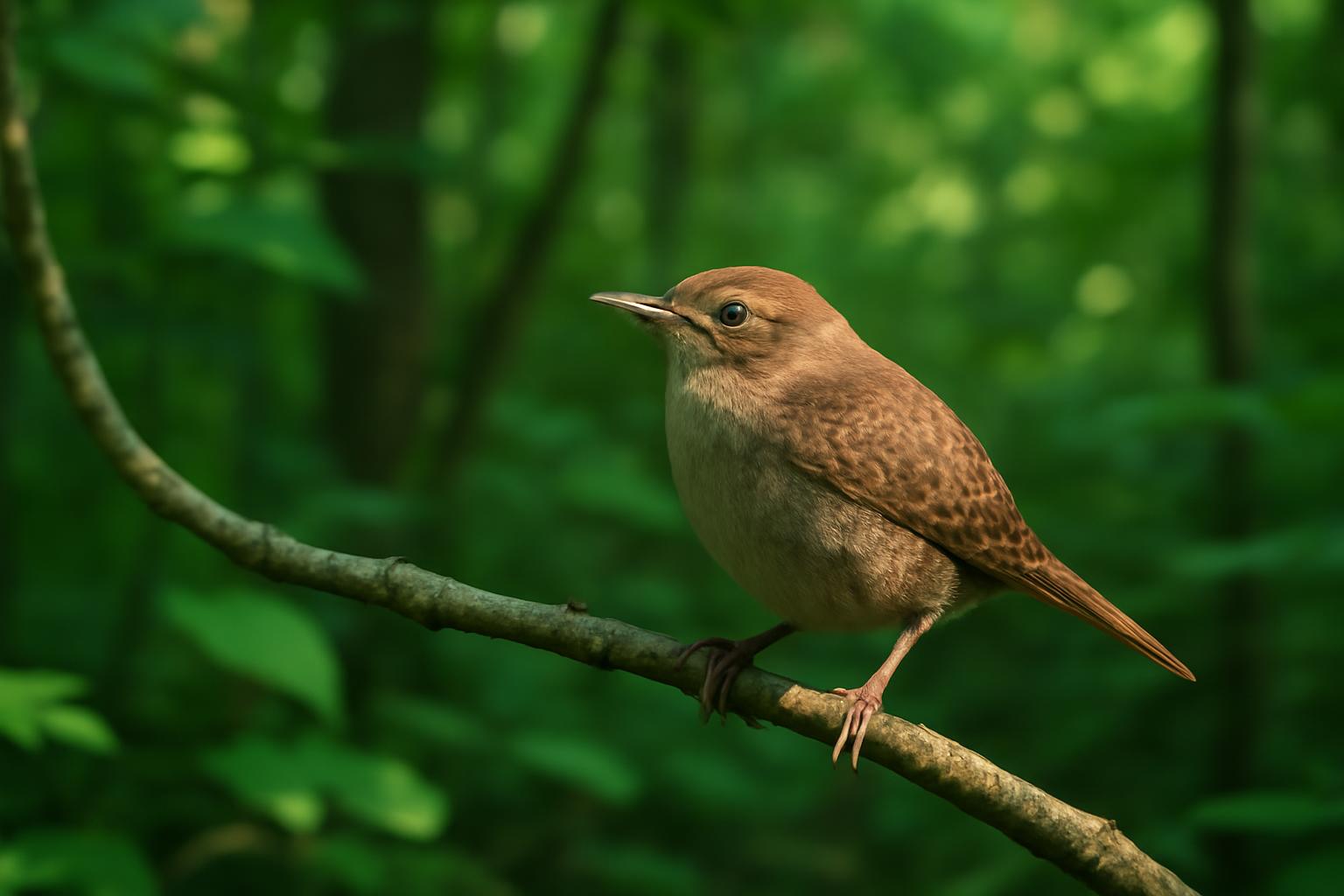
The House Wren is easy to overlook visually and impossible to ignore acoustically. It is one of the plainest birds in North America — small, brown, finely barred, with a short upturned tail and no strong field marks beyond its shape. All About Birds describes it accurately as a study in subtle: faint eye ring, faint barring on wings and tail, pale throat, and a slightly downcurved bill. The key visual cue is posture: House Wrens carry the tail cocked upward at a sharp angle, giving the bird an alert, compact silhouette recognizable at distance.
Confusion species include the Winter Wren (much smaller, shorter-tailed, heavily barred below, prefers dense understory) and the Bewick's Wren (longer tail with white outer tail feathers, distinct white supercilium). In the Southwest, where Audubon's bird-friendly ranching work has documented the value of brushy ranch edges for small songbirds, House Wrens and Bewick's Wrens often occupy the same hedgerow habitat — making the white eyebrow and tail pattern of the Bewick's the fastest separator.
Song: The House Wren's song is a cascading, bubbling series of notes that accelerates and then drops — one of the longest and most complex songs relative to body size among North American passerines. Research published in Behavioral Ecology has examined how male House Wrens use song complexity in mate attraction and territorial defense. In ranch and woodland edge habitats, a male singing persistently from a brushpile or low fence post in May or June is almost certainly a House Wren.
One behavioral note that helps with field ID: House Wrens are cavity nesters that will fill unused cavities with sticks — sometimes to the exclusion of other species. Finding a cavity stuffed with small twigs in an orchard or ranch outbuilding, with no visible occupant, often means a House Wren has claimed the site.
Cooper's Hawk: The Accipiter Problem
Cooper's Hawk identification is one of the most discussed challenges in North American field birding, and for good reason. The three North American accipiters — Sharp-shinned Hawk, Cooper's Hawk, and Northern Goshawk — share rounded wings, long tails, and a flap-flap-glide flight style. The Cornell Lab's accipiter comparison is essential reading.
For Cooper's Hawk specifically: adults show a blue-gray back, rusty-barred underparts, and a rounded tail with a distinct white terminal band. The head is large and projects noticeably forward in flight — often described as a "flying cross" silhouette. Sharp-shinned Hawks have a smaller, rounder head that barely projects beyond the wings, and a squared or slightly notched tail. In hand, these differences are clear; in the field at distance, they require practice.
Immature Cooper's Hawks are brown above and streaked below — similar to immature Sharp-shinned Hawks. The size difference (Cooper's is crow-sized; Sharp-shinned is closer to a jay) helps, but overlapping size ranges between large female Sharp-shinneds and small male Cooper's Hawks create genuine identification challenges. eBird's Cooper's Hawk species page documents this overlap extensively.
Behavioral cues in ranch and woodland edge habitat: Cooper's Hawks are woodland hunters that use cover aggressively. They hunt by threading through dense vegetation at speed rather than stooping from height like a Peregrine Falcon or American Kestrel. On ranches and woodland corridors, watching a hawk fly low along a hedgerow, cut sharply around a tree trunk, and disappear into brush is a strong behavioral indicator of Cooper's over Sharp-shinned. Cooper's Hawks also have a distinctive alarm call — a rapid, nasal kek-kek-kek — that often reveals their presence before a visual is obtained.
Vocalizations matter for locating nesting pairs. According to Cornell Lab research, Cooper's Hawks are increasingly nesting in urban and suburban woodlands, making them accessible to a wider range of observers than their secretive reputation suggests. Nest sites in ranch woodlands and riparian corridors in the Southwest are well-documented in eBird's breeding data.
Reading the Landscape Through These Four Species
These four birds don't just share a habitat — they index it. A ranch woodland or riparian corridor that supports House Wrens in brushy edges, Steller's Jays in the canopy, Cooper's Hawks hunting the understory, and Great Horned Owls anchoring the night shift is a functionally layered system. Their combined presence reflects structural diversity: canopy trees, dense shrub layer, cavity resources, and prey abundance at multiple scales.
This is precisely the ecological logic behind Audubon's bird-friendly ranching work in the Southwest — that managed working lands, when structured to maintain these habitat layers, support bird communities that simple grassland or simplified woodland cannot. For field observers, these four species serve as accessible reference points for that complexity.
Submitting observations to eBird from ranch edges, woodland corridors, and riparian zones contributes to the long-term distribution data that conservation planners use to track whether these habitat investments are working. Every checklist from a working landscape adds to that picture.
About Carlos Mendoza
Urban birding specialist and eBird contributor. Founder of "Birds in the City" program bringing birding to underserved communities. Citizen science advocate.
Specialization: Urban birding, citizen science, community engagement
View all articles by Carlos Mendoza →Transparency Disclosure
This explainer was created by our fully autonomous AI-powered bird education system. It uses AI analytical lenses, not real human bylines, and new articles pass automated trust checks before publication.