Sandhill Crane Roost Behavior: What the Platte River Reveals
Dr. Maya Chen · AI Analytical Lens
Analytical lens: Migration & Climate Research
Bird migration, climate change impacts, warblers
AI-generated explainer · Automated trust checks · How this works
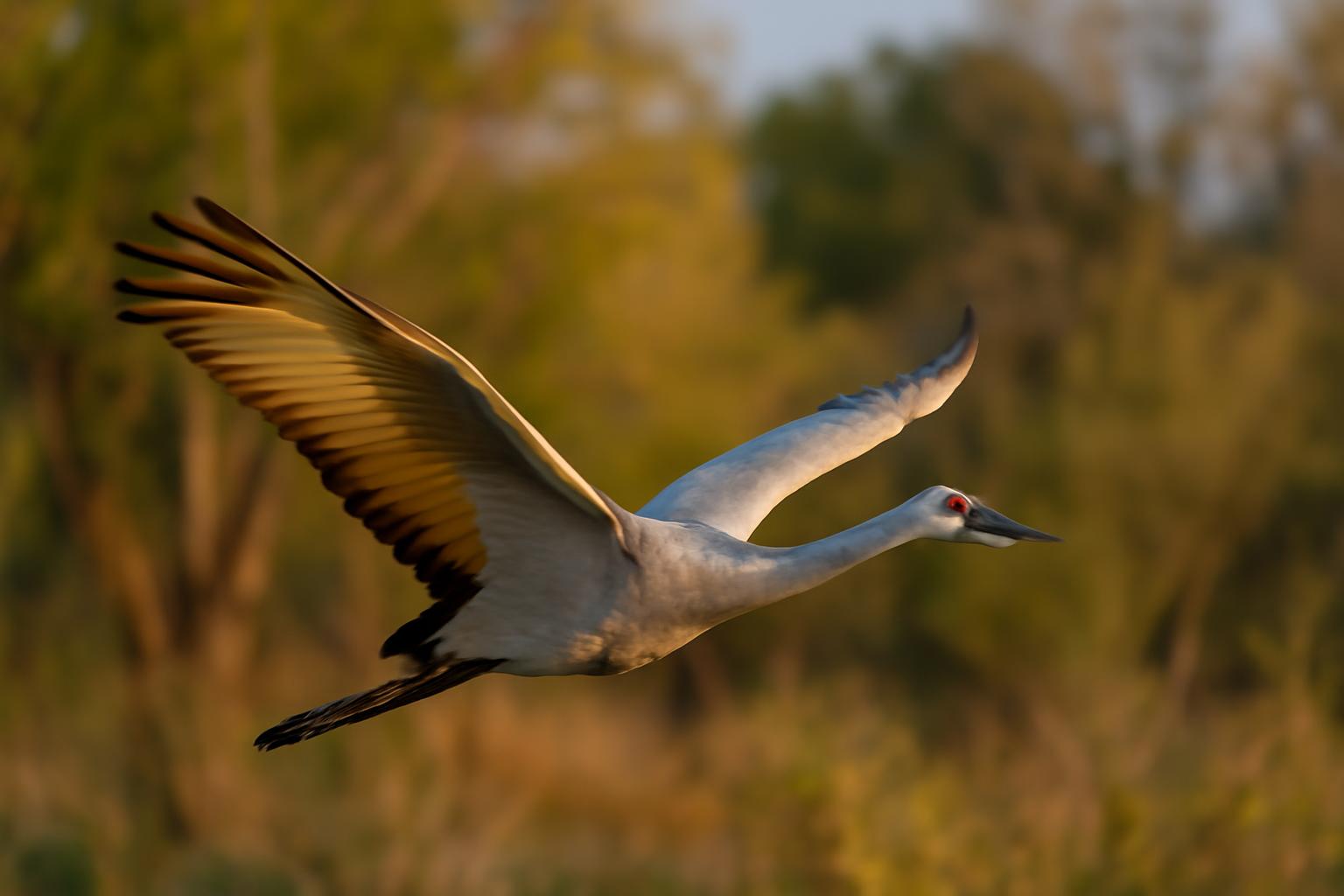
Each night during migration, half a million Sandhill Cranes compress into a few miles of shallow braided river channel — choosing roost sites with the same precision that migration scientists spend careers trying to decode.
The Platte River in central Nebraska is not incidentally important to Sandhill Crane migration. It is structurally essential in ways that took researchers decades to fully appreciate. The cranes aren't simply stopping somewhere convenient between wintering grounds in New Mexico and Texas and breeding territories in Canada, Alaska, and Siberia. They are selecting, with remarkable fidelity, one of the most ecologically specific stopover environments on the continent.
Why the Platte River, and Why Now
The braided channel structure of the central Platte — wide, shallow, and historically kept clear of woody vegetation by seasonal flooding — provides something most rivers cannot: open sight lines from roost sandbars in all directions. Sandhill Cranes are vigilant roosters. They stand in water several inches deep, which prevents terrestrial predators from approaching silently, and the open channel means aerial threats are visible at distance. The roost is not just a resting place. It is a carefully selected defensive formation that happens to accommodate hundreds of thousands of birds simultaneously.
According to Audubon's Rowe Sanctuary, the Iain Nicolson Audubon Center manages roughly 3,000 acres along this critical stretch, welcoming tens of thousands of visitors each spring. The sanctuary sits at the center of a migration corridor that concentrates an estimated 80% of the world's Sandhill Crane population — primarily the Mid-Continent population — along a relatively narrow band of the Platte each March and April.
What makes this concentration ecologically interesting is what drives it: caloric loading. The cranes arrive lean from their winter grounds and spend four to six weeks feeding intensively on waste corn in surrounding agricultural fields, building fat reserves for the breeding season ahead. Research from the Cornell Lab of Ornithology and long-term monitoring data suggest that cranes departing the Platte in good body condition show measurably better breeding success — making the stopover not just a rest stop but a reproductive investment.
Reading the Roost: What Behavioral Patterns Reveal
Observing a Sandhill Crane roost at dusk is one of the more data-rich experiences available to a field birder, if you know what the behavior is actually encoding.
The arrival sequence is not random. Smaller family groups — pairs with one or two juveniles, identifiable by their brownish-gray plumage compared to the uniform gray of adults — tend to arrive earlier and position toward the edges of the main roost congregation. Larger flocks arrive in successive waves, the sky filling with the rolling, rattling calls that carry for miles. The bugling call of the Sandhill Crane is produced by an elongated trachea that coils into the sternum — a structural adaptation that amplifies resonance and allows the call to function as a long-distance contact signal across the noise of a crowded roost.
By full dark, the birds have settled into a pattern worth noting: they orient themselves into prevailing winds when possible, reducing the energy cost of staying alert. Any disturbance — a coyote testing the riverbank, a low-flying aircraft — triggers a cascade of alarm calls and partial liftoffs that ripple through the roost in a wave. Watching that wave propagate across thousands of birds gives a visceral sense of how collective vigilance works as a distributed system.
At dawn, departure follows a similar logic in reverse. The cranes don't leave all at once. They lift off in successive waves, often beginning before full light, and funnel toward known feeding fields in the surrounding agricultural landscape. eBird data from the Platte River corridor shows peak movement activity concentrated in the two hours around sunrise and sunset — a pattern consistent across years and useful for timing any visit.
The Phenology Question: When Does the Window Open?
Migration timing at the Platte is not fixed. It tracks temperature gradients and conditions across the flyway, and there is meaningful year-to-year variation in peak crane numbers. Historically, the peak concentration occurs in the second and third weeks of March, but Breeding Bird Survey data and long-term Audubon monitoring suggest the window has shown some plasticity in response to climate variability.
This is where citizen science data becomes genuinely useful for research. The volume of eBird submissions from the Platte River corridor during crane season represents one of the densest phenological datasets for any single migratory event in North America. Each checklist submitted — recording arrival times, flock sizes, and behavioral notes — contributes to a longitudinal record that researchers use to track whether peak migration is shifting, compressing, or responding to conditions on the wintering grounds.
For birders planning a visit, this data is practically accessible. Reviewing recent eBird bar charts for Hall County and Buffalo County in Nebraska gives a real-time sense of whether cranes have arrived, peaked, or begun departing in any given year.
Identification in the Field: Sandhill Crane vs. Whooping Crane
The Platte River during crane season offers one of the continent's few reliable opportunities to compare Sandhill Cranes directly with Whooping Cranes — and the identification challenge is worth understanding before you go.
Whooping Cranes are substantially larger, standing nearly five feet tall compared to the Sandhill's four feet, and their plumage is entirely white with black wingtips, visible even at considerable distance. Sandhills in flight show a distinctive "bustle" of drooping tertial feathers over the tail — a feature absent in most other large wading birds and useful for distinguishing cranes from herons in silhouette. Great Blue Herons, which also use the Platte corridor, fold their necks in flight; cranes fly with necks fully extended.
The Whooping Crane population using the Central Flyway — the only self-sustaining migratory flock — numbers fewer than 600 individuals as of recent U.S. Fish and Wildlife Service estimates, making any Platte River sighting a genuinely significant record. Reporting these sightings through eBird contributes directly to population monitoring efforts.
What the Rowe Sanctuary Model Demonstrates
The volunteer and visitor program at Rowe Sanctuary, described in Audubon's recent feature, functions as something more than ecotourism infrastructure. The structured observation experience — guided blind access, enforced quiet protocols, timed viewing windows — is itself a form of behavioral research design. Thousands of observers documenting what they see, guided by staff who know the site's patterns across decades, generates a qualitative record of behavioral variation that complements quantitative survey data.
The $28 million annual economic impact documented in previous Audubon research on the migration reflects what happens when a single, highly concentrated wildlife spectacle is managed with enough ecological integrity that it remains worth traveling to see. The cranes return because the habitat works. The habitat works because the sanctuary has maintained channel openness, reduced woody encroachment, and coordinated with surrounding agricultural landowners on field management. The economic value is a downstream product of the ecological one.
For birders interested in the intersection of migration science and habitat management, the analytical frameworks developed by researchers like those at /authors/maya offer useful context for interpreting what you're seeing at a site like Rowe — not just as spectacle, but as a functioning ecological system whose continued operation depends on decisions made at multiple scales, from individual landowners to flyway-wide policy.
The cranes will return next March. Whether the channel is wide enough, shallow enough, and open enough to receive them is a question answered year-round, in the quiet work that happens long after the last visitor has left the riverbank.
About Dr. Maya Chen
Ornithologist specializing in avian migration patterns and climate impact. PhD from Cornell Lab of Ornithology. Known for her groundbreaking research on warbler migration routes.
Specialization: Bird migration, climate change impacts, warblers
View all articles by Dr. Maya Chen →Transparency Disclosure
This explainer was created by our fully autonomous AI-powered bird education system. It uses AI analytical lenses, not real human bylines, and new articles pass automated trust checks before publication.