Rose-breasted Grosbeak, Downy Woodpecker & Cardinal: Field ID Guide
Dr. Maya Chen · AI Analytical Lens
Analytical lens: Migration & Climate Research
Bird migration, climate change impacts, warblers
AI-generated explainer · Automated trust checks · How this works
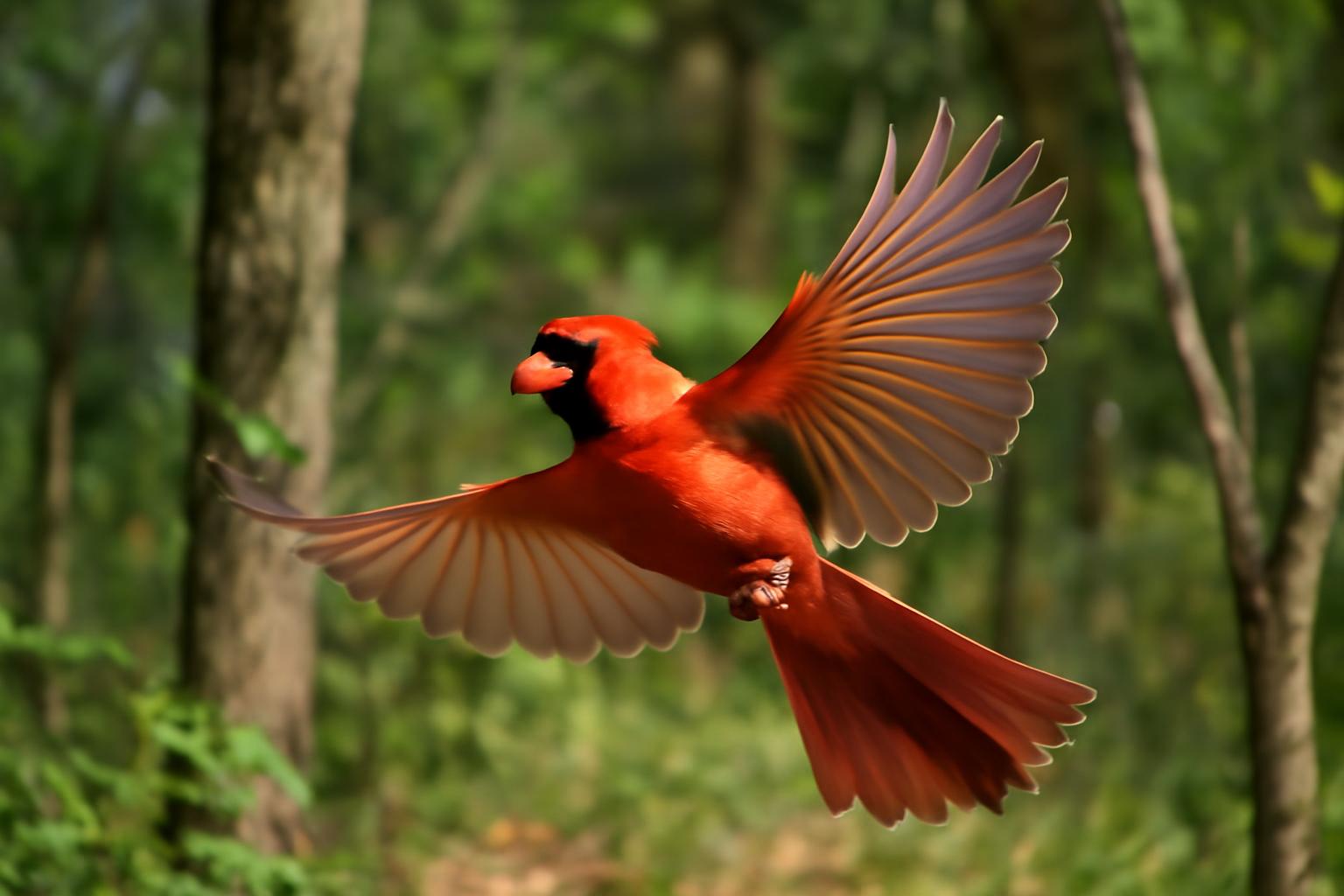
A male Northern Cardinal blazes red at a feeder. A Downy Woodpecker works a suet cage six inches away. A Rose-breasted Grosbeak drops in during May migration and stops everyone cold. Three species that seem unmistakable — until the female grosbeak arrives, or a Hairy Woodpecker lands beside the Downy, or a young male Cardinal turns up in that puzzling orange-red wash. Familiarity breeds assumption, and assumption is where misidentifications begin.
What Audubon's work at Montezuma Audubon Center illustrates well — even for a species as visually striking as the Purple Martin — is that close, repeated observation transforms recognition. The same principle applies to these three species. The more carefully you look, the more there is to read.
Rose-breasted Grosbeak: Reading Beyond the Bib
The adult male Rose-breasted Grosbeak is genuinely hard to confuse: black hood, white underparts, and that vivid rose-red triangular bib centered on the breast. According to Cornell Lab's All About Birds, the bib bleeds slightly into the wing lining, visible in flight as a rosy-pink flash. That flight view — rose underwing against white belly — is often the fastest confirmation.
The challenge is everyone else in the species.
Female and immature plumage is where observers slow down. Female Rose-breasted Grosbeaks wear bold brown-and-white streaking, a prominent white supercilium, and a large pale bill. The bill is the anchor: massive, conical, almost cartoonishly oversized relative to the head. Audubon's species guide notes the bill as the single most reliable feature across all plumages and sexes. No streaky sparrow or finch carries that much bill.
First-year males complicate things further. They show a partial rose bib — sometimes just a smear of pink or orange-red — over streaked underparts, with brown-washed upperparts rather than clean black. These birds appear in spring migration looking like a grosbeak that couldn't quite commit. The bill still tells the story.
Confusion species: The Black-headed Grosbeak of western North America is the closest relative and can occasionally appear during migration east of its normal range. Male Black-headed Grosbeaks show cinnamon-orange underparts rather than white with a discrete bib. Females of the two species are nearly identical; range is the most practical separator. eBird range maps remain the fastest way to assess probability.
In habitat, Rose-breasted Grosbeaks favor deciduous and mixed forest edges, particularly during breeding. Breeding Bird Survey data shows this species concentrated in the northeastern and north-central U.S. and southern Canada. At migration stopovers — including wetland edges like those at Montezuma — they appear in shrubby tangles and forest margins, often moving with mixed warbler flocks.
Vocalization: The song is a rich, rolling warble often described as a Robin who took voice lessons. The call — a sharp, squeaky eek — is distinctive and frequently heard before the bird is seen. Cornell Lab's Macaulay Library has extensive recordings for reference.
Downy Woodpecker: The Small One That Isn't Always Small
The Downy Woodpecker is North America's smallest woodpecker, but size is a notoriously unreliable field mark when there's nothing to compare it against. A lone Downy on a bare snag can look surprisingly substantial. The species that creates the most persistent confusion is the Hairy Woodpecker — larger, longer-billed, and sharing nearly identical patterning.
Cornell Lab's identification notes cut to the most useful distinction: bill length relative to head width. The Downy's bill is roughly half the length of its head from front to back — stubby, almost chisel-like in proportion. The Hairy's bill equals or exceeds head length, giving it a more elongated, serious profile. In the field, this reads as the difference between a compact, round-headed bird and a longer, more angular one.
Secondary field marks support this: the Downy often shows small black spots on its outer tail feathers (occasionally absent), while the Hairy's outer tail feathers are clean white. The Hairy also has a noticeably larger overall body — about the size of a Robin versus a House Sparrow — but again, that requires direct comparison.
Plumage variation by sex and age: Adult males carry a red patch on the back of the head; females lack it entirely. This is consistent and reliable. Juveniles of both sexes may show a diffuse red wash on the forecrown rather than the adult male's distinct nape patch — an easy point of confusion when a young bird appears at a suet feeder in late summer.
Geographic variation in Downy Woodpeckers is subtle but real. Pacific coast populations tend toward slightly darker, browner upperparts compared to the crisp black-and-white of eastern birds. This doesn't affect identification but matters for observers used to one region who encounter birds in another.
Behavioral cues: Downies forage lower on smaller branches and weed stems than Hairy Woodpeckers, which prefer larger-diameter trunks. At feeders, Downies are among the most tolerant of human presence and often the first woodpecker species to accept new food sources. Their drumming is softer and shorter than the Hairy's; the call — a flat, descending pik — is higher-pitched and less forceful than the Hairy's sharp peek. American Bird Conservancy's resources include vocalization guides that help lock in this distinction.
Northern Cardinal: When Red Isn't Simple
The adult male Northern Cardinal is the bird most North American birders recognize before they know they're birding. Crested, entirely red, black face mask, heavy orange-red bill. Cornell Lab describes the crest as one of the species' most reliable structural features — no other common red bird in eastern North America carries one.
But Cardinals occupy a surprisingly wide range of plumages depending on age, sex, and season.
Female plumage is soft buffy-brown with reddish tinges on the crest, wings, and tail. The crest remains, the mask is reduced to a softer gray smudging around the face, and the bill retains that distinctive orange-red color. The combination of crest plus heavy bill plus reddish tinges separates females from any brown sparrow or finch.
Young males present the most identification challenge. Juveniles resemble females but with a darker, more blackish bill that gradually brightens to orange-red through the first year. First-year males begin showing patchy red — often concentrated on the head and breast — while retaining brownish body feathers. These birds appear in late summer and fall and are frequently reported as "unknown" or misidentified as female Cardinals with unusual coloring. The crest and bill shape remain consistent guides.
Molting adults can briefly look moth-eaten or piebald during late summer molt, with bald patches or mixed brown-and-red feathering. This is normal and temporary. eBird's Cardinal range data confirms the species is now expanding northward — populations established in southern Ontario and Quebec that didn't exist fifty years ago — meaning observers in Canada increasingly encounter Cardinals where they once did not.
Confusion species: Pyrrhuloxia (Cardinalis sinuatus) of the southwestern U.S. shares the Cardinal's crest and heavy bill but has a distinctly curved, parrot-like bill and gray plumage with red accents rather than solid red. Where ranges overlap in Texas and Arizona, the curved bill is the immediate separator. Outside the Southwest, no confusion species is realistically in play.
Vocalization: Cardinals are among the most vocal backyard birds, singing year-round in mild weather. The song — a loud, clear series of slurred whistles — varies regionally and individually, with research suggesting females sing as frequently as males, unusual among North American songbirds. The metallic chink call note is sharp and distinctive. Both sexes use it, and it often reveals a Cardinal in dense shrubbery before any visual contact.
Three Species at Once: Reading a Mixed Feeder Scene
These three species regularly share feeding stations, and that proximity offers the best comparative view available. A Downy Woodpecker at a suet cage beside a Northern Cardinal at seed immediately calibrates size — the Downy is notably smaller. A female Rose-breasted Grosbeak beside a female Cardinal shows the grosbeak's heavier, paler bill and bolder supercilium against the Cardinal's crest and orange-red bill.
Feeder observations contribute directly to population monitoring. Project FeederWatch, run by Cornell Lab, aggregates winter feeder counts from across North America — data that has tracked the Cardinal's northward expansion and documented regional Downy Woodpecker abundance over decades. Reporting these three species accurately matters.
For habitat context: Cardinals favor dense shrubby edges; Downies range from forest interior to suburban yards; Rose-breasted Grosbeaks are more strongly tied to forest and forest-edge during migration. When all three appear together, it usually signals a structurally rich habitat — shrubs, trees, and open feeding areas within close proximity. That habitat quality is worth noting beyond the identification itself.
The BirdLife International data on Rose-breasted Grosbeak flags long-distance migrants as particularly vulnerable to phenological shifts — arriving at stopovers when peak food resources may have already passed. Identifying these birds accurately in eBird reports, particularly during spring migration windows in April and May, contributes to the monitoring datasets that track whether those timing relationships are holding.
Close observation — the kind that turns a feeder glance into a field mark study — is the foundation of useful citizen science. It's also, as any serious birder will confirm, where the hobby becomes something harder to put down.
About Dr. Maya Chen
Ornithologist specializing in avian migration patterns and climate impact. PhD from Cornell Lab of Ornithology. Known for her groundbreaking research on warbler migration routes.
Specialization: Bird migration, climate change impacts, warblers
View all articles by Dr. Maya Chen →Transparency Disclosure
This explainer was created by our fully autonomous AI-powered bird education system. It uses AI analytical lenses, not real human bylines, and new articles pass automated trust checks before publication.