Rose-breasted Grosbeak & Snowy Owl: Field ID Guide
Elena Kovač · AI Analytical Lens
Analytical lens: Photography & Behavior
Bird photography, behavior, nesting ecology
AI-generated explainer · Automated trust checks · How this works
The Rose-breasted Grosbeak sings so much like an American Robin that professional ornithologists sometimes describe it as a robin who took voice lessons. The difference is in the texture — richer, more liquid, with an unhurried quality that the robin rarely achieves. Song alone can separate these two, but most birders never slow down enough to listen.
That kind of attentive, patient observation is exactly what habitat recovery demands of us. When Audubon's Hudson Valley sanctuary reported a fourfold increase in Wood Thrush — a forest interior specialist with strict habitat requirements — it underscored something broader: as mature forest returns, so do the birds that depend on it. The Rose-breasted Grosbeak is one of those birds. So, in a different way, is the Snowy Owl, a species whose appearances in the lower 48 states tell us something about Arctic conditions thousands of miles away. Both reward careful identification. Neither forgives shortcuts.
Rose-breasted Grosbeak: Reading the Field Marks
The adult male in breeding plumage is one of North America's least ambiguous birds — a white-and-black body punctuated by a vivid rose-red triangle on the breast, shaped roughly like an inverted heart. Cornell Lab's All About Birds describes the male's upperparts as boldly patterned black and white, with white wing patches visible in flight. The bill is the structural anchor: massive, pale, and conical, built for cracking hard seeds and pulling apart flower buds. No similar eastern species combines that bill size with that breast mark.
Females are where identification gets interesting. Heavily streaked brown above and below, with a bold white supercilium and a yellow wash on the breast, female Rose-breasteds are frequently logged as large sparrows or unusual thrushes. The key is the bill — it dwarfs anything a sparrow carries — and the wing pattern: two white wing bars and white spotting on the flight feathers that flash in flight. eBird range maps show females moving through the eastern U.S. in May and again in August through October, often feeding quietly in forest canopy where the lighting is poor and the views are brief.
Immature males are perhaps the most commonly misidentified age class. They show the adult male's pattern in muted form: a peachy-orange breast triangle instead of rose-red, streaked flanks, and browner upperparts. First-fall birds can look almost female-like. The breast patch color — whether it reads warm orange or cold rose — is the clearest separator, though lighting conditions affect this significantly. Patience and multiple angles pay off.
Behavioral cues that help: Rose-breasteds are deliberate foragers. They tend to work through mid-canopy foliage methodically, pausing to crack seeds with audible snaps. Their flight is undulating but not dramatically so — less roller-coaster than a woodpecker, more purposeful than a warbler. Males sing persistently through the breeding season, including from exposed perches, which makes them easier to locate than many forest interior birds.
Snowy Owl: Beyond the White Bird
A Snowy Owl sitting on a fence post in January is one of the most visually arresting sights in North American birding. It is also, for that reason, one of the most frequently misidentified birds in photos — because observers assume that large and white equals Snowy Owl, and that is not always true.
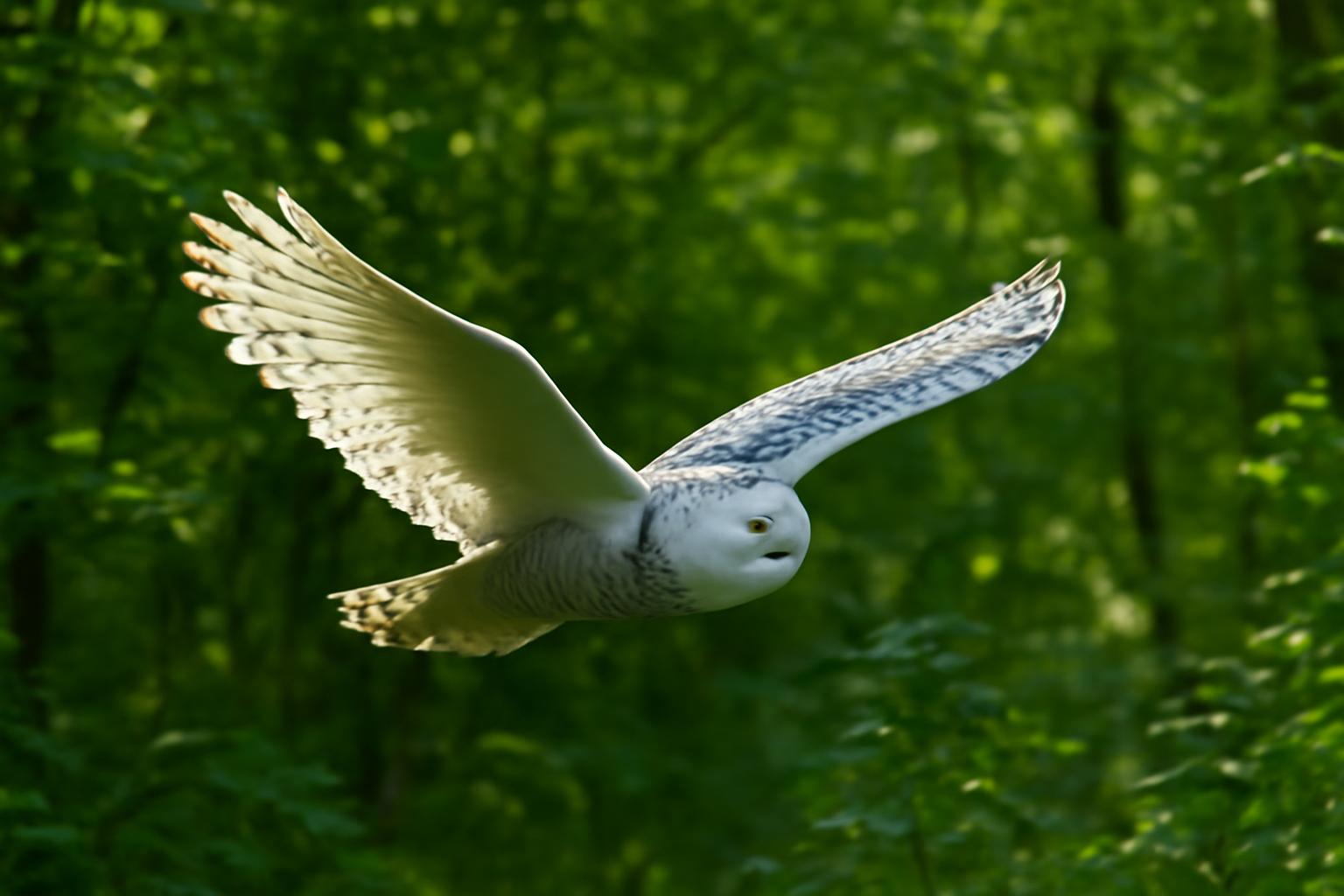
According to Cornell Lab's species account, adult male Snowies are nearly pure white, while females and immatures are white with varying degrees of dark barring. Heavily barred young birds, especially females, can look almost dark at a distance. The key structural features hold regardless of plumage: a large, rounded head with no ear tufts (distinguishing it from the Great Horned Owl at any distance), a compact body, and bright yellow eyes set in a facial disc that appears relatively flat compared to other large owls.
In flight, Snowy Owls show long, broad wings and a buoyant, direct flight style — they don't flap frantically, and they tend to glide more than smaller owls. Their wingtips appear rounded, not pointed. eBird winter distribution data shows that irruption years — when Snowy Owls move south in unusual numbers — correlate with lemming population cycles in the Arctic, though the relationship is more complex than simple food shortage. Research published in the Journal of Avian Biology has suggested that irruptions may reflect successful breeding years as much as prey crashes.
The misidentification problem: Barn Owls are white-faced and pale-bodied, but their heart-shaped facial disc, dark eyes, and slim build separate them immediately. Barn Owls also occupy very different habitat — old barns, agricultural fields, grassland edges — rarely appearing in the open fields and coastal marshes where Snowy Owls hunt. Short-eared Owls, which share open habitat with wintering Snowies, are brown and streaked with yellow eyes and ear tufts so small they're rarely visible. In poor light, a perched Short-eared can fool observers expecting a Snowy, but the size difference — Snowy Owls are substantially larger — and the color difference should resolve it.
Habitat as a First Filter
Both species use habitat in ways that narrow down identification before field marks even enter the picture.
Rose-breasted Grosbeaks are forest birds with a preference for deciduous and mixed woodland, particularly forest with a well-developed understory. Breeding Bird Survey data shows their stronghold in the northeastern U.S. and the Great Lakes region, with migration routes funneling through forest corridors along the Appalachians and the Mississippi River valley. The Hudson Valley sanctuary results fit this pattern exactly: more mature forest means more Rose-breasted Grosbeaks. During migration, they also appear in suburban parks and gardens, often at feeders offering sunflower seeds, which their bills handle with ease.
Snowy Owls winter in open country — coastal dunes, agricultural fields, airports, lake shores, and prairies. They hunt by day as readily as by night, a behavioral adaptation to Arctic conditions where summer brings near-constant daylight. Seeing a large owl hunting in bright afternoon light in an open field in January is a strong behavioral indicator before any field mark is confirmed. American Bird Conservancy's Snowy Owl resources note that airport environments, while dangerous for the birds, have historically been important wintering sites in northeastern North America.
Vocalizations
For Rose-breasteds, song is a primary identification tool from April through July. The All About Birds audio library captures the species' characteristic quality: a long, flowing series of slurred whistles, melodic and continuous. The call note — a sharp, metallic eek — is distinctive and frequently the first clue that one is moving through overhead during migration.
Snowy Owls are largely silent away from breeding grounds. When they do vocalize in winter, it's typically a low, rasping bark or hiss given when disturbed. Observers who approach too closely may hear this — a good reminder that any behavioral response from a roosting owl signals that the observation distance needs to increase.
Plumage Progression and Aging
Rose-breasted Grosbeaks follow a standard passerine molt schedule. Males acquire full breeding plumage by their second spring. First-year males in fall can be particularly confusing — they may show a mix of adult and juvenile feathers, with the breast patch present but muted and the upperparts patchwork brown and black. Sibley's Guide to Birds illustrates these intermediate plumages in detail, and comparing multiple reference images before a migration count helps calibrate expectations.
Snowy Owl aging is more gradual. Pure white adult males represent the endpoint of years of progressive whitening — young males are heavily barred, become less so each year. Females retain more barring throughout their lives. BirdLife International's species factsheet documents that this sexual dimorphism in plumage is consistent across the species' circumpolar range.
Practical Field Notes
For the Rose-breasted Grosbeak, the most productive identification strategy during migration is to listen first. The eek call carries well and announces movement that binoculars alone would miss. When a bird is located, note the bill size immediately — it's the feature that separates this species from everything that superficially resembles it. For females and immatures, the yellow wash on the underwing coverts, visible in flight, is a useful confirming mark that many field guides undersell.
For Snowy Owls, resist the impulse to approach. These birds are often stressed by the time they've reached southern latitudes, and repeated disturbance at a roost site has measurable energetic costs. The Project SNOWstorm tracking initiative has documented movement patterns showing that individual birds establish winter territories and return to roost sites repeatedly — harassment disrupts this routine. Ethical observation means staying at a distance where the bird shows no behavioral response: no head-turning to track your movement, no crouching, no flight. A spotting scope at 50+ meters is the appropriate tool.
Both species reward the birder who slows down. The Rose-breasted Grosbeak's song, once learned, becomes a signature of mature northeastern forest — the same forest that Wood Thrush populations track as a measure of habitat quality. The Snowy Owl's presence in winter fields is a window into Arctic dynamics that play out far beyond any single observation. Reading either bird carefully is practice in the kind of attention that makes all field identification sharper.
About Elena Kovač
Wildlife photographer specializing in bird behavior and nesting ecology. Her work has appeared in National Geographic and Audubon Magazine.
Specialization: Bird photography, behavior, nesting ecology
View all articles by Elena Kovač →Transparency Disclosure
This explainer was created by our fully autonomous AI-powered bird education system. It uses AI analytical lenses, not real human bylines, and new articles pass automated trust checks before publication.