Rocky Mountain Birds and Working Lands: What Monitoring Reveals
Carlos Mendoza · AI Analytical Lens
Analytical lens: Urban Birding & Citizen Science
Urban birding, citizen science, community engagement
AI-generated explainer · Automated trust checks · How this works
Conservation ranching is one of the most consequential—and least celebrated—forces shaping bird populations across the Rocky Mountain West, and long-term monitoring data are making that case clearly.
The Rocky Mountain landscape is not wilderness in the classic sense. Much of it is working land—cattle ranches, hay meadows, irrigated pastures, and seasonal wetlands created by agricultural water management. For species like the American Kestrel, Sandhill Crane, Dark-eyed Junco, and Mallard, this mosaic of managed and natural habitat is not a compromise. It is the habitat. Understanding how land management decisions ripple through bird populations is now a core part of Rocky Mountain ornithology, and recent conservation ranching monitoring results from Audubon's Rockies program add to a growing body of evidence that voluntary, incentive-based ranching partnerships produce measurable outcomes for birds.
The Monitoring Framework
Bird monitoring on working lands combines point count surveys, eBird citizen science data, and targeted nest monitoring to build a picture of how populations respond to specific management practices. Audubon's Conservation Ranching program works with ranchers who agree to habitat-friendly grazing management in exchange for certification and market access, then tracks whether bird communities respond. The methodology draws on protocols developed through the Breeding Bird Survey, one of North America's longest-running avian monitoring programs, and integrates with eBird's regional bar charts to contextualize local findings within broader population trends.
What makes this approach valuable is its specificity. Rather than measuring general biodiversity, conservation ranching monitoring tracks indicator species—birds whose habitat requirements are well understood and whose presence or absence signals something meaningful about land condition. The four species examined here each serve that function in different ways.
American Kestrel: Nest Box Success and Grassland Quality
The American Kestrel is North America's smallest falcon and one of its most studied grassland birds. It is also declining. Breeding Bird Survey trend data show a long-term population decrease across much of the continent, with the steepest losses in the East but significant declines in parts of the West as well. In the Rockies, kestrels depend on open grasslands and meadows with adequate perch structure—fence posts, snags, isolated trees—and sufficient prey, primarily large insects and small mammals.
Conservation ranching monitoring consistently identifies kestrel presence as a proxy for grassland invertebrate abundance. Where grazing management maintains diverse forb cover and avoids overgrazing that would eliminate prey habitat, kestrels tend to persist. Nest box programs on participating ranches, which American Bird Conservancy and regional Audubon chapters have promoted for years, show occupancy rates that correlate with surrounding habitat quality—boxes placed in degraded, heavily grazed pastures attract fewer pairs than those in structurally diverse grasslands.
For birders visiting Rocky Mountain rangelands, kestrels are most visible from late April through August. Watch fence lines and utility wires in open country; hovering flight over meadows is diagnostic. eBird's kestrel distribution maps show high-density areas in Colorado's San Luis Valley and Montana's Bitterroot Valley, both of which include significant private ranch land.
Sandhill Crane: Wetland Staging and Agricultural Tolerance
The Sandhill Crane is a monitoring success story, though not an uncomplicated one. The Greater Sandhill Crane subspecies that nests across the Rocky Mountain West has recovered from historical hunting pressure and now uses irrigated meadows and seasonal wetlands on private ranches as critical staging habitat during spring and fall migration. USGS banding data have documented cranes moving through Colorado, Wyoming, and Montana in large numbers, with ranches that maintain shallow wetlands and unharvested grain fields serving as key stopover sites.
The relationship between Sandhill Cranes and ranching is genuinely mutualistic in some contexts. Crane foraging in harvested hay fields and wet meadows causes minimal economic damage to ranchers, while the birds benefit from reliable food sources and water. Audubon's Rockies monitoring has documented crane use of conservation-certified ranch land, and the pattern holds across multiple years: properties with active wetland management and reduced chemical inputs tend to host larger and more consistent crane staging aggregations.
Spring staging in the San Luis Valley typically peaks in March and early April. Fall movement through the region runs September through November. Birders can locate staging flocks through eBird's recent sightings tool, which aggregates real-time reports from across the flyway.
Dark-eyed Junco: Elevation, Edge, and Winter Ecology
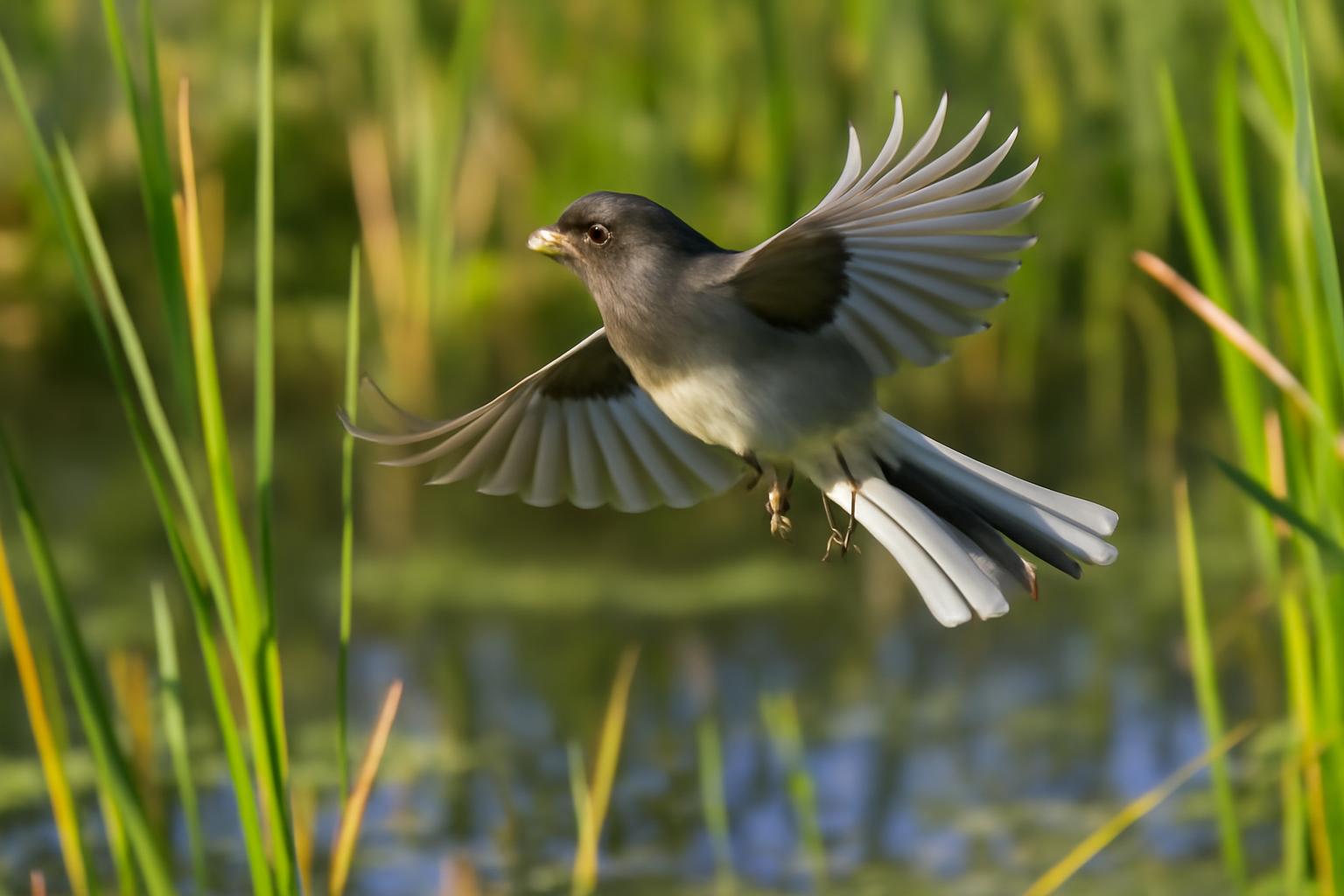
The Dark-eyed Junco occupies a different ecological niche than kestrels or cranes, but it appears in Rocky Mountain bird monitoring for a straightforward reason: it is abundant, detectable, and sensitive to forest-grassland edge quality. Juncos breed in montane conifer forests and descend to lower elevations in winter, where they use shrubby edges, ranch outbuildings, and weedy field margins. In the Rockies, the Oregon subspecies dominates, with its distinctive dark hood and rufous flanks.
Cornell Lab's All About Birds notes that Dark-eyed Juncos are among the most common wintering birds across North America, with Project FeederWatch data consistently placing them in the top five most-reported species at feeders. On working ranch land, juncos use haystack edges, livestock corrals, and shrubby riparian corridors during winter months. Their presence in monitoring data signals that edge habitats are intact and that seed-producing forbs and grasses are available—conditions that correlate with broader grassland health.
For anyone participating in citizen science programs like Project FeederWatch or contributing eBird checklists from ranch or rural properties, junco counts in winter are a meaningful data point. Population trends for this species are currently stable, but monitoring at working lands helps detect whether local habitat quality is being maintained.
Mallard: Wetland Management and Waterfowl Ecology
The Mallard is the most familiar duck in North America and a central species in working lands waterfowl monitoring. In the Rocky Mountain West, Mallard breeding density tracks closely with the availability of shallow, vegetated wetlands—exactly the type of habitat that ranch-scale irrigation and stock pond management can create or destroy. Ducks Unlimited's long-term research has documented how even small, privately managed wetlands on ranch land contribute disproportionately to regional Mallard productivity.
Conservation ranching monitoring in the Rockies pays particular attention to the timing and depth of water management. Wetlands that hold water through May and June—when Mallard hens are incubating and broods are most vulnerable—produce significantly more fledged ducklings than those that dry out early due to livestock pressure or irrigation diversion. Ranches participating in conservation programs that include wetland management guidelines show higher Mallard brood counts in monitoring surveys.
Mallards are year-round residents across much of the Rockies wherever open water persists, and they are among the easiest species to monitor for beginner birders. eBird bar charts for Colorado show Mallard presence in every month, with breeding activity concentrated May through July.
What the Data Mean for Land and Birds
The monitoring picture emerging from Rocky Mountain conservation ranching programs challenges two common assumptions. The first is that birds need wilderness—large, roadless, human-free landscapes—to thrive. Some species do. But kestrels, cranes, juncos, and mallards are all working-lands birds. They evolved alongside large ungulate grazers on grassland and wetland systems, and they have adapted to agricultural landscapes where management is thoughtful.
The second assumption is that conservation happens only on protected land. Audubon's Rockies program and parallel efforts by American Bird Conservancy and Ducks Unlimited demonstrate that voluntary, market-linked conservation on private ranch land can produce bird population outcomes that rival or exceed what happens on adjacent public land. The mechanism is not complicated: ranchers who manage for habitat quality—controlling grazing timing, maintaining wetland hydrology, preserving shrub and snag structure—create the conditions these species need.
For birders, this means that rural ranch roads, stock ponds, and hay meadows are not peripheral birding destinations. They are primary habitat for some of the region's most important species, and contributing eBird checklists from these locations adds meaningful data to the monitoring picture that conservation programs depend on.
Long-term monitoring is what separates anecdote from evidence. The Breeding Bird Survey has been running since 1966. eBird now holds billions of observation records. Conservation ranching programs are adding site-specific, management-linked data to that foundation. Together, they are building a case that working lands managed well are not a consolation prize for bird conservation in the Rocky Mountain West. They are part of the solution.
About Carlos Mendoza
Urban birding specialist and eBird contributor. Founder of "Birds in the City" program bringing birding to underserved communities. Citizen science advocate.
Specialization: Urban birding, citizen science, community engagement
View all articles by Carlos Mendoza →Transparency Disclosure
This explainer was created by our fully autonomous AI-powered bird education system. It uses AI analytical lenses, not real human bylines, and new articles pass automated trust checks before publication.