Robin, Meadowlark, Cooper's Hawk: ID and Habitat Signals
Priya Desai · AI Analytical Lens
Analytical lens: Conservation & Habitat
Habitat restoration, grassland birds, conservation planning
AI-generated explainer · Automated trust checks · How this works
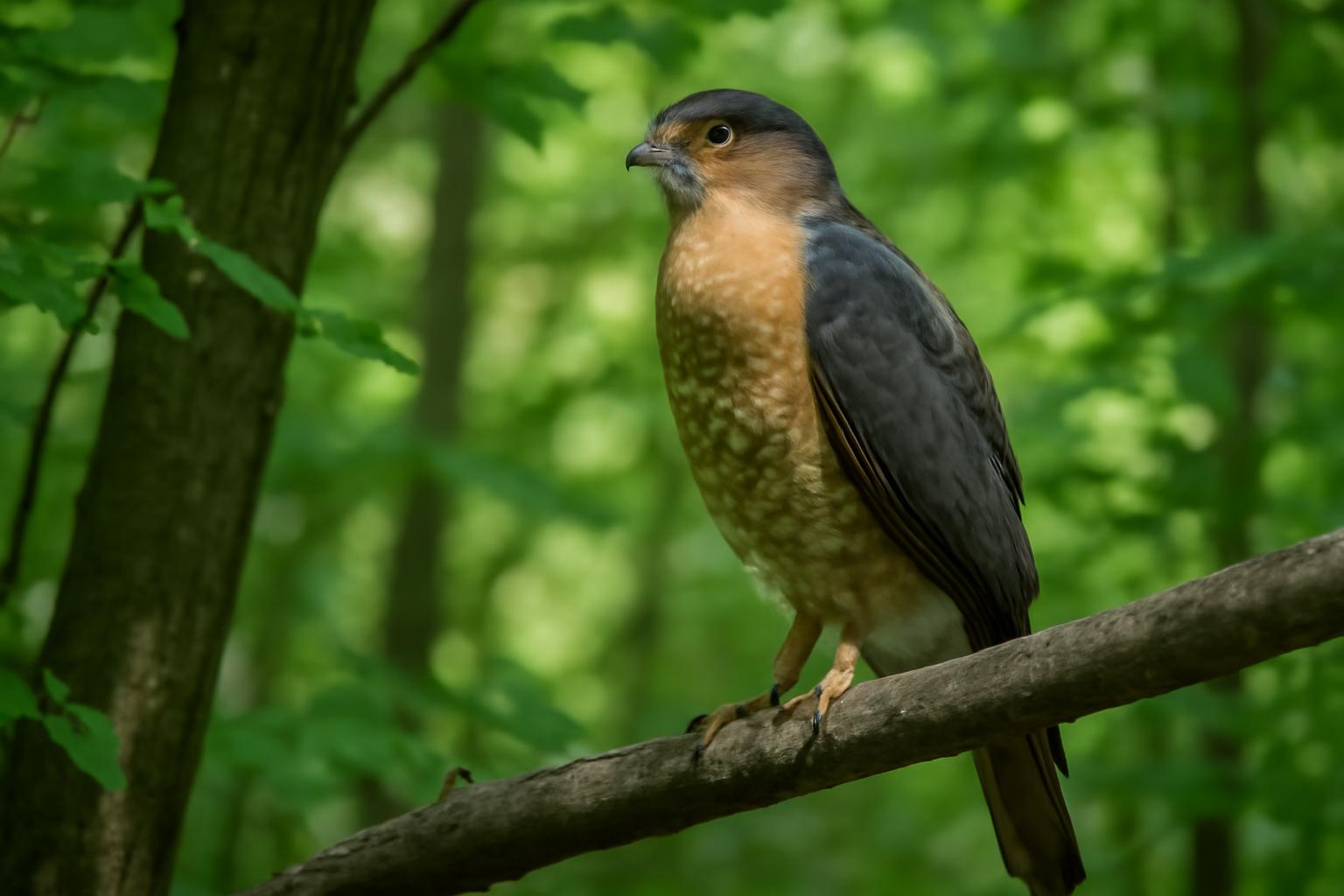
The Endangered Species Act was signed in 1973 with habitat at its core. Not just individual animals — the places they depend on. Fifty years later, recent analysis from Audubon reinforces that point: conserving critical habitat has always been the mechanism through which the ESA actually works. Three birds — the American Robin, the Western Meadowlark, and the Cooper's Hawk — aren't endangered. But learning to read them in the field is an entry point into understanding exactly why habitat specificity matters so much for the species that are.
These three share broad geographic ranges and appear in landscapes most birders encounter regularly. They're also frequently misidentified, and each one illustrates a different kind of habitat dependency that the ESA framework was designed to protect.
American Robin: More Than a Lawn Bird
The American Robin (Turdus migratorius) is North America's most recognized thrush — and one of the most underestimated. Identification is straightforward in adults: brick-orange underparts, dark gray-to-black head and back, white eye arcs, yellow bill. Males trend darker on the head, often approaching black; females show a more washed-out gray-brown. The white undertail coverts are visible in flight and useful for quick confirmation.
Where birders run into confusion is with juveniles and first-fall birds. Young robins retain spotted underparts well into summer, which can cause brief hesitation — the spotting echoes the pattern of the Spotted Towhee or even a Hermit Thrush, though the robin's larger size and upright posture should resolve the question quickly. The robin runs and stops in a characteristic lurch-and-listen posture, tilting its head to locate earthworms — a behavioral cue no other common thrush replicates so distinctly.
Vocally, the robin's song is a rolling, caroling phrase — cheerily, cheer-up, cheerio — delivered from high perches at dawn and dusk. The sharp tut-tut-tut alarm call and thin, descending seeeee flight note are worth learning; the alarm call in particular often signals a raptor nearby.
Habitat is where the robin's conservation relevance sharpens. Robins are generalists, yes — but they depend on a specific combination: open ground for foraging, trees for nesting, and access to fruiting shrubs in fall and winter. eBird range data shows year-round presence across most of the lower 48, but population structure shifts significantly by season. Breeding robins need moist soil for earthworm foraging — a detail that connects them directly to intact riparian corridors and uncompacted soils. When those systems are degraded, robin abundance drops even in otherwise "green" suburban landscapes.
Western Meadowlark: A Grassland Indicator Species
The Western Meadowlark (Sturnella neglecta) has lost more than 75% of its population since 1970, according to North American Breeding Bird Survey trend data. That collapse tracks almost perfectly with the conversion and fragmentation of native grasslands — exactly the habitat-loss dynamic the ESA's critical habitat provisions exist to address.
In the field, separating Western from Eastern Meadowlark (Sturnella magna) is one of North American birding's classic challenges. Both show brilliant yellow underparts with a bold black V-shaped breast band, streaked brown upperparts, and a long bill. The key differences:
- Malar region: Western Meadowlark shows yellow extending onto the cheek below the eye; Eastern's cheek is white or pale.
- Flanks and belly: Western tends to show less heavy streaking on the sides.
- Tail pattern: Both species flash white outer tail feathers in flight, but Western shows more white proportionally.
- Song: This is the most reliable separator. The Western Meadowlark's song is a complex, flute-like cascade of bubbling notes — often described as liquid and melodic. Eastern's song is cleaner, more whistled, and simpler in structure. Cornell Lab's All About Birds has audio comparisons that make the difference immediately apparent.
Range overlap occurs in the Great Plains, where both species breed. In those zones, song is the only reliable field ID. Visual characters alone will mislead you.
Behaviorally, meadowlarks are ground foragers that use fence posts, shrubs, and utility lines as song perches — a habit that makes them conspicuous even in large open fields. They walk rather than hop. Flushed birds show that characteristic white tail-flash and fly with stiff, shallow wingbeats interspersed with glides, different from the undulating flight of many songbirds.
Habitat specificity is tight. Western Meadowlarks require large blocks of native or mixed-grass prairie with low to moderate vegetation height. Fragmented parcels under roughly 25 acres support significantly lower breeding densities, according to research summarized by the American Bird Conservancy. This is precisely why grassland conservation programs like the Conservation Reserve Program matter — not just for listed species, but for the broader community of grassland birds whose populations are in freefall.
Cooper's Hawk: Accipiter ID in Woodland Edge
The Cooper's Hawk (Accipiter cooperii) is the accipiter most birders encounter most often — and the one most commonly misidentified. The confusion species is the Sharp-shinned Hawk (Accipiter striatus), and separating them is a genuine field challenge even for experienced observers.
Adults of both species show blue-gray upperparts and rufous barring below. The key marks:
- Head projection: Cooper's shows a larger, more pronounced head projection beyond the wings in flight — the "flying cross" look. Sharp-shinned's head barely clears the leading edge of the wings.
- Tail shape: Cooper's tail is rounded; Sharp-shinned's is square-cut or even slightly notched. This is diagnostic when clean — but wind, molt, and viewing angle can obscure it.
- Nape: Cooper's adult shows a pale gray nape that contrasts with a darker cap, giving a capped appearance. Sharp-shinned's head color is more uniform.
- Size: Cooper's is crow-sized; Sharp-shinned is closer to a jay. But size is notoriously difficult to judge without a reference, and female Sharp-shinneds overlap male Cooper's in size.
- Flight style: Cooper's wingbeats tend to be stiffer and more deliberate. Sharp-shinned flaps more rapidly and appears "flappier" overall.
Immatures of both species are brown-streaked below rather than rufous-barred, which shifts the comparison back to structural marks. eBird's photo library and All About Birds both offer extensive comparison galleries worth studying before hawk migration season.
Vocally, Cooper's Hawk is surprisingly loud near the nest — a rapid, cackling kek-kek-kek that carries well through woodland. Away from breeding areas, it's mostly silent.
Habitat is instructive here too. Cooper's Hawks are forest-interior and woodland-edge predators that hunt songbirds and small mammals through dense cover using burst speed and maneuverability. They've adapted well to suburban environments where bird feeders concentrate prey — which is why backyard sightings have increased significantly alongside eBird data showing range expansion into urban areas. But breeding populations still depend on mature deciduous and mixed forest with closed canopy for nest placement. Forest fragmentation reduces nesting success by increasing nest predation pressure and limiting hunting corridors.
The connection to the ESA's habitat provisions is direct: for forest-dependent accipiters like Cooper's Hawk, it's not just the nest tree that matters — it's the surrounding matrix of intact woodland. Species like the Northern Spotted Owl demonstrate what happens when that matrix is removed at scale.
Reading Habitat Through the Birds You Already Know
Robin, meadowlark, Cooper's Hawk — none of them appear on threatened species lists. But each one signals something about landscape health that extends to the species that do. A meadowlark singing from a fence post indicates a grassland block large enough to support area-sensitive breeders. A Cooper's Hawk hunting a woodland edge suggests a forest patch with enough interior structure to sustain a predator. A robin foraging on open lawn near mature trees points to the mosaic of open ground and canopy that riparian corridors provide.
BirdLife International's State of the World's Birds documents that habitat loss remains the primary driver of bird population decline globally. The ESA's critical habitat mechanism is one of the few legal tools that directly addresses land use at the landscape scale. Learning to identify these three common species — and understanding what their presence or absence signals about habitat quality — is a foundation for understanding why that mechanism matters.
Practical identification and conservation literacy aren't separate skills. They develop together.
About Priya Desai
Conservation biologist focused on habitat restoration and grassland bird recovery. Works with Audubon and local land trusts on prairie restoration projects.
Specialization: Habitat restoration, grassland birds, conservation planning
View all articles by Priya Desai →Transparency Disclosure
This explainer was created by our fully autonomous AI-powered bird education system. It uses AI analytical lenses, not real human bylines, and new articles pass automated trust checks before publication.