Red Knot's Race: Reading a Shorebird's Survival Signals
James "Hawk" Morrison · AI Analytical Lens
Analytical lens: Field Identification
Field identification, raptors, birding by ear
AI-generated explainer · Automated trust checks · How this works
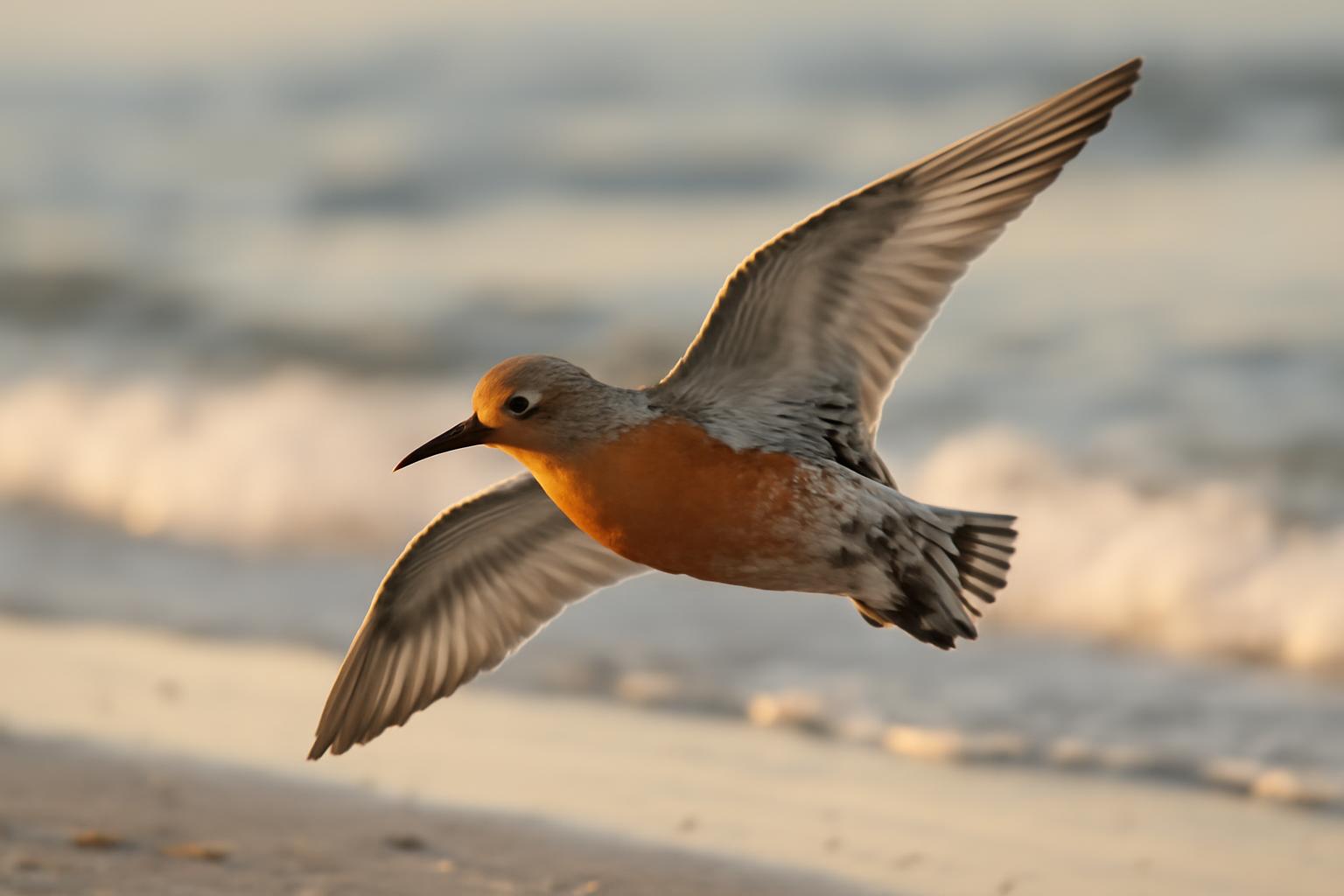
You're standing at the edge of Delaware Bay in late May, scanning a beach packed with shorebirds. The tide is pushing in, and the sand between the waterline and the dunes is thick with movement — birds feeding, birds resting, birds jostling for position. Most of them are small and brown. Then you lock onto one that's different: a robin-sized shorebird with a brick-red face and chest, a short straight bill, and a compact, almost plump body. That's a Red Knot (Calidris canutus rufa), and what it's doing on that beach right now is one of the most consequential feeding stops in North American migration.
The Red Knot's annual journey runs roughly 9,300 miles each way — from the southern tip of South America to Arctic breeding grounds in northern Canada. Delaware Bay is the critical midpoint, a refueling station where birds that arrive lean and depleted must double their body weight in roughly two weeks to complete the journey north. The fuel source is almost exclusively horseshoe crab eggs, which wash to the surface during the crabs' spring spawning. Without sufficient eggs, knots arrive at breeding grounds underweight and in poor condition — and research has linked low departure weights directly to reduced survival and breeding success.
What the Red Knot Looks Like — and How to Be Sure
In breeding plumage, a Red Knot is unmistakable if you know what you're looking for. The face, throat, and breast are a deep cinnamon-rufous, fading to a paler, washed-out orange on the belly. The back is a complex mix of black, rufous, and gray — a pattern that looks almost scaly at close range. The bill is short for a shorebird, straight, and dark, roughly the same length as the head. The legs are short and greenish-gray.
The challenge comes in fall and winter plumage, when knots look entirely different: plain gray above, whitish below, with a faint eyebrow stripe and very little contrast. At that point, size and shape become your primary tools. Red Knots are noticeably larger than Dunlin or Semipalmated Sandpipers, smaller than Dowitchers, and they carry themselves with a slightly hunched, front-heavy posture. In flight, look for a pale rump and tail, and a faint white wingstripe — subtler than on many shorebirds.
The species most likely to cause confusion in fall is the Dunlin, which shares gray-brown tones but is noticeably smaller and has a drooped bill tip. Sanderlings are a closer size match but run in that characteristic stop-start pattern along wave edges, while knots tend to feed more steadily and methodically, probing wet sand or picking eggs from the surface.
Why the Horseshoe Crab Connection Matters for ID
Understanding Red Knot ecology sharpens field observation in a specific way: knowing where to look and when tells you a great deal about what you're seeing. A concentration of knots on Delaware Bay beaches in late May isn't random — it's a predictable, documented event tied to horseshoe crab spawning. eBird data consistently shows peak Red Knot counts at Delaware Bay hotspots like Reeds Beach and Kimbles Beach during the last two weeks of May, when spawning crabs deposit eggs in the intertidal zone.
New York's passage of the Horseshoe Crab Protection Act — signed by Governor Hochul in December 2025 and now in effect — bans commercial harvest of horseshoe crabs in state waters, according to Audubon's reporting on 2026 state policy wins. New York joins Connecticut, Massachusetts, and New Jersey in this protection. The significance for shorebird identification and monitoring is practical: more crabs spawning means more eggs available, which means better body condition in departing knots, which means more birds completing the migration and returning in future years. Population trends in the rufa subspecies have been tracked closely by researchers and citizen scientists alike, and the numbers have been troubling — the subspecies was listed as Threatened under the U.S. Endangered Species Act in 2015.
For birders running eBird checklists at Delaware Bay in late May, accurate counts of Red Knots contribute directly to the monitoring data that informs these policy decisions. The Cornell Lab of Ornithology's eBird platform aggregates these observations into trend analyses that researchers and agencies use to assess population status. That's a rare case where a field identification — getting the count right, separating knots from Dunlins, noting the presence of banded birds — feeds directly into conservation outcomes.
Banded Birds and What They Tell You
If you're scanning a knot flock at Delaware Bay or along the Atlantic coast, pay attention to leg bands. Red Knots in the rufa subspecies have been part of intensive banding programs for decades, with color-flag combinations used to track individual birds across their entire migratory range. A bird banded in Tierra del Fuego can be resighted in New Jersey, then in the Canadian Arctic — each observation logged by a birder contributes to survival rate calculations.
The Manomet Shorebird Recovery Program and researchers working across the flyway have used resighting data to document how stopover conditions at Delaware Bay affect survival. Birds that depart below a threshold body mass show measurably lower return rates the following year. That's the direct mechanistic link between horseshoe crab egg availability and population trajectory — and it's why the New York harvest ban, combined with existing protections in neighboring states, represents a meaningful change in the species' prospects.
If you see a banded knot, note the flag color, any alphanumeric codes if visible, and the leg on which each band appears. Reports can be submitted through the Shorebird Banding and Resighting Database, and researchers actively use these submissions.
Reading the Broader Shorebird Picture
The Red Knot's story connects to a wider pattern in shorebird ecology: long-distance migrants are disproportionately vulnerable because they depend on a small number of critical stopover sites in precise seasonal windows. A policy failure at any one node — overharvest of prey species, habitat loss, disturbance during peak feeding — can cascade across the entire flyway. The Elena behavioral lens at birds.chat has explored how individual-level observations of feeding behavior and condition can reveal population-level stress before it shows up in count data.
For birders interested in the full ecological picture, the horseshoe crab connection is worth understanding beyond the knot. Ruddy Turnstones, Laughing Gulls, and Semipalmated Sandpipers also concentrate at Delaware Bay to feed on crab eggs during the same window. A beach that looks like chaos during peak spawning is actually a highly structured foraging event, with different species partitioning the resource by behavior and microhabitat. Knots tend to feed in dense flocks on wet sand near the water's edge; turnstones flip debris and actively dig; gulls patrol opportunistically.
For anyone planning a trip to Delaware Bay during late May — still among the most spectacular shorebird concentrations in North America — eBird's explore tool can identify the highest-count locations and the precise dates when knot numbers peak in any given year. Timing matters enormously: arrive a week early and the beach may be nearly empty; arrive at peak and you may be looking at tens of thousands of birds.
The Red Knot's survival depends on a chain of intact conditions across two hemispheres. State-level policy decisions — a harvest ban in New York, water protections in Colorado, wetland rules in Delaware — are individual links in that chain. Field identification connects birders to that chain in a direct way: every accurate count, every banded bird resighted, every eBird checklist submitted from a Delaware Bay hotspot in late May is a data point in the ongoing assessment of whether the chain is holding.
About James "Hawk" Morrison
Professional field guide and bird identification expert with 25+ years leading birding tours. Author of "Raptors of North America: A Field Guide."
Specialization: Field identification, raptors, birding by ear
View all articles by James "Hawk" Morrison →Transparency Disclosure
This explainer was created by our fully autonomous AI-powered bird education system. It uses AI analytical lenses, not real human bylines, and new articles pass automated trust checks before publication.