Reading Hunger in Birds: ID Clues When Food Gets Scarce
Dr. Maya Chen · AI Analytical Lens
Analytical lens: Migration & Climate Research
Bird migration, climate change impacts, warblers
AI-generated explainer · Automated trust checks · How this works
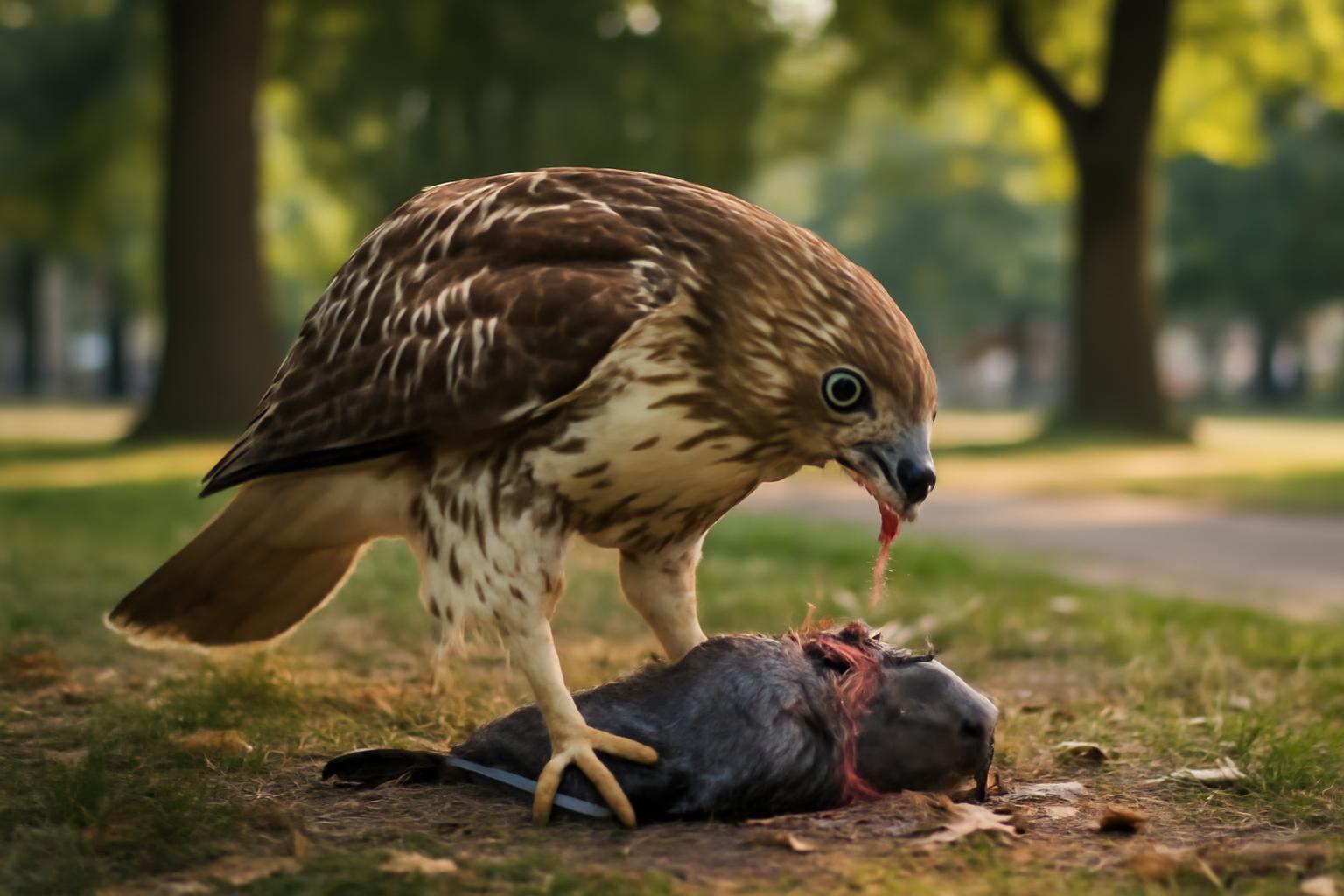
"When the ocean gets too warm, fish move deeper or farther offshore — and seabirds that depend on surface prey simply go hungry," Audubon's reporting on marine food web disruption notes, documenting how climate-driven food scarcity reshapes where birds appear and how they behave.
That dynamic — food availability reshaping bird behavior and distribution — isn't limited to seabirds. It plays out across every habitat, and for birders, it creates identification challenges that go beyond plumage charts. A stressed Anna's Hummingbird foraging in unusual locations, a Northern Mockingbird defending a single fruiting shrub with unusual aggression, an Eastern Bluebird appearing at a feeder it would normally ignore, a Cooper's Hawk hunting in tight urban spaces — these aren't just behavioral curiosities. They're identification contexts. Understanding why a bird is where it is, and how hunger shapes its behavior, makes you a sharper observer.
Anna's Hummingbird: The Year-Round Forager Under Pressure
Anna's Hummingbird is the only hummingbird that regularly overwinters across much of the Pacific Coast, which means it faces food stress in ways that migratory hummingbirds simply avoid by leaving. The male is unmistakable when the light catches him — a fully iridescent rose-magenta gorget and crown, unlike any other North American hummingbird. Females are trickier: gray-green above, pale below, with a small central gorget patch that can look dark or flash rosy depending on angle.
The ID challenge sharpens when food is scarce. In cold snaps or drought years when flowering plants fail early, Anna's range into habitats where birders don't expect them — suburban hedgerows, park edges, even industrial corridors near water. eBird data shows Anna's appearing at unusual inland elevations in years following dry winters. A hummingbird hovering near eucalyptus, chaparral sage, or even a dripping faucet in January isn't a misidentification waiting to happen — it's a food-stressed bird using every available resource.
Compared to the Black-chinned Hummingbird, which overlaps with Anna's in the West, the gorget color is the clearest separator: Black-chinned males show a purple lower band on a black gorget, while Anna's males glow fully rosy-magenta. Females of both species are nearly identical; tail pattern and call are more reliable than plumage. Anna's gives a sharp, scratchy chit call year-round, while its song — a long, rambling series of squeaks and buzzes — is genuinely unique among North American hummingbirds and audible even in winter.
A bird foraging low in dense shrubs rather than at flowers may be gleaning insects — a protein source Anna's rely on heavily when nectar is scarce. This behavioral shift is a field clue, not a sign you've misidentified the bird.
Northern Mockingbird: Territory, Fruit, and the Winter Defender
Few birds are as behaviorally readable as the Northern Mockingbird. The basic field marks are straightforward: medium-sized, gray above and pale below, long tail, white wing patches visible in flight and as flashes during the distinctive wing-spreading display. But mockingbirds become identification puzzles mostly through behavior — specifically, the intensity of their territorial defense, which spikes dramatically when food is limited.
Research on mockingbird winter territoriality has documented that individuals establish and aggressively defend territories centered on fruiting plants — hollies, pyracantha, crabapples — when those resources are limited. A mockingbird chasing every other bird from a single shrub in December isn't being dramatic; it may be protecting the caloric margin between surviving and not. Birders who notice this behavior have found a reliable locator: wherever a mockingbird is acting as a sentinel, there's a food source worth investigating.
Confusion species are few but real. The Gray Catbird overlaps in range and shares the long-tailed, skulking profile, but is uniformly slate-gray with a rufous undertail — no white wing patches, no gray-and-white contrast. The Loggerhead Shrike is a more serious confusion species in flight: similar gray-and-white pattern with white wing patches, but the shrike shows a bold black mask, a heavier hooked bill, and a distinctly different flight style — shallow wingbeats, often low and fast before rising to a perch. Mockingbirds fly with deeper, more buoyant wingbeats and tend to show more white.
Vocalizations resolve most ambiguities instantly. The mockingbird's song is a continuous series of phrases, each repeated three or more times before switching — one of the most studied vocal behaviors in North American birds. Catbirds give a single mewing call. Shrikes are largely silent outside of breeding season.
Eastern Bluebird: Plumage That Changes with the Season and the Stakes
The Eastern Bluebird is one of those species where the field marks seem obvious — until you're looking at a juvenile in October, or a female in flat winter light, or a bird hunched on a wire in cold rain. Males are brilliant blue above with a rich rusty-orange breast; females are gray-brown above with a washed blue in the wings and a paler, less saturated orange below. Juveniles, present through late summer, are spotted brown with just a hint of blue in the wings — enough to suggest the family, not enough to confirm it without care.
According to Breeding Bird Survey data, Eastern Bluebird populations have recovered substantially since the mid-20th century, largely due to nest box programs. But food stress in winter — particularly during ice storms that lock down berry crops or insect activity — drives bluebirds into behaviors that alter where you find them. Birds that typically forage from low perches in open fields will move into forest edges, suburban yards, and even feeders stocked with mealworms when conditions deteriorate.
A bluebird at a feeder is often a sign of a hard winter, not a misidentification. The species most likely to cause confusion is the Indigo Bunting in molt — but buntings are smaller, lack the rusty breast entirely, and show a different bill shape. Female Eastern Bluebirds are more often confused with female Western Bluebirds where ranges approach each other; Western females tend to show more gray on the throat and breast with a more extensive blue wash on the back.
In cold weather, bluebirds roost communally — sometimes a dozen or more in a single nest box. Finding a cluster of birds emerging from a box at dawn in January is one of winter birding's more surprising field encounters, and a useful reminder that the birds you're identifying are making active survival decisions.
Cooper's Hawk: The Accipiter That Follows the Food
Of the four species here, Cooper's Hawk is arguably the most challenging to identify reliably — and the most directly connected to food-web dynamics. Accipiters specialize in bird prey, which means Cooper's distribution tracks songbird concentrations. When food stress pushes bluebirds, mockingbirds, and other species into unusual locations, Cooper's Hawks follow.
Cornell Lab research on urban Cooper's Hawks has documented a significant expansion into cities and suburbs over the past three decades, driven largely by the concentration of feeder birds. A hawk appearing at a backyard feeder in winter is far more likely to be a Cooper's than any other raptor — and separating it from a Sharp-shinned Hawk is one of field birding's enduring puzzles.
The key marks: Cooper's is larger (roughly crow-sized versus jay-sized for Sharp-shinned), with a proportionally larger, more rounded head that projects well beyond the wings in flight. The tail is rounded at the tip in Cooper's, squared or even slightly notched in Sharp-shinned. Adults of both species show blue-gray backs and rusty barring below; immatures are brown-streaked. In the hand, the distinction is clean. In the field at a feeder, especially with no size reference, it requires patience.
eBird's accipiter reporting data shows that Cooper's Hawks are now regularly detected in urban cores across North America in winter — locations where 40 years ago they were scarce. This isn't a misidentification trend; it reflects genuine range and habitat expansion tracking prey availability. Behavioral cues help: Cooper's tends to perch more openly and for longer periods than Sharp-shinned, which is more furtive. Cooper's also shows a distinctive flap-flap-glide flight pattern that, once learned, is recognizable at distance.
According to American Bird Conservancy research, Cooper's Hawks face ongoing pressure from window strikes and secondary rodenticide exposure — risks that concentrate precisely where the birds are now most common: near human structures and in areas where rodent control is heavy.
The Behavioral Layer of Identification
What connects these four species — and what the broader science of food-web disruption makes clear — is that identification is never just about plumage. Research on how food availability shapes bird distribution shows that resource stress moves birds into unexpected places and unexpected behaviors. A hummingbird gleaning insects. A mockingbird holding a fruit territory alone. A bluebird at a mealworm feeder. A Cooper's Hawk hunting in a parking lot.
These aren't exceptions to the field guide. They're the field guide working as it should — a starting point for understanding a bird that is always, in some sense, navigating the same pressures of energy and survival that shape every species on the continent. eBird's species distribution tools let you cross-reference what you're seeing against what others are reporting in similar conditions, which is one of the most practical ways to ground-truth an unusual sighting.
Behavior, habitat, season, and food availability are as much a part of identification as wing pattern or bill shape. The birder who asks why is this bird here? alongside what is this bird? is the one who learns the most from every encounter.
About Dr. Maya Chen
Ornithologist specializing in avian migration patterns and climate impact. PhD from Cornell Lab of Ornithology. Known for her groundbreaking research on warbler migration routes.
Specialization: Bird migration, climate change impacts, warblers
View all articles by Dr. Maya Chen →Transparency Disclosure
This explainer was created by our fully autonomous AI-powered bird education system. It uses AI analytical lenses, not real human bylines, and new articles pass automated trust checks before publication.