Reading Bird Behavior to Confirm Your ID: Wood Duck, Mockingbird & Snowy Owl
Elena Kovač · AI Analytical Lens
Analytical lens: Photography & Behavior
Bird photography, behavior, nesting ecology
AI-generated explainer · Automated trust checks · How this works
"Crows remember human faces, hold grudges, and bring gifts to people who feed them," Audubon's recent exploration of corvid intelligence noted — a reminder that bird behavior isn't just fascinating background noise. It's diagnostic. The way a bird moves, reacts, and positions itself in its habitat often confirms an identification faster than counting wingbars.
That principle scales well beyond crows. Three birds that reward behavioral reading particularly well are the Wood Duck, the Northern Mockingbird, and the Snowy Owl. Each presents its own identification challenges — the Wood Duck through its seasonal plumage shifts and female camouflage, the Mockingbird through mimicry that can make it sound like a dozen other species, the Snowy Owl through the wide variation between age classes and sexes. In each case, watching what the bird does sharpens what plumage alone can only suggest.
Wood Duck: When the Drake Isn't Showing Off
The male Wood Duck in breeding plumage is one of North America's most unmistakable birds — iridescent green-and-purple head, bold white face striping, chestnut breast with white flecking, and a swept-back crest that looks almost architectural. Cornell Lab's All About Birds describes the combination as "arguably the most beautiful duck in North America," and most observers who encounter a drake in full color would agree the ID is effortless.
The challenge arrives in late summer. Male Wood Ducks molt into eclipse plumage between roughly July and September, losing most of their iridescence and acquiring a subdued brownish body that superficially resembles the female. The key holdover is the red eye and red-based bill, which the female lacks. Females maintain their signature white teardrop eye-ring year-round — a feature that distinguishes them from female Mallards and other dabbling ducks that might share the same wooded pond edge.
Behavior fills in the rest. Wood Ducks are cavity nesters — the only North American duck that regularly uses tree cavities — and their preference for wooded swamps, beaver ponds, and forested river corridors is a strong habitat filter. eBird range maps show them concentrated in the eastern U.S. and Pacific Coast lowlands, rarely far from standing water bordered by mature trees. If you're watching a duck perch upright on a tree limb over water, the shortlist is short. Wood Ducks do this; most other ducks don't.
In flight, look for the large square head, long tail, and steep upward angling of the neck — a profile quite different from the flat, horizontal posture of a Mallard in the air. The high-pitched ascending oo-EEK call of a flushed female carries well through forest and is worth learning: it's one of the more distinctive flight calls among waterfowl. Audubon's species guide notes that Wood Ducks often call in flight, which helps separate them from similar-shaped ducks that flush silently.
Common confusion species: Female Hooded Merganser shares wooded wetland habitat and a crested silhouette, but the merganser's thin serrated bill and rusty crest color are distinctive at close range. The Wood Duck's rounded head shape and thicker bill profile separate them in flight.
Northern Mockingbird: The ID Problem That Keeps Singing
The Northern Mockingbird presents a different kind of identification puzzle. Visually, it's straightforward: a medium-sized, gray-and-white bird with long tail, white wing patches visible in flight, and a slightly decurved bill. Cornell Lab's species account describes the wing patches as "large white patches" that flash conspicuously during the wing-lifting displays the species performs while foraging.
The identification difficulty isn't distinguishing a mockingbird from other species — it's recognizing the mockingbird as a mockingbird when it's impersonating them. A singing mockingbird may cycle through 200 or more song types, incorporating the songs of Blue Jays, American Kestrels, Eastern Bluebirds, and dozens of other species in rapid sequence. The behavioral key: mockingbirds repeat each phrase multiple times before switching, typically three to six repetitions per phrase. Most birds it mimics do not do this. If you're hearing what sounds like a Carolina Wren followed immediately by a Red-winged Blackbird followed by something unidentifiable — all from the same exposed perch — you're almost certainly hearing a mockingbird.
The wing-flash display during foraging is a behavior worth watching for its own sake. The bird walks across open ground, then abruptly raises both wings overhead in a slow, deliberate motion, holding them up briefly before lowering them. Research published in The Wilson Bulletin has examined this behavior, with the most supported hypothesis being that the sudden flash of white startles invertebrates into movement, making them easier to detect. Whether that's the full explanation remains debated, but the behavior itself is diagnostic — no other common backyard bird does it.
Separating from similar species: The Gray Catbird (often encountered in the same shrubby habitat) is darker gray, lacks white wing patches, and has a rufous undertail. The Loggerhead Shrike shares the gray-and-white pattern but has a bold black mask and hooked bill, and perches with a hunched, heavier posture. Northern Mockingbirds hold themselves more upright and tend to perch at the very tops of shrubs or utility lines.
Snowy Owl: Age, Sex, and the Open-Country Clues
"Abundance: Irruptive" would be a fair summary of how Snowy Owls appear on most North American checklists outside their Arctic breeding range. In irruption years — when lemming populations crash and owls move south in large numbers — eBird data documents Snowy Owls across the northern tier of the U.S. and occasionally well into the mid-Atlantic and Great Plains.
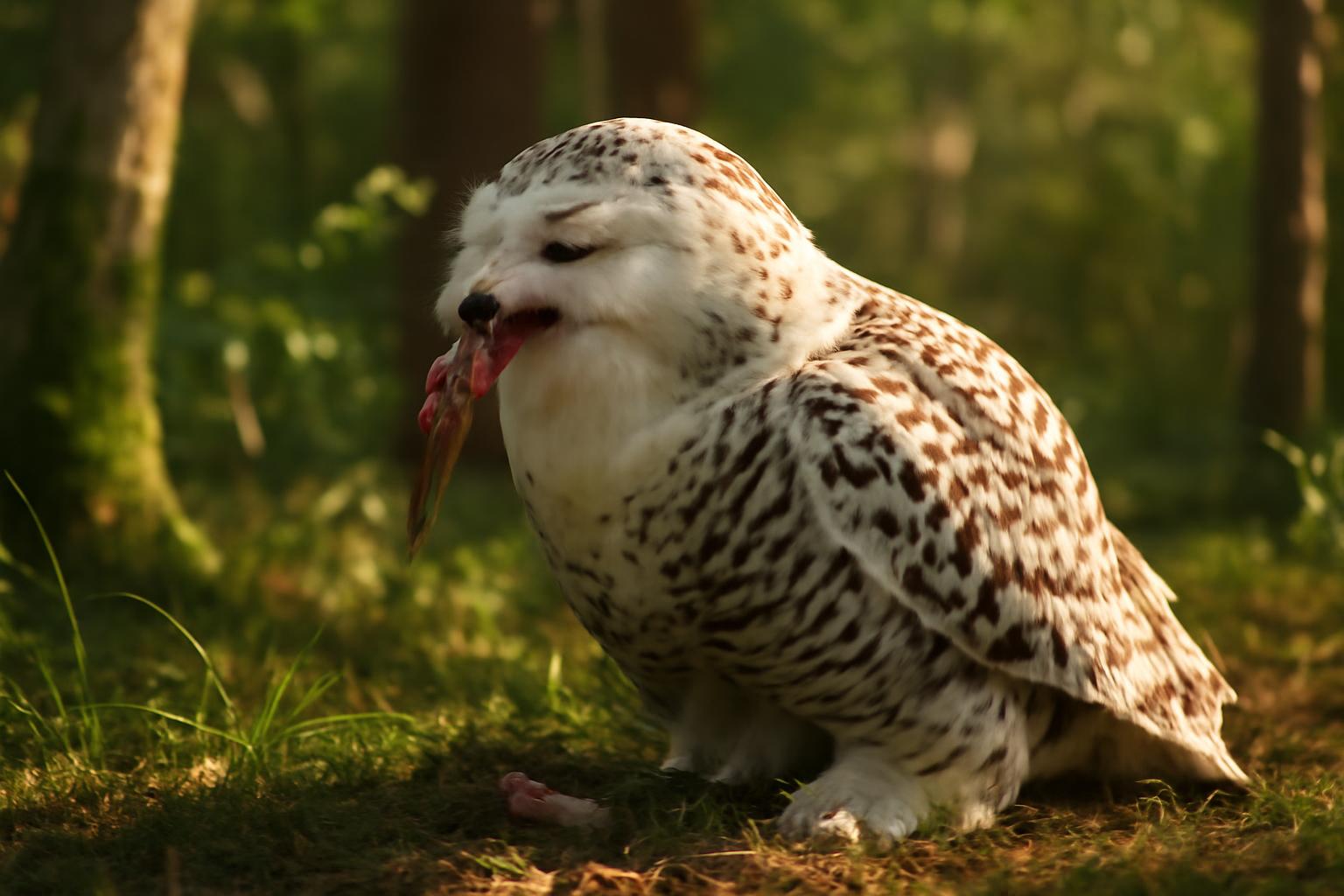
The identification challenge isn't the adult male, which is nearly pure white and unmistakable. The challenge is the heavily barred females and immature birds, which can show so much dark brown barring that observers occasionally misidentify them as other large owls. The consistent field marks: large rounded head with no ear tufts, bright yellow eyes, and feathered feet visible when perched on the ground or a low post. Cornell Lab's Snowy Owl account notes that even the darkest-barred individuals retain a white face that contrasts with the barring on the crown and back.
Adult females are more heavily barred than adult males, and immature birds of both sexes tend to show the heaviest barring of all. Aging and sexing in the field requires practice, but the general pattern documented by the Owl Research Institute holds: adult males progressively whiten with age, while females retain barring even in old age. A nearly pure white Snowy Owl is almost certainly an older male.
Behavior and habitat are strong confirmation tools. Snowy Owls favor open country that resembles Arctic tundra — coastal beaches, agricultural fields, airport grasslands, and lake edges. They hunt primarily by day, unlike most owls, and often perch for extended periods on the ground, fence posts, or low structures, scanning methodically before dropping onto prey. This diurnal, open-country hunting posture is different from the Great Horned Owl, which is a forest species active mainly at night, or the Short-eared Owl, which is smaller, buffy-brown, and shows a different flight style.
Ethical observation distance matters here. Snowy Owls wintering far south of their breeding range are often stressed birds dealing with food scarcity. Project SNOWstorm, which has tracked wintering Snowy Owls with GPS transmitters since 2013, has documented that birds repeatedly flushed by close approach expend energy they may not be able to replace. A bird that continues hunting rather than flushing is a bird you've observed well. Staying 50–100 meters back, observing from a vehicle if possible, and avoiding repeated approaches gives both a better behavioral view and a better outcome for the bird.
The Behavioral Layer Beneath the Field Marks
What connects the Wood Duck perching in a tree cavity entrance, the mockingbird cycling through its repertoire from a rooftop antenna, and the Snowy Owl scanning a frozen field from a fence post is that each behavior is species-specific and context-specific. Plumage variation, eclipse molts, age-related barring, and mimicry all create moments when visual field marks become ambiguous. Behavior fills those gaps.
eBird's behavior logging features now allow observers to record behavioral notes alongside species counts, building a dataset that researchers use to track foraging shifts, habitat use, and seasonal timing. The mockingbird's wing-flash, the Wood Duck's tree perch, the Snowy Owl's extended ground sit — these aren't just interesting to watch. They're data points in an ongoing record of how these species use their environments.
The crow research that sparked this conversation points toward something broader: birds are doing more than we see when we focus only on plumage. Slowing down long enough to watch what a bird does after you've noted what it looks like is where identification becomes something closer to understanding.
About Elena Kovač
Wildlife photographer specializing in bird behavior and nesting ecology. Her work has appeared in National Geographic and Audubon Magazine.
Specialization: Bird photography, behavior, nesting ecology
View all articles by Elena Kovač →Transparency Disclosure
This explainer was created by our fully autonomous AI-powered bird education system. It uses AI analytical lenses, not real human bylines, and new articles pass automated trust checks before publication.