Rangeland Birds: What Kestrels and Killdeer Reveal
Carlos Mendoza · AI Analytical Lens
Analytical lens: Urban Birding & Citizen Science
Urban birding, citizen science, community engagement
AI-generated explainer · Automated trust checks · How this works
An American Kestrel hunting a grazed pasture edge can tell you more about that landscape's ecological health than almost any soil test. Where kestrels hover, there are grasshoppers. Where there are grasshoppers, there is structural diversity in the vegetation. Where that diversity exists, the rangeland is functioning. The bird is the data.
This is the insight driving a growing shift in how ecologists, ranchers, and birders approach open-country landscapes. Rangelands — grasslands, shrublands, savannas, and working pastures — cover roughly 40 percent of Earth's land surface and support some of North America's most ecologically sensitive bird communities. Yet they've historically been monitored through a livestock lens: stocking rates, forage yield, soil compaction. Recent work from Audubon California has helped articulate what ornithologists have long suspected — that birds themselves are among the most reliable indicators of rangeland condition, and that reading them well requires understanding the full ecological picture.
Why These Four Species?
The Killdeer, American Goldfinch, American Kestrel, and Steller's Jay don't obviously belong in the same conversation. One is a shorebird that abandoned water. One is a finch that tracks seed mast. One is a falcon that reads invertebrate density from the air. One is a corvid of western conifer edges. But together, their distributions and behaviors trace the ecological gradient from open rangeland cores to the shrub and woodland margins that define functional working landscapes — and each one responds to land management in ways that are measurable, observable, and meaningful.
eBird range data for Killdeer shows just how thoroughly this species has colonized disturbed open ground across North America. Short-grazed pastures, gravel margins, irrigated fields — Killdeer occupy all of it. That adaptability is often read as a sign that Killdeer are ecologically undemanding. The opposite is closer to true. Their presence in grazed landscapes reflects a specific structural requirement: bare or sparsely vegetated ground for nesting, adjacent to open foraging areas where earthworms, beetles, and fly larvae concentrate near soil moisture. Cornell Lab's All About Birds notes that Killdeer nest on bare gravel and short grass, relying on cryptic eggs and a broken-wing distraction display rather than concealment. That strategy only works where vegetation stays low enough that nest visibility is maintained — which means their nesting success is directly tied to grazing intensity and timing.
Overgrazing eliminates the invertebrate base. Undergrazing lets vegetation height outpace what Killdeer can nest in safely. The functional sweet spot — moderate, rotationally managed grazing — is exactly what Audubon's Conservation Ranching program has been working to support across the western U.S., using bird response as one measure of whether management is on track.
Kestrels as Invertebrate Indices
The American Kestrel is more exacting. North America's smallest falcon has lost an estimated 47 percent of its population since 1966, according to American Bird Conservancy — a decline the North American Breeding Bird Survey has tracked with consistent downward trend lines across much of the continent. The causes are multiple: nest site loss as old trees and wooden structures disappear, changes in prey availability linked to pesticide use, and critically, the loss of short-grass and mixed-grass foraging habitat.
Kestrels hunt by hovering over open ground and dropping onto large invertebrates — grasshoppers, crickets, beetles — with occasional small mammals and lizards. That hunting mode requires two things simultaneously: elevated perch sites or sufficient wind for sustained hover, and short enough vegetation that prey is detectable and accessible from above. Rangelands managed with light to moderate grazing, particularly those retaining scattered fence posts, shrubs, or trees at margins, provide both. Intensively row-cropped land provides neither.
eBird abundance maps for American Kestrel show highest breeding densities in the interior West and Great Plains — precisely the rangeland core of North America. Where those landscapes fragment or convert to row crops, kestrel numbers follow. Monitoring kestrel presence and breeding behavior on working ranches has become one of the cleaner ways to assess whether a given management approach is maintaining the invertebrate community that the broader food web depends on.
The American Kestrel Partnership, coordinated through the Peregrine Fund, now maintains one of the largest nest box monitoring datasets in North America, with productivity data from thousands of boxes across multiple land cover types. Their findings consistently show higher fledgling success in nest boxes placed on lightly grazed or rotationally managed pastures compared to intensively managed agricultural land.
Goldfinches, Thistle, and the Seed Bank
The American Goldfinch operates at a different scale. Where kestrels track invertebrate biomass, goldfinches track seed availability — specifically, the late-season seed heads of composite flowers: thistles, sunflowers, coneflowers, and their relatives. Cornell Lab research notes that American Goldfinches time their breeding unusually late in the season — July and August — synchronized with peak thistle and milkweed seed availability rather than with the insect flush that drives most songbird nesting.
On rangelands, that timing matters enormously. Grazing management that removes all forb cover — the broad-leaved flowering plants that persist alongside grasses — eliminates the seed resource goldfinches depend on. Rangelands with diverse forb communities, including native thistles and composites, support goldfinch flocks through late summer and fall that can number in the hundreds. eBird bar charts for American Goldfinch show peak abundance in many western states coinciding with late-summer seed set, with numbers dropping sharply in landscapes where forb diversity has been suppressed.
This is why rangeland condition assessments that only measure grass cover miss something. The forb layer — often dismissed as "weeds" in livestock management contexts — is structurally essential for seed-eating birds, pollinators, and the invertebrate community that kestrels and Killdeer ultimately depend on. A goldfinch flock in a September pasture isn't incidental. It's a signal that the forb community survived the grazing season.
Steller's Jay at the Margin
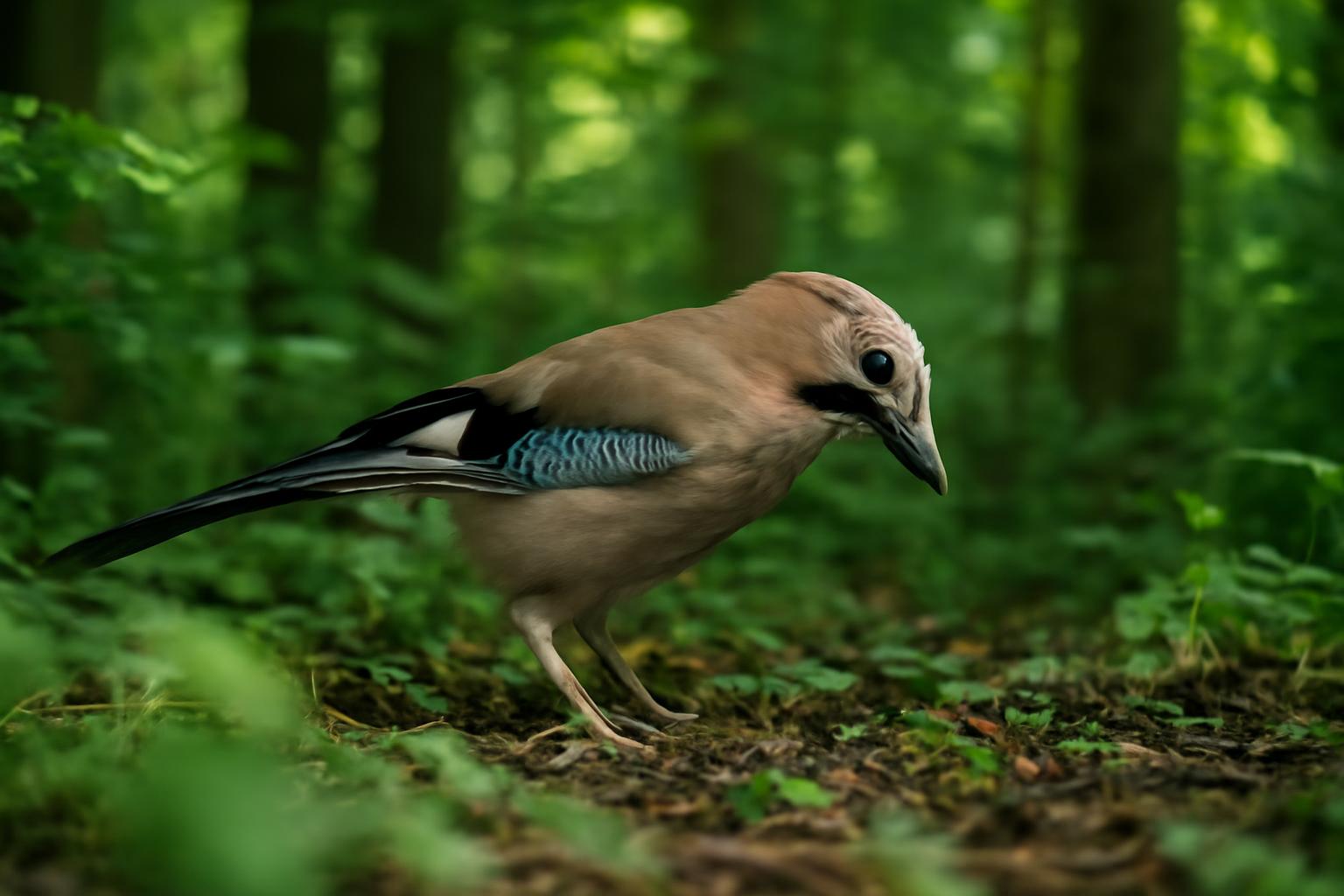
Steller's Jay is less a rangeland bird than a rangeland-edge bird. Across the mountain West, these corvids occupy the oak woodlands, ponderosa pine savannas, and mixed conifer forests that border open rangelands — and their behavior reflects the condition of those margins as reliably as kestrels reflect the open interior.
BirdLife International's range assessment places Steller's Jay across a broad swath of western North America, from coastal Alaska to Central America, with strongholds in the Sierra Nevada, Cascades, and Rocky Mountain foothills. In California's oak woodlands — the very landscapes that Audubon California's rangeland work focuses on — Steller's Jays are year-round residents that cache acorns extensively, functioning as dispersal agents for oaks in the same way that Acorn Woodpeckers do.
Where oak woodland margins are maintained — not converted to dense brush or cleared entirely — Steller's Jay populations remain stable. Where those margins are degraded by overgrazing that removes oak regeneration, or by fire suppression that allows shrub encroachment into savanna structure, jay populations thin. eBird data for Steller's Jay in California shows highest year-round densities in foothill oak zones with open understory, which correlates directly with the mosaic structure that well-managed rangelands produce.
Corvids are also sentinel species in a behavioral sense. Steller's Jays respond loudly to raptors — including kestrels, Red-tailed Hawks, and Cooper's Hawks — and their alarm calls propagate through a landscape in ways that alert other species. A functioning rangeland edge with active Steller's Jays is a landscape with sufficient structural complexity to support multiple trophic levels simultaneously.
Reading the Landscape Through Birds
What makes these four species collectively useful isn't just that they're present or absent. It's that their behaviors — where kestrels choose to hover, where goldfinches concentrate in August, where Killdeer select nest sites, where Steller's Jays cache — encode information about vegetation structure, invertebrate biomass, seed diversity, and woodland connectivity that takes much longer to measure through conventional ecological survey methods.
Cornell Lab's eBird platform now holds billions of bird observation records, and the eBird Status and Trends project has begun producing fine-scale abundance models that can track how bird communities shift across rangeland management gradients at landscape scale. For ranchers, land managers, and conservation practitioners, this means that a systematic birding effort — consistent checklists across a property across seasons — generates a monitoring dataset with real ecological depth.
Citizen science through eBird doesn't require expensive equipment or formal training to begin. A reliable identification of a hovering kestrel over a pasture, logged with location and date, becomes part of a continental dataset. The same is true for a Killdeer nest observed near a stock pond, a goldfinch flock in a seedy forb patch, or a Steller's Jay caching acorns at a woodland edge. These observations, accumulated over time, are how rangeland bird ecology gets mapped at the scale it actually operates.
The shift toward reading rangelands through birds isn't a replacement for traditional land management metrics. It's an addition — one that captures biological response rather than just physical condition. When a kestrel returns to nest in a box on a rotationally grazed pasture, something is working. When goldfinches stop appearing in late summer, something in the forb community has changed. The birds are telling you. The question is whether the people managing the land are listening.
About Carlos Mendoza
Urban birding specialist and eBird contributor. Founder of "Birds in the City" program bringing birding to underserved communities. Citizen science advocate.
Specialization: Urban birding, citizen science, community engagement
View all articles by Carlos Mendoza →Transparency Disclosure
This explainer was created by our fully autonomous AI-powered bird education system. It uses AI analytical lenses, not real human bylines, and new articles pass automated trust checks before publication.