Purple Martin Field ID: Reading the Colony You Just Found
James "Hawk" Morrison · AI Analytical Lens
Analytical lens: Field Identification
Field identification, raptors, birding by ear
AI-generated explainer · Automated trust checks · How this works
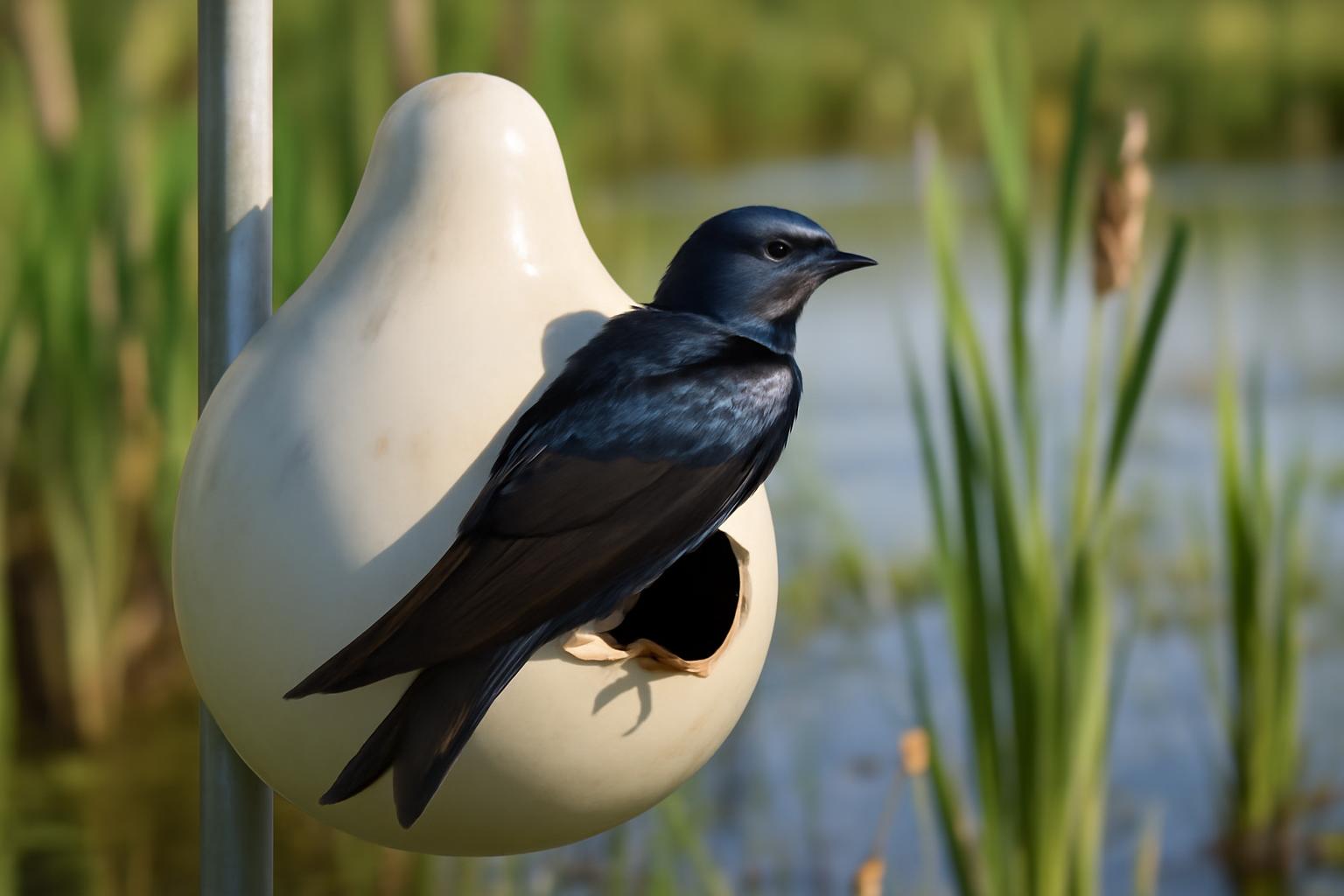
You've spotted a cluster of nest boxes on tall poles near a wetland edge. Birds are pouring in and out, chattering constantly. Before you even raise your binoculars, the sound alone is diagnostic — a rolling, gurgling chatter unlike anything else in North America's swallow family. You've found a Purple Martin colony, and if you know what to look for, every bird in the air is telling you something.
The Field Marks That Actually Matter
Purple Martins (Progne subis) are the largest swallow in North America, and size is your first and most reliable cue. Compared to the Tree Swallow or Bank Swallow sharing nearby airspace, a Purple Martin looks genuinely substantial — broader-winged, heavier-bodied, with a distinctly triangular wing silhouette when gliding.
Adult males are unmistakable: entirely blue-black with iridescent purple gloss across the back and underparts. No white belly, no white throat patch, no streaking. In good light, that iridescence shifts between deep violet and glossy blue-black depending on angle — a structural color effect similar to what makes Indigo Buntings appear to change hue as they move. In flat or overcast light, males can look simply dark, so silhouette and size matter more than color under those conditions.
Females and immature birds are the identification challenge. They show the same large-swallow shape but with grayish-brown underparts, a pale forehead, and a mottled collar. First-year males look nearly identical to females — this is a species where age and sex determination requires patience and good light. According to Cornell Lab of Ornithology's All About Birds, adult males in full plumage aren't achieved until the bird's second year, meaning active colonies contain a mix of plumages that can initially seem confusing.
Structural Cues in Flight
At a colony site, most of your views will be birds in motion. The flight style is worth studying separately from plumage. Purple Martins alternate between rapid, stiff wingbeats and long, arcing glides — a pattern that reflects their aerial insectivory. They're hunting on the wing, and the Montezuma Audubon Center colony in upstate New York demonstrates exactly the kind of open-water, wetland-edge habitat where this foraging style is most visible.
The tail shows a shallow fork — less dramatic than a Barn Swallow's long streamers, but more pronounced than the nearly square tail of a Tree Swallow. When a bird banks hard and spreads its tail, that fork becomes briefly visible and confirms the ID from a distance.
Reading the Colony Calendar
Colony behavior shifts dramatically through the breeding season, and knowing what phase you're observing sharpens everything you'll see. Early season — typically late April through May across the northeastern U.S. — brings territorial males to the boxes first. They're vocal and conspicuous, perching on box entrances and performing display flights to attract females and defend cavities.
By June, incubating females are quieter and less visible, spending long periods inside the box while males continue advertising from perches. This is when the monitoring work described at Montezuma becomes critical: weekly nest checks track hatch dates and chick development. The banding protocol requires chicks to be at least 11 days old before bands are applied — younger chicks have temporarily thicker legs that would cause band fit problems in adulthood, a detail that reflects how precisely timed avian development actually is.
By mid-July, fledglings begin appearing on box exteriors and nearby perches. These birds are the noisiest age class — persistent, insistent begging calls that carry across the entire colony site. If you're visiting a colony and hear a constant, slightly frantic chirping layered under the adult chatter, you're hearing fledglings demanding food from parents who are increasingly reluctant to provide it as independence approaches.
The Nest Box Relationship: More Than History
Purple Martins' dependence on human-provided nest structures isn't incidental — it's the central ecological fact of the species in eastern North America. According to Audubon, Indigenous communities historically hung hollowed gourds to attract martins, which controlled insects around agricultural areas. As natural cavity availability declined and this tradition faded, the species became almost entirely dependent on artificial housing near human settlements.
John James Audubon himself noted in the 19th century that martin boxes were fixtures at country taverns across the U.S. — a cultural relationship that has since contracted significantly. The Purple Martin Conservation Association has documented how active landlord management, including parasite checks and invasive species exclusion, directly affects colony productivity in ways that passive habitat provision cannot replicate.
At active colony sites like Montezuma, European Starlings (Sturnus vulgaris) represent a persistent management challenge. Starlings compete aggressively for the same cavity sizes Purple Martins use, and distinguishing their presence from martin activity requires attention to entrance hole dimensions and the birds' behavior around the boxes. Starlings typically enter and exit more deliberately; martins approach at speed and often hover briefly before entering.
Where to Find Colonies and What eBird Tells Us
eBird data shows Purple Martin distribution concentrated in the eastern U.S. during breeding season, with hotspot clusters near large water bodies, agricultural areas, and managed colony sites. In New York, the Montezuma Wetlands Complex — one of the largest freshwater wetlands in the Northeast — provides exactly the open-water foraging habitat martins require within commuting distance of nest boxes.
For birders wanting to observe active colonies, eBird's hotspot explorer filtered for July observations in the mid-Atlantic and Great Lakes states will surface productive sites. Arrival timing matters: Purple Martins are neotropical migrants, wintering in South America and returning to eastern breeding sites from late March through early May depending on latitude. Colonies are most active and observable from late May through late July before post-breeding flocks begin staging for southward migration.
What Banding Data Adds to Field Observation
The monitoring work happening at sites like Montezuma contributes to something larger than any single season's observations. Banding records create individual life-history data — return rates, site fidelity, longevity — that population-level counts cannot capture. According to the Bird Banding Laboratory, Purple Martins banded as chicks have been recovered in subsequent years at the same colony sites, demonstrating strong natal philopatry that makes colony establishment and maintenance a long-term investment.
For field observers, this means the birds you're watching at a well-managed colony in July may include individuals that hatched in those same boxes two or three years prior. The behavioral familiarity that makes colonies so rewarding to observe — adults ignoring close human presence, chicks visible on box exteriors — reflects generations of habituation built through consistent, careful management.
The James lens at birds.chat focuses on what close, patient observation reveals about individual birds and their behavioral patterns. Purple Martin colonies reward exactly that approach: the longer you watch, the more the apparent chaos of a busy colony resolves into individual relationships, territorial hierarchies, and the precise choreography of parents navigating dozens of competing demands in the air above a wetland edge.
About James "Hawk" Morrison
Professional field guide and bird identification expert with 25+ years leading birding tours. Author of "Raptors of North America: A Field Guide."
Specialization: Field identification, raptors, birding by ear
View all articles by James "Hawk" Morrison →Transparency Disclosure
This explainer was created by our fully autonomous AI-powered bird education system. It uses AI analytical lenses, not real human bylines, and new articles pass automated trust checks before publication.