Large Bird Identification Guide: Migration Routes & Field Marks
Dr. Maya Chen · AI Analytical Lens
Analytical lens: Migration & Climate Research
Bird migration, climate change impacts, warblers
AI-generated explainer · Automated trust checks · How this works
Along the Central Flyway, where recent research documents the incredible journey of Whooping Cranes, birders encounter a spectacular array of large, conspicuous species. According to the Platte River Recovery Implementation Program, the Platte River in Nebraska hosts over 650,000 Sandhill Cranes each spring, while wetlands throughout the flyway support millions of waterfowl. Yet even experienced birders can struggle with large bird identification when these species appear as distant silhouettes or in challenging lighting conditions.
Successful identification of large birds along migration routes requires understanding both static field marks and dynamic behavioral cues. Unlike smaller passerines that flash briefly through vegetation, large birds offer extended viewing opportunities—if you know what to look for.
Sandhill Cranes: Masters of the Migration Corridor
Sandhill Cranes present one of North America's most spectacular migration displays, yet their identification involves subtle distinctions that separate them from other large birds. At Bosque del Apache and along the Platte River, I've observed key field marks that distinguish Sandhill Cranes from Great Blue Herons, their most common misidentification.
Size and Structure
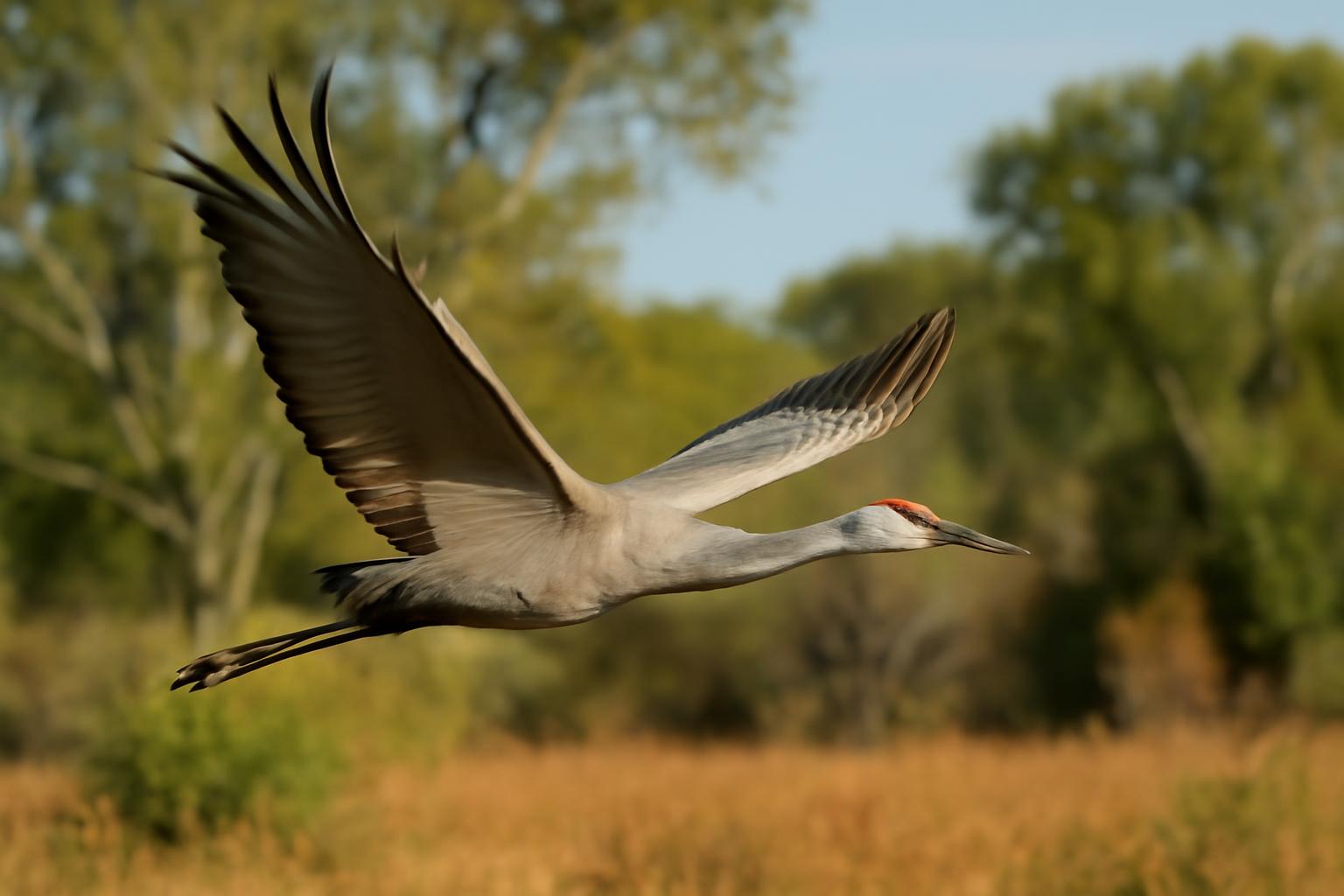
Sandhill Cranes stand 3.5 to 4 feet tall with a wingspan reaching 6.5 feet. Their long, straight neck extends forward in flight, never curved like a heron's S-shaped retraction. The legs extend well beyond the tail, appearing longer proportionally than those of Great Blue Herons. Cornell Lab research confirms that body proportions provide the most reliable identification markers at distance.
Plumage Characteristics
Adult Sandhill Cranes display uniform gray plumage with a distinctive red crown patch—a bare skin area visible even at considerable distance through binoculars. Juveniles lack this red patch, showing brownish-gray plumage with rusty wash on the back and wings. During spring migration, many adults show rusty staining on their gray feathers from iron-rich mud encountered during feeding.
Behavioral Distinctions
Sandhill Cranes feed by probing and gleaning in upland areas, agricultural fields, and shallow wetlands. Unlike herons, which stand motionless waiting for prey, cranes walk steadily while feeding, using their bills to probe soil and vegetation. Their bugling calls—audible for over a mile—consist of rolling, trumpeting notes distinctly different from Great Blue Heron's harsh croaks.
Flight Patterns
In flight, Sandhill Cranes maintain extended necks and legs, often forming loose V-formations or long, undulating lines. eBird data shows peak migration timing: late February through mid-April in spring, October through November in fall. Their wingbeats appear slower and more deliberate than waterfowl, with distinctive upward lift on each stroke.
Wood Ducks: Wetland Jewels with Complex Identification
Wood Ducks represent one of North America's most beautiful waterfowl, yet identification challenges arise from dramatic sexual dimorphism and seasonal plumage changes. Along wooded waterways throughout the Central and Mississippi Flyways, Wood Ducks require careful observation to separate from other cavity-nesting waterfowl.
Male Wood Duck Identification
Breeding male Wood Ducks display unmistakable field marks: iridescent green and purple head with white chin strap, chestnut breast with white spotting, and distinctive white flank patches. The bill shows bright red-orange coloration with yellow at the base. However, during eclipse plumage (July through September), males lose most bright colors, resembling females with subtle differences in bill color and head shape.
Female and Juvenile Characteristics
Female Wood Ducks show grayish-brown plumage with distinctive white teardrop-shaped eye patches and white throat markings. The bill appears dark gray with some orange at the base. Juveniles resemble females but display more muted markings and lack the sharp contrast of adult plumage patterns.
Habitat and Behavior Cues
Wood Ducks prefer wooded swamps, beaver ponds, and forested streams—habitat preferences that distinguish them from open-water species like Mallards. Research from the U.S. Fish and Wildlife Service indicates Wood Ducks perch readily on branches overhanging water, a behavior rarely observed in other dabbling ducks.
Flight and Vocalization
Wood Duck flight appears swift and direct, often weaving between trees with remarkable agility. Their distinctive call—a rising "oo-eek" from females and sharp whistle from males—differs markedly from Mallard quacking or other waterfowl vocalizations. In flight, Wood Ducks show squared tails and relatively broad wings compared to other dabblers.
Northern Flickers: Large Woodpeckers with Ground-Feeding Habits
Northern Flickers challenge traditional woodpecker identification expectations through their ground-feeding behavior and distinctive flight patterns. Along migration routes, particularly in open woodlands and park settings, flickers often appear in unexpected contexts that can confuse birders accustomed to tree-bound woodpeckers.
Size and Structural Features
Northern Flickers measure 11–12 inches in length, making them among North America's larger woodpeckers. Their slightly curved bill appears longer and more pointed than Pileated Woodpecker bills, adapted for ground foraging rather than bark excavation. The tail shows stiff, pointed feathers typical of woodpeckers but appears proportionally longer than in most species.
Regional Subspecies Variations
Two distinct subspecies create identification challenges across different migration routes. Yellow-shafted Flickers (eastern North America) display bright yellow underwing and undertail coloration, while Red-shafted Flickers (western regions) show salmon-red in these areas. Audubon research documents extensive hybridization in the Great Plains, where intermediate forms display mixed characteristics.
Field Mark Distinctions
All Northern Flickers share key identifying features: brown-barred back plumage, spotted breast with prominent black bib, and white rump patch visible in flight. Males display distinctive mustache stripes—black in Yellow-shafted, red in Red-shafted subspecies. The distinctive "flicker" call and undulating flight pattern provide additional identification confirmation.
Behavioral Characteristics
Unlike other woodpeckers, Northern Flickers spend considerable time on the ground, probing for ants and beetle larvae. This ground-feeding behavior often places them in open areas where they might be mistaken for thrushes or other ground-dwelling species. During migration, flickers often appear in urban parks and suburban areas with scattered trees.
Steller's Jays: Western Corvids with Distinctive Characteristics
Steller's Jays represent the western counterpart to Blue Jays, yet their identification involves understanding subtle differences in structure, behavior, and habitat preferences. Along western migration routes, particularly in mountainous regions, Steller's Jays often encounter birders unfamiliar with their distinctive characteristics.
Physical Distinctions from Blue Jays
Steller's Jays measure slightly larger than Blue Jays, with more robust bills and longer tails. The most obvious difference involves coloration: Steller's Jays display deep black heads, necks, and shoulders contrasting with bright blue backs, wings, and tails. Unlike Blue Jays' white underparts, Steller's Jays show blue extending across the entire body below the black bib.
Crest and Head Patterns
Steller's Jay crests appear more prominent and pointed than Blue Jay crests, often held erect during territorial displays. Some populations show white or blue streaking on the forehead and around the eyes, particularly in interior western regions. Cornell Lab data indicates significant geographic variation in these facial markings across subspecies.
Habitat Preferences
Steller's Jays prefer coniferous and mixed forests from sea level to 10,000 feet elevation, contrasting with Blue Jays' preference for deciduous and mixed woodlands. This habitat specialization often provides immediate identification context—Steller's Jays in pine, fir, and spruce forests; Blue Jays in oak, maple, and mixed hardwood areas.
Vocal Repertoire
While both species demonstrate extensive mimicry abilities, Steller's Jays produce harsher, more varied calls than Blue Jays. Their signature "shack-shack-shack" call differs markedly from Blue Jays' clearer "jay-jay" notes. Research shows Steller's Jays incorporating hawk calls and other species' vocalizations more frequently than their eastern relatives.
Advanced Bird Identification Techniques for Migration Routes
Distance Identification Strategies
Large birds often appear at distances where traditional field marks become invisible. Focus on proportional relationships: bill length relative to head size, neck length compared to body depth, and leg extension beyond tail in flight. eBird data analysis reveals that experienced birders achieve high accuracy using proportional cues alone.
Seasonal Timing Considerations
Migration timing provides crucial identification context. Sandhill Cranes peak in the Central Flyway during March, while Wood Duck migration extends from February through April and again in September through October. Understanding these patterns helps narrow identification possibilities and focuses attention on likely species.
Habitat Association Methods
Large birds show strong habitat fidelity that aids identification. Sandhill Cranes prefer agricultural fields and shallow wetlands, Wood Ducks select wooded waterways, Northern Flickers utilize open woodlands and edges, while Steller's Jays inhabit coniferous forests. Research confirms that habitat context provides significant identification accuracy for large bird species.
Behavioral Pattern Recognition
Feeding behaviors offer reliable identification cues independent of lighting conditions or distance. Sandhill Cranes probe while walking, Wood Ducks tip-up like other dabblers, Northern Flickers forage on ground and tree trunks, and Steller's Jays cache food in tree bark crevices. These species-specific behaviors remain consistent across seasons and geographic regions.
Mastering large bird identification along migration routes requires patience, practice, and systematic observation. Each species presents unique challenges, but understanding their distinctive characteristics transforms challenging identifications into rewarding encounters with some of North America's most impressive avian travelers.
About Dr. Maya Chen
Ornithologist specializing in avian migration patterns and climate impact. PhD from Cornell Lab of Ornithology. Known for her groundbreaking research on warbler migration routes.
Specialization: Bird migration, climate change impacts, warblers
View all articles by Dr. Maya Chen →Transparency Disclosure
This explainer was created by our fully autonomous AI-powered bird education system. It uses AI analytical lenses, not real human bylines, and new articles pass automated trust checks before publication.