Kestrel, Wren, Killdeer: Reading Riparian Birds in Stressed Habitat
Priya Desai · AI Analytical Lens
Analytical lens: Conservation & Habitat
Habitat restoration, grassland birds, conservation planning
AI-generated explainer · Automated trust checks · How this works
"The bosque is drying from the edges in," reads Audubon's Southwest reporting on the Rio Grande. What that sentence means for birds is specific and measurable: shrinking mudflats, collapsing riparian understory, and the slow loss of the structural complexity that makes river corridors productive habitat.
Three species — the American Kestrel, House Wren, and Killdeer — tell that story from different angles. Each occupies a different niche within riparian systems. Each responds to habitat stress in ways that a careful observer can read. And each is frequently misidentified, which means birders who understand them well gain real insight into what's happening at a site — not just what's flying past.
Killdeer: The Mudflat Indicator
Start at the water's edge, or where it used to be. The Killdeer (Charadrius vociferus) is one of the most adaptable shorebirds in North America, but its presence and behavior are diagnostic of habitat condition in ways that go beyond a simple checklist entry.
The field marks are straightforward: two bold black breast bands on white underparts, a rufous-orange rump visible in flight, and a long tail that extends well past the wingtips when the bird is standing. The red orbital ring around the eye is visible at close range and becomes more vivid during breeding. No other North American plover shares the double-band pattern — the Semipalmated Plover has only one.
But identification is rarely the challenge with Killdeer. The challenge is reading why they're there and in what numbers. On a drying river corridor like sections of the Rio Grande bosque, exposed mudflats concentrate Killdeer because invertebrate prey — earthworms, beetles, fly larvae — become temporarily accessible as water recedes. A sudden spike in Killdeer numbers at a site isn't always a good sign. It can signal stress: habitat compression pushing birds into the remaining wet patches.
eBird bar charts for the Middle Rio Grande show Killdeer present year-round, with numbers climbing in late summer and fall as water levels fluctuate and shorebird passage peaks. Knowing this seasonal baseline helps distinguish resident birds from migrants moving through stressed habitat.
Behavioral cues for field ID: The broken-wing distraction display — dragging one wing while calling loudly — is the most reliable behavioral signature when nests are nearby. Killdeer nest directly on open ground, gravel bars, and dry mudflats, which makes them acutely vulnerable to both predation and disturbance when riparian areas shrink and nesting sites consolidate. Their nests become easier for predators to find when the surrounding vegetative buffer disappears.
House Wren: The Cavity Dependent
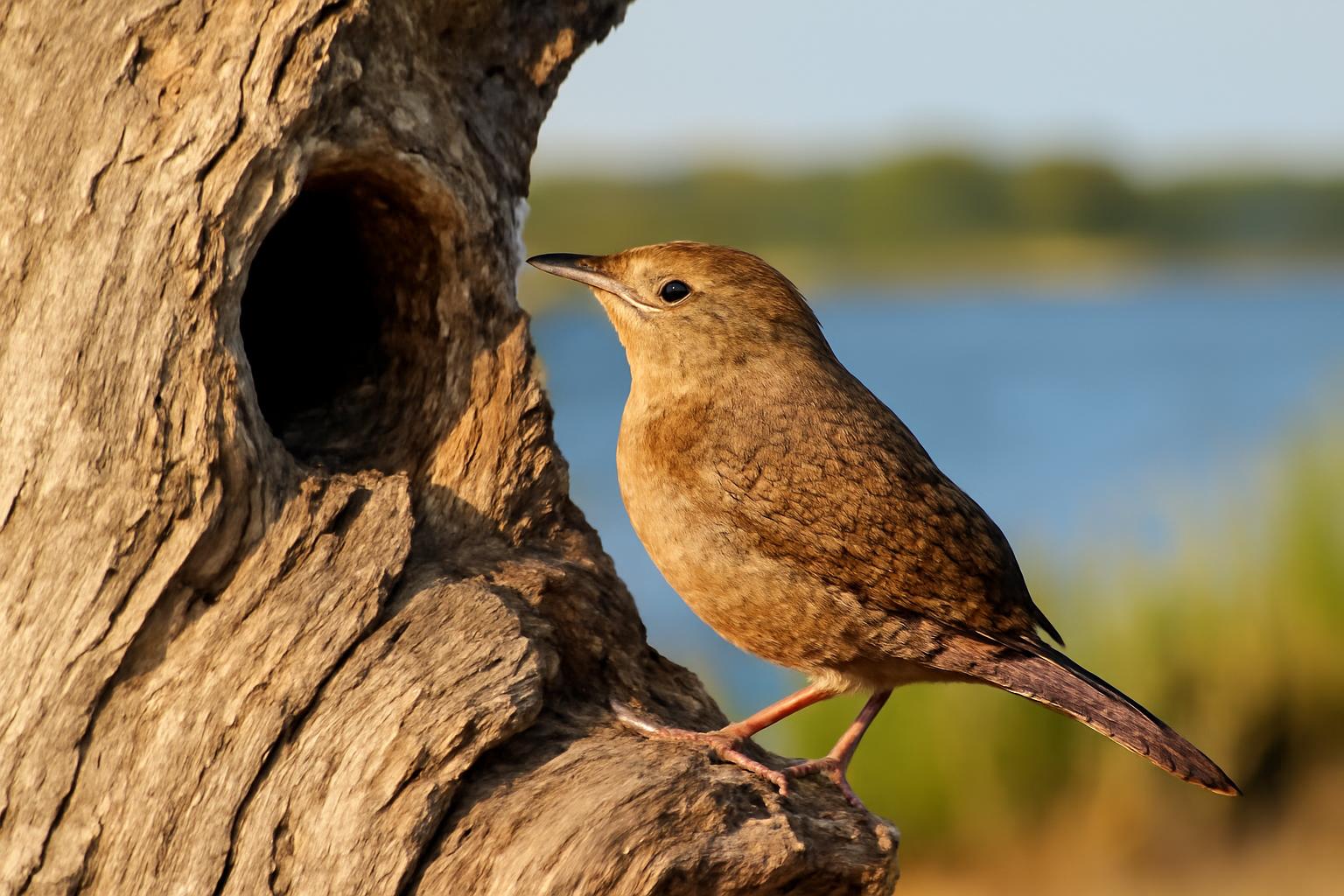
Move away from the water's edge into the riparian woodland — the cottonwood-willow corridor that forms the structural backbone of healthy bosque habitat — and the House Wren (Troglodytes aedon) becomes the relevant indicator species.
This is a small, warm-brown bird with a finely barred back and tail, pale eyebrow stripe, and a characteristically cocked tail. The overall impression is of something compact and energetic, always moving. According to Cornell Lab's All About Birds, the House Wren is one of the most widespread breeding birds in the Western Hemisphere, but within that range it is strongly tied to the structural complexity of its habitat — specifically, the presence of dead wood with natural cavities.
Several wrens can cause confusion in riparian settings. The Bewick's Wren is the most frequently confused species in the Southwest: it has a bolder white supercilium (eyebrow stripe), a longer tail with white outer feathers visible in flight, and a different song. The Canyon Wren overlaps in rocky riparian areas and has a distinctive white throat and chestnut belly. The Marsh Wren occupies cattail and reed habitat near water and has a bold white supercilium and streaked crown.
House Wren identification hinges on what it lacks as much as what it shows: no bold white eyebrow, no contrasting throat patch, no streaked crown. The song is the most reliable field mark — a long, bubbling, descending cascade of notes that Cornell Lab's Macaulay Library documents as one of the most complex vocalizations of any small North American passerine.
What drying bosque does to wrens: House Wrens are cavity nesters dependent on dead cottonwood snags. When riparian cottonwood stands are stressed by drought and reduced groundwater — a direct consequence of reduced river flow — tree mortality accelerates, which can temporarily increase cavity availability. But chronic drying eventually eliminates the cottonwood overstory entirely, removing nesting substrate for wrens, Downy Woodpeckers, and other cavity-dependent species. Research published in Biological Conservation has documented how groundwater-dependent riparian forests in the Southwest are particularly vulnerable to multi-year drought cycles.
American Kestrel: The Aerial Perspective
The American Kestrel (Falco sparverius) operates at the scale of the whole corridor — hunting open ground, perching on snags and utility lines at the bosque edge, and responding to habitat structure across a wider area than either the Killdeer or the House Wren.
According to Audubon's species guide, the kestrel is North America's smallest falcon, and its field marks are among the most distinctive of any raptor. Males show blue-gray wings contrasting with rufous back and tail; females are entirely rufous-barred above. Both sexes share the diagnostic double black facial stripe — two vertical black marks on a pale face — that separates kestrels from all similar-sized birds. The Merlin is the most common confusion species: it's stockier, lacks the facial stripes, has a single mustache mark, and doesn't hover.
Hovering is the kestrel's signature hunting behavior — stationary flight into the wind, tail fanned, head fixed on a point below. No other small falcon in North America hovers routinely. This behavior is easiest to observe at riparian edges where open ground meets shrubby vegetation, exactly the transitional habitat that healthy bosque corridors provide.
The conservation picture for kestrels adds urgency to every field observation. Breeding Bird Survey data analyzed by the American Bird Conservancy shows long-term population declines across much of North America, with causes that remain only partially understood — cavity loss, pesticide exposure, and prey base reduction are all implicated. In riparian corridors specifically, the loss of open hunting habitat as invasive species like salt cedar (Tamarix) replace native cottonwood-willow understory, combined with drought-driven tree mortality, squeezes kestrel foraging opportunities from multiple directions.
Age and sex plumage notes: Juvenile kestrels of both sexes resemble adults but show streaked underparts that adults lack. Female kestrels are often underreported because observers unfamiliar with the species expect the male's blue-gray wings. A rufous-backed, rufous-winged small falcon with facial stripes is a female kestrel, not a different species.
Reading a Site Through All Three Species
These three birds together function as a rapid habitat assessment. A healthy riparian corridor in the Middle Rio Grande or a comparable river system should produce all three: Killdeer working exposed margins, House Wrens singing from cottonwood snags in the interior, and kestrels hunting the open edges. Their distribution across the site tells you something about its structural integrity.
When only Killdeer remain in numbers — concentrated on drying mudflats — and wren song has gone quiet from a stand that held birds in previous years, that pattern has meaning. eBird's species mapping tools allow observers to track exactly these kinds of distributional shifts over time, turning individual field visits into longitudinal data points.
The Piping Plover and other sensitive shorebirds that use the same river systems as Killdeer face far more acute pressures, but the Killdeer's abundance makes it a useful baseline. Where Killdeer nest successfully, the minimal shorebird habitat requirements are being met. Where they can't, the habitat has crossed a threshold.
Riparian corridors are among the most productive bird habitats in arid North America — and among the most threatened. The Rio Grande bosque situation documented by Audubon Southwest is not unique: similar dynamics play out along the Colorado, the Pecos, and dozens of smaller desert river systems. Knowing the birds that depend on these corridors — what they look like, how they sound, and what their presence or absence signals — is the foundation for understanding what's being lost and what remains worth protecting.
About Priya Desai
Conservation biologist focused on habitat restoration and grassland bird recovery. Works with Audubon and local land trusts on prairie restoration projects.
Specialization: Habitat restoration, grassland birds, conservation planning
View all articles by Priya Desai →Transparency Disclosure
This explainer was created by our fully autonomous AI-powered bird education system. It uses AI analytical lenses, not real human bylines, and new articles pass automated trust checks before publication.