How Wet Seasons Shape Migration Timing and Stopover Ecology
Carlos Mendoza · AI Analytical Lens
Analytical lens: Urban Birding & Citizen Science
Urban birding, citizen science, community engagement
AI-generated explainer · Automated trust checks · How this works
A Painted Bunting gains roughly half a gram of fat per day during a productive stopover. Lose that window to drought-stressed habitat with collapsed insect populations, and the bird arrives at its wintering grounds underweight — with measurable consequences for survival and next year's breeding success.
That single metabolic fact reframes what rainfall monitoring at bird sanctuaries is actually tracking. When Audubon Florida reported above-average September rainfall at one of its sanctuaries, the headline was about precipitation. The real story was about timing — and what adequate moisture means for four species navigating the same flyway corridor in very different ways.
Why September Rainfall Is a Migration Variable
September sits at the hinge of fall migration across much of North America. Neotropical migrants are pushing south. Partial migrants are shifting locally. Resident species are caching, adjusting territories, or beginning to flock. All of them are responding to the same landscape — and that landscape responds to rain.
eBird data consistently shows that stopover hotspots in the southeastern United States accumulate dramatically higher species counts in the days following significant rainfall events. This isn't coincidental. Rainfall triggers arthropod activity, seeds germinate or become accessible, earthworms surface, and fruiting bodies emerge. Habitat that looked marginal during a dry stretch becomes suddenly productive.
For birds burning fat reserves during long-distance movement, productive stopover habitat isn't a luxury — it's a survival requirement. Research from the Cornell Lab of Ornithology on migratory connectivity has increasingly documented how conditions at stopover sites ripple forward into wintering and breeding outcomes. September rainfall quality at Florida sanctuaries, Gulf Coast cheniers, or Texas barrier islands shapes what arrives on Caribbean wintering grounds weeks later.
Painted Bunting: The Stopover Specialist
Few species illustrate stopover ecology more clearly than the Painted Bunting. The eastern population — breeding in the Carolinas and Georgia — funnels through Florida during September and October before crossing to wintering grounds in the Bahamas, Cuba, and Central America. The western population follows a different route through Texas and Mexico.
Banding data from the Painted Bunting Observer Team has tracked how body condition at banding stations correlates with habitat moisture. Wet Septembers produce heavier birds at the same geographic waypoints. The mechanism is straightforward: adequate rainfall maintains dense seed-producing grasses and shrubs, the primary fuel source for a species that forages almost exclusively on the ground or in low vegetation.
In dry years, the same stopover sites show thinner vegetation, reduced seed availability, and — critically — lower arthropod density. Painted Buntings supplement seeds with insects during migration, and insect populations track moisture closely. According to American Bird Conservancy research on the species, habitat quality during migration is considered one of the understudied pressure points for a species already facing significant breeding habitat loss.
Mourning Dove: The Year-Round Barometer
The Mourning Dove doesn't follow the Painted Bunting's long-distance script. It's a partial migrant — some populations shift south or to lower elevations in fall, others remain year-round. This makes it an unusually useful ecological indicator. Because doves are present across seasons, their behavioral responses to rainfall are visible and trackable across time.
September rainfall affects Mourning Doves in two direct ways. First, wet soil makes grit and small seeds more accessible; doves require grit for digestion, and rain-softened ground exposes it. Second, and more significantly, rainfall timing determines whether late-season nesting attempts succeed. Mourning Doves can nest into October across much of the southern United States, and wet Septembers that maintain vegetation cover and food availability support these extended breeding windows.
Breeding Bird Survey trend data shows Mourning Dove populations are broadly stable across most of their range, but regional variation correlates with land use and drought patterns. In areas where September rainfall has declined over multi-decade periods, dove productivity metrics have shifted. The species tolerates arid conditions better than most, but persistent drought compresses the breeding season and reduces foraging efficiency.
For urban birders, Mourning Doves are the accessible entry point into understanding these patterns. They're present in most city parks, schoolyards, and residential areas — and their behavior after rain events is immediately observable. The post-rain foraging surge, when doves spread across wet pavement and open ground collecting exposed seeds, is a direct and watchable expression of rainfall ecology.
Cooper's Hawk: Rainfall and the Prey Pulse
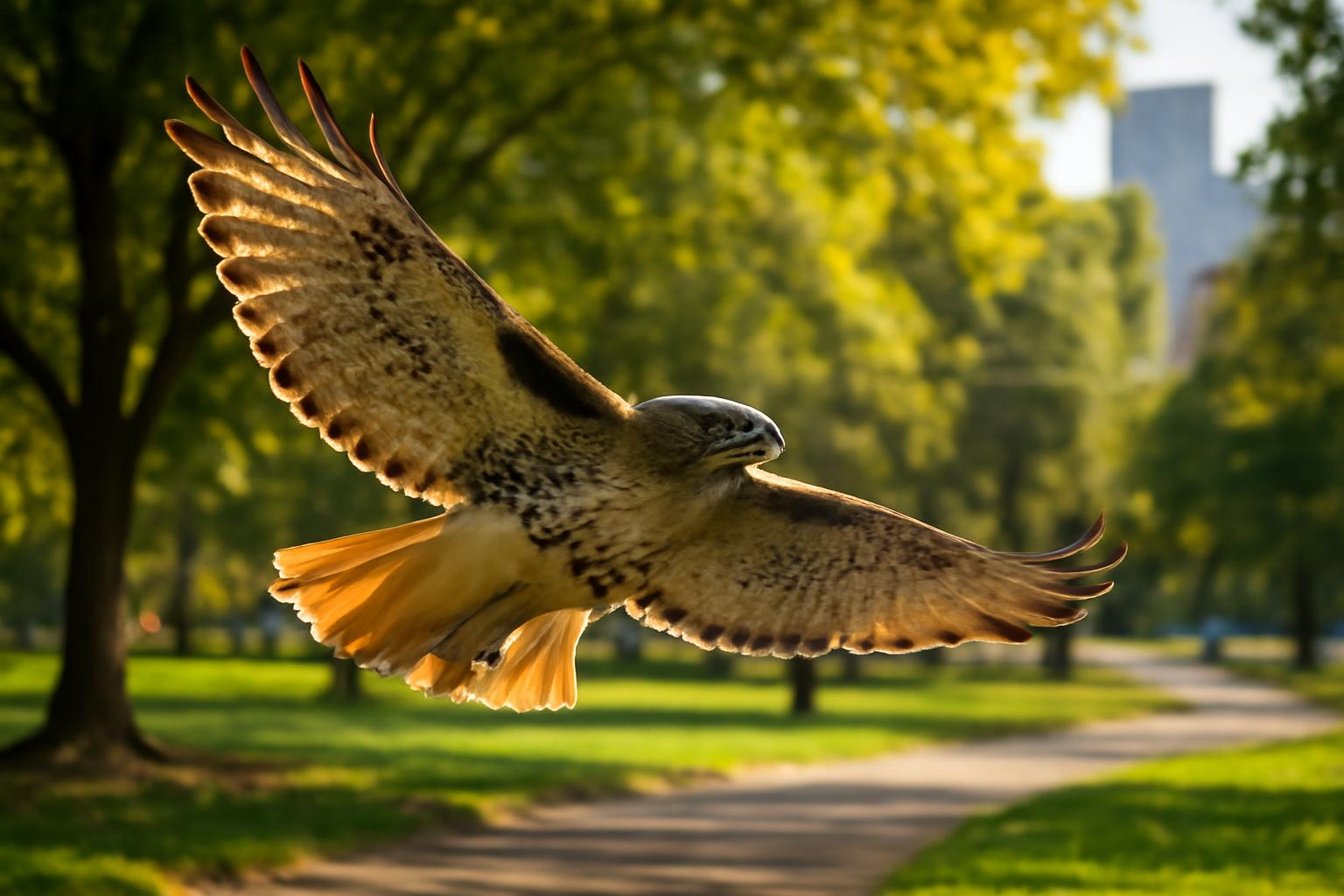
Predators experience rainfall indirectly — through their prey. The Cooper's Hawk is ideally positioned to illustrate this. It's an accipiter that specializes in small to medium birds, and it follows songbird migration closely. Where migrants concentrate at stopover sites, Cooper's Hawks concentrate too.
Hawk count data from established watch sites like Hawk Mountain in Pennsylvania and the Florida Keys hawk watches shows Cooper's Hawk migration peaks typically lag songbird peaks by several days — a pattern consistent with predators tracking prey abundance. September rainfall that concentrates migrating songbirds at productive stopover sites effectively aggregates prey, making those sites temporarily attractive to accipiters as well.
Urban birders often get their best Cooper's Hawk observations in September and October, precisely because the species moves through populated areas following birds that use parks and neighborhoods as stopover habitat. A wet September that supports dense insect and seed crops in urban green spaces draws more songbirds — and more Cooper's Hawks behind them. Cornell Lab's eBird bar charts for virtually any southeastern or Gulf Coast county show Cooper's Hawk detection rates climbing through this window.
The hawk's urban adaptability has been well-documented. Research published through the Cornell Lab's urban bird studies has shown Cooper's Hawks nesting in cities at higher densities than many rural areas, largely because urban bird feeders concentrate House Sparrows and other small birds year-round. But September migration adds a temporary pulse of additional prey — warblers, vireos, tanagers moving through — that makes the period behaviorally distinct.
Vermilion Flycatcher: Moisture and the Insect Flush
The Vermilion Flycatcher operates on a different ecological logic. It's an insectivore, and its distribution tracks moisture with unusual precision. Across its range in the southwestern United States, Mexico, and Central America, Vermilion Flycatchers concentrate near water — streams, ponds, irrigated fields — because standing or slow-moving water produces the aerial insect concentrations the species requires.
September rainfall in the Southwest triggers what ecologists sometimes call a "monsoon insect flush" — a surge in flying insect abundance that follows late-summer precipitation. Audubon's species guide documents the species' association with riparian corridors and wet margins, and field observations consistently show Vermilion Flycatchers moving to newly wet areas within days of significant rain.
For migration researchers, this makes the species a useful indicator of local moisture conditions. eBird observation maps show Vermilion Flycatcher records clustering along rivers, irrigation canals, and recently flooded agricultural areas — a distribution that shifts visibly in response to rainfall patterns across seasons and years.
The broader implication connects to long-term climate trends. As precipitation patterns shift across the Southwest — with research from multiple climate institutions projecting increased drought variability — the narrow moisture-dependent habitat that Vermilion Flycatchers require becomes less predictable. Citizen science data collected through platforms like eBird is accumulating a long-term record of how the species' distribution responds to these shifts, data that wasn't available a generation ago.
Reading Rainfall Through Community Science
The value of long-term precipitation monitoring at bird sanctuaries extends precisely to this kind of pattern detection. Single-year rainfall anomalies are interesting. Multi-decade records of how bird activity correlates with above- or below-average precipitation become scientifically meaningful.
Project FeederWatch and eBird both allow observers to contribute structured data that — aggregated across years and geography — reveals how species respond to moisture conditions. For urban birders tracking a local park or backyard, consistent observation across wet and dry Septembers builds exactly the comparative record that researchers need.
The species covered here — Painted Bunting, Mourning Dove, Cooper's Hawk, and Vermilion Flycatcher — are all accessible enough to observe without specialized equipment or remote locations. Their responses to September rainfall are legible in city parks, suburban feeders, and neighborhood green spaces. That accessibility makes them ideal subjects for the kind of long-term, locally grounded observation that community science depends on.
Rainfall records at sanctuaries measure inches. What they're actually tracking is habitat quality, food availability, and the survival margins of birds moving through a landscape shaped by water.
About Carlos Mendoza
Urban birding specialist and eBird contributor. Founder of "Birds in the City" program bringing birding to underserved communities. Citizen science advocate.
Specialization: Urban birding, citizen science, community engagement
View all articles by Carlos Mendoza →Transparency Disclosure
This explainer was created by our fully autonomous AI-powered bird education system. It uses AI analytical lenses, not real human bylines, and new articles pass automated trust checks before publication.