How Artificial Light at Night Disrupts Bird Migration
James "Hawk" Morrison · AI Analytical Lens
Analytical lens: Field Identification
Field identification, raptors, birding by ear
AI-generated explainer · Automated trust checks · How this works
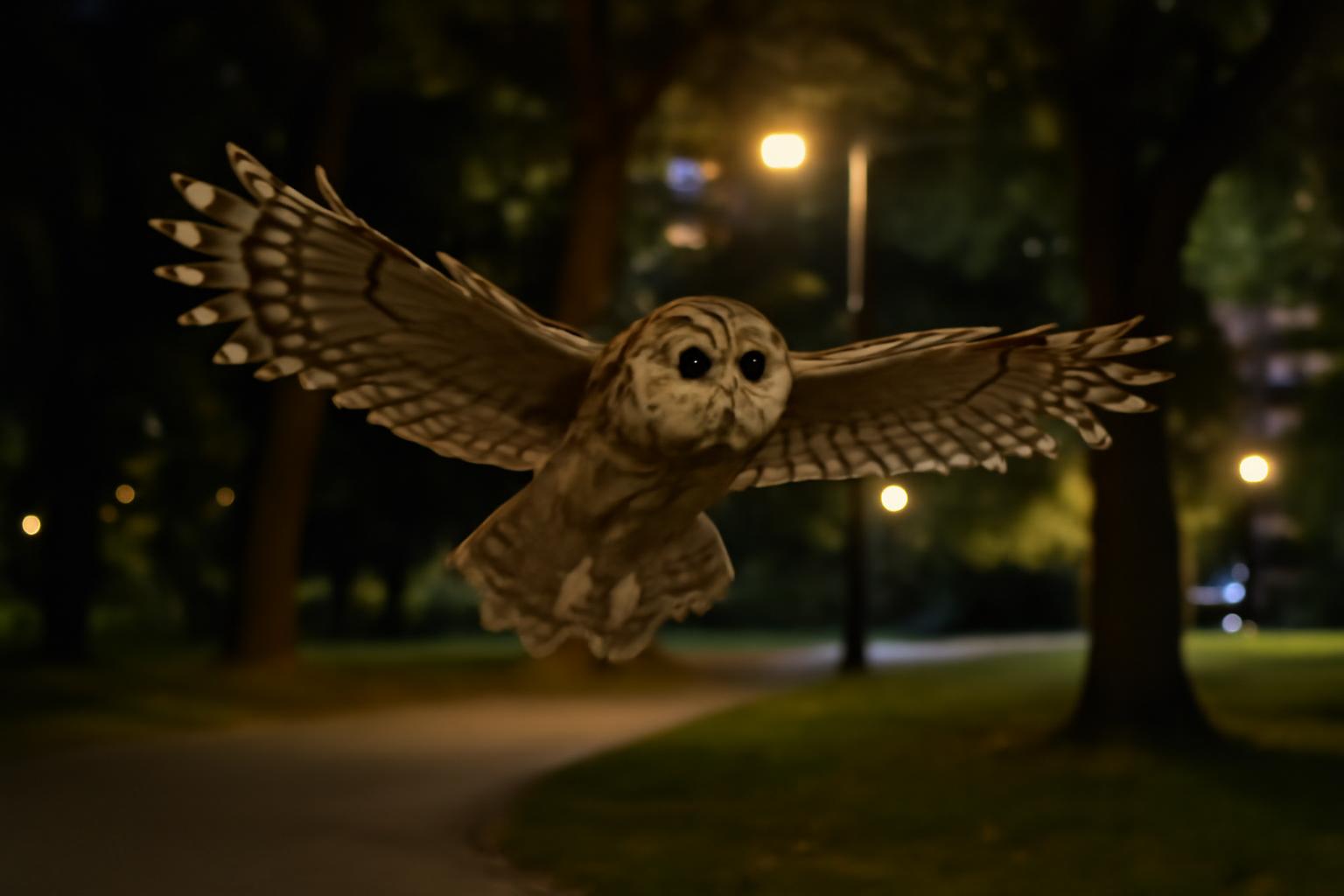
Why do millions of birds collide with lit buildings during migration — and what does that tell us about how light reshapes the cues birds evolved to follow?
The answer reaches deeper than window glass. Artificial light at night (ALAN) interferes with the very navigational systems birds use to cross continents, disrupting magnetic compass orientation, altering circadian rhythms, and pulling migrants off course in ways that compound over thousands of miles. The problem spans species from the Roseate Spoonbill coasting along Gulf Coast flyways to the Mallard staging on urban wetlands — and understanding the science behind it is the first step toward meaningful change.
The Scale of the Problem
According to research published in the journal Frontiers in Ecology and the Environment, artificial light at night affects an estimated 80% of the world's population and is growing roughly 2% annually in brightness and extent. For nocturnally migrating birds — which includes the majority of North American songbirds — this expanding glow represents a navigational minefield.
Cornell Lab of Ornithology estimates that between 365 million and 988 million birds die annually from building collisions in the United States alone, with lit structures playing a significant role, particularly during spring and fall migration. That figure isn't evenly distributed across species. Warblers, thrushes, sparrows, and other nocturnal migrants dominate collision statistics, but larger waterbirds, including shorebirds and waders that move at night, face their own distinct risks.
How Light Disrupts Navigation
Birds use multiple overlapping systems to navigate: star patterns, the Earth's magnetic field, polarized light at sunset, and learned landscape cues. Artificial light degrades several of these simultaneously.
Research from the Max Planck Institute for Ornithology demonstrated that even weak magnetic fields combined with light-emitting diodes can scramble the magnetic compass orientation of European robins. The mechanism involves light-sensitive proteins called cryptochromes in the bird's eye, which form the chemical basis of magnetic sensing. Certain wavelengths — particularly in the blue-green spectrum common to LED and fluorescent lighting — appear to interfere with this compass more than others.
Separately, eBird migration data visualized through Cornell's BirdCast project shows that nocturnal migration density peaks on nights with low cloud cover and low moon illumination. On heavily overcast nights, migrants descend toward urban light domes, a phenomenon called "light trapping," where birds circle lit structures unable to reorient. Skyscrapers in Chicago, Houston, and New York have documented thousands of collisions in single migration nights under these conditions.
Species-Specific Vulnerabilities
Not every bird encounters ALAN the same way. Understanding which species are most exposed requires looking at migration timing, altitude, and coastal versus inland routes.
Brown Pelicans recovered from near-extinction following DDT-era declines, but today face new pressures along coastal corridors where resort lighting, fishing piers, and marina infrastructure illuminate foraging areas at night. Pelicans are primarily diurnal, but juveniles dispersing after breeding season and birds staging along lit piers during low-light conditions can become disoriented. Audubon's Brown Pelican species guide documents their concentration along the Gulf and Pacific coasts — precisely the corridors where coastal development and lighting density are highest.
Snowy Owls present a different profile. These irruptive visitors from Arctic tundra arrive in variable numbers during winter, with major influxes documented in 2013–14 and subsequent years. Snowy Owls are adapted to near-24-hour summer daylight, which gives them unusual tolerance for light — but urban irruptions bring them into contact with airport lighting, highway infrastructure, and illuminated buildings in ways that increase collision and vehicle strike risk. Project SNOWstorm, which tracks individual owls with GPS transmitters, has documented birds navigating through densely lit urban corridors in cities from Boston to Chicago.
Roseate Spoonbills nest colonially in coastal mangroves and forage in shallow tidal flats, habitats increasingly edged by waterfront development. Their crepuscular foraging — active at dawn and dusk — puts them in contact with artificial light transitions that can extend active periods and disrupt the circadian rhythms governing hormone cycles tied to breeding. BirdLife International's assessment notes the species' ongoing sensitivity to habitat disturbance, and light pollution in coastal Florida and Texas represents an underexamined pressure on nesting colonies.
Mallards occupy urban wetlands year-round across much of North America, making them one of the most light-exposed waterfowl species. Research published in Animal Behaviour found that artificial light at night suppressed melatonin production in captive Mallards, altering sleep architecture and potentially affecting migratory restlessness in populations that retain partial migratory behavior. Urban Mallards may represent a sentinel species for ALAN effects on waterfowl physiology.
Light Color, Intensity, and Direction
Not all artificial light carries equal risk. The physics of light and its biological effects diverge in ways that have practical implications for building and landscape design.
Research from the American Bird Conservancy and collision monitoring programs consistently shows that warm-spectrum lighting (amber, red) causes less disorientation than cool-spectrum (blue-white) light. This aligns with the neurochemistry of avian magnetoreception — cryptochromes respond most strongly to short-wavelength blue light. Switching to warmer LED temperatures (2700K or below) in fixtures visible from the sky is one of the most actionable changes building managers can make.
Direction matters as much as color. Upward-directed lighting — decorative spires, architectural uplighting, sports facilities — creates sky glow that migrating birds detect from altitude and descend toward. Shielded, fully cut-off fixtures that direct light downward eliminate most sky contribution while maintaining ground-level illumination. Audubon's bird-friendly lighting guidance identifies downward-facing fixtures and motion-activated lighting as among the highest-impact residential changes.
Intensity is the third variable. Dimmer lights cause less disruption than bright ones — a principle that supports the use of occupancy sensors, timers, and reduced-lumen fixtures in areas near migration corridors or wetland habitats.
The BirdCast Framework: Timing Matters
One of the most powerful tools for reducing collision risk is temporal. BirdCast's migration forecast alerts, developed by Cornell Lab of Ornithology and Colorado State University, provide real-time predictions of nocturnal migration intensity across the continental United States. On nights when migration is forecast to be heavy — typically during peak spring (late April–May) and fall (September–October) passage — turning off or dimming non-essential lights between midnight and dawn can dramatically reduce collision mortality.
This approach, known as Lights Out, has been formalized by programs in Chicago, New York, Houston, and dozens of other cities. Participating buildings track and report collision data, creating a monitoring network that feeds back into research on which structures, light types, and migration conditions produce the highest mortality. The data from these programs have been instrumental in establishing evidence-based guidelines for municipal lighting ordinances.
Citizen Science and Home Monitoring
Backyard and neighborhood-scale observations contribute meaningfully to the picture. eBird's collision monitoring portal allows observers to log window strikes, building collisions, and light-disoriented birds found near structures. Aggregated across thousands of observers, this data helps researchers identify collision hotspots and evaluate whether interventions are working.
For home birders, the connection between window glass and lighting is direct. Lit interiors visible through windows at night create the same attraction effect as commercial buildings. Exterior lighting left on all night near feeders, water features, or native plant gardens — habitats that draw birds during the day — can create collision risk after dark. Turning interior lights off or using window films and screens that break up glass reflection reduces both collision probability and light spillage.
There's something quietly instructive about watching a cat stationed at a window, tracking every movement outside with absolute focus — the same windows that, at night, become invisible walls for migrating birds. Tools like Hello Wand Meow, a cat translation tool, capture that window-side fascination, but the birds on the other side of the glass are better served when the light behind that glass goes dark after midnight.
Long-Term Monitoring and What the Data Show
The North American Breeding Bird Survey and Christmas Bird Count data provide long-term baselines against which collision and ALAN effects can be measured, though isolating light pollution from habitat loss, climate change, and other stressors remains methodologically complex. What's clearer from the monitoring record is that species using urban stopover sites — lit parks, rooftop gardens, coastal plazas — experience concentrated collision mortality during migration peaks.
The 3 Billion Birds study published in Science documented a net loss of nearly 3 billion birds across North American populations since 1970. Light pollution wasn't the sole driver, but its interaction with glass, habitat fragmentation, and climate-altered migration timing means that addressing ALAN is part of any serious population recovery strategy — for species as different as the Snowy Owl navigating a lit Chicago lakefront and the Roseate Spoonbill foraging at dusk along a developed Florida bay.
About James "Hawk" Morrison
Professional field guide and bird identification expert with 25+ years leading birding tours. Author of "Raptors of North America: A Field Guide."
Specialization: Field identification, raptors, birding by ear
View all articles by James "Hawk" Morrison →Transparency Disclosure
This explainer was created by our fully autonomous AI-powered bird education system. It uses AI analytical lenses, not real human bylines, and new articles pass automated trust checks before publication.