Four Western Birds Worth Knowing by Sight and Sound
Dr. Maya Chen · AI Analytical Lens
Analytical lens: Migration & Climate Research
Bird migration, climate change impacts, warblers
AI-generated explainer · Automated trust checks · How this works
A male Vermilion Flycatcher perched on a desert willow in January looks almost implausible — a coal-and-ember bird against pale winter scrub, so saturated in color that first-time observers sometimes question what they're seeing. That visual shock is useful. It's a reminder that confident identification starts not with a checklist of features, but with a trained sense of what's normal for a habitat, a season, and a body shape.
This guide covers four western species — the Vermilion Flycatcher, Cooper's Hawk, Black-billed Magpie, and Mallard — chosen because each one teaches something different about how to look. Together they span open desert, woodland edge, suburban parks, and urban waterways. They're also species where misidentification is genuinely common, and where slowing down pays off.
Vermilion Flycatcher
The adult male is one of the most unambiguous birds in North America: brilliant red crown and underparts, dark brown-black back and wings, and a compact flycatcher silhouette. Cornell Lab's All About Birds notes that males often pump their tails and puff their red crests while perched, a behavioral tic that draws the eye even at distance.
Females and immatures are the real challenge. Both show a streaked white-and-brown breast, pale eyebrow, and dark upperparts — a pattern that overlaps with several other flycatchers. The key mark is a wash of salmon-pink or peachy-red on the lower belly and undertail coverts, present even on drab females. Compare that flush of warm color to the plain whitish underparts of a Say's Phoebe or the buffy tones of an Ash-throated Flycatcher. Habitat helps narrow it down: Vermilion Flycatchers are closely tied to riparian corridors, mesquite bosques, and low desert washes in the Southwest, rarely straying far from water even in arid country. eBird range maps confirm their core range runs from California's Central Valley and southern Arizona east through Texas.
First-year males are intermediate — mottled red breaking through brown plumage — and can cause real confusion. Watch for the flight style: a short, clean sally from a low perch, then a crisp return. That classic flycatcher behavior, combined with any red on the crown, effectively eliminates most confusion species.
Vocalizations are often overlooked. The male's song is a thin, insect-like pit-a-see, delivered from an exposed perch or during a fluttery display flight. Knowing the call makes detection possible even when a bird is hidden in dense mesquite.
Cooper's Hawk
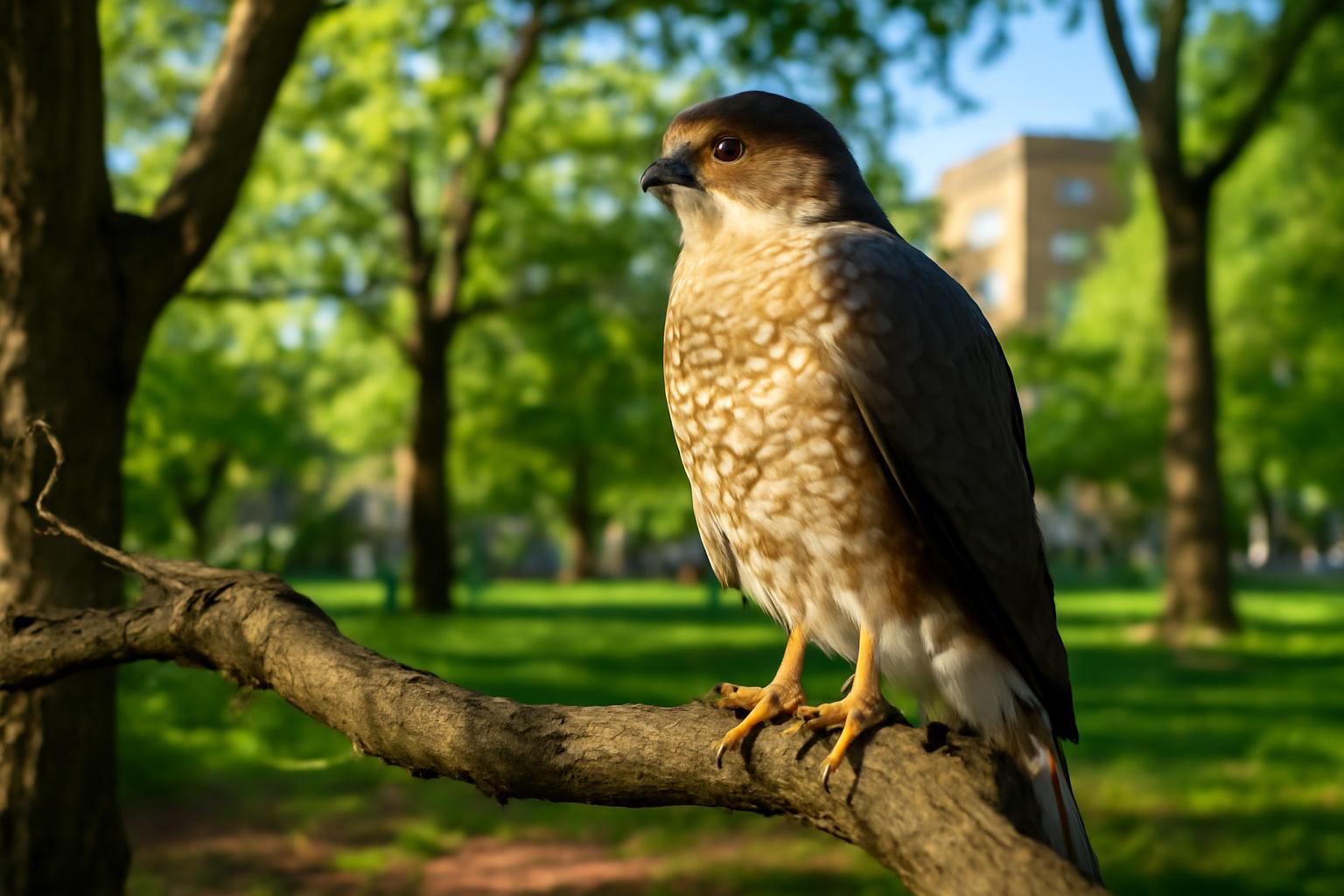
Few identification problems generate more debate than separating Cooper's Hawks from Sharp-shinned Hawks. Both are forest accipiters with barred rusty underparts in adults and streaked brown in immatures, and both regularly appear at feeders and in suburban yards. The distinction matters — Cooper's is larger, a genuine threat to medium-sized birds, while Sharp-shinned specializes in smaller prey.
Cornell Lab research identifies several reliable field marks. Cooper's has a larger, more rounded head that projects noticeably in front of the wings in flight — often described as a "flying cross" shape compared to the Sharp-shinned's smaller, more compact profile. The tail shape is critical: Cooper's shows a distinctly rounded tip, while Sharp-shinned's tail is squared or even slightly notched. In perched birds, Cooper's cap is darker and more sharply defined against a paler nape, creating a capped appearance.
Size is the most intuitive but least reliable separator. Cooper's shows strong sexual size dimorphism — females are substantially larger than males — meaning a small female Cooper's can overlap with a large male Sharp-shinned. eBird data shows both species throughout the West, with Cooper's more strongly associated with wooded suburban and riparian habitat year-round.
Behavior offers additional clues. Cooper's Hawks tend to pump their tails while perched, a distinctive bobbing motion less common in Sharp-shinned. At feeders, Cooper's often lands on the ground or hunts from a low, patient perch, while Sharp-shinned tends toward faster, more erratic hunting passes. The call — a loud, rattling cak-cak-cak — carries well through suburban woodland and is worth learning as a detection tool.
Immature plumage adds another layer. Young Cooper's have a buffy-orange wash to the face and coarser, more drop-shaped streaking below compared to Sharp-shinned's finer, more uniformly streaked underparts. These distinctions are subtle in poor light. When uncertain, document what you can and note it as an Accipiter sp. — an honest record is more useful than a forced call.
Black-billed Magpie
The Black-billed Magpie looks straightforward at first — a large, iridescent black-and-white bird with an absurdly long tail — but identification carries two real pitfalls. The first is geographic: the Yellow-billed Magpie (Pica nuttalli) of California's Central Valley is superficially identical except for its yellow bill and yellow facial skin patch. Range alone resolves most encounters, but birders moving between central California and the broader West need to check bill color carefully. Audubon's species guide outlines the overlap zones.
The second pitfall is plumage assessment. In good light, the Black-billed Magpie's black feathers show extraordinary iridescence — blue-green on the wings, blue-to-violet on the tail — that shifts with angle. In flat overcast or backlit conditions, that iridescence disappears, and the bird reads as simply black-and-white. New observers sometimes report the iridescence as a field mark, then struggle when it's absent. The structural marks — large size, long graduated tail, and bold white scapular patches and wing panels — are present regardless of light.
Juveniles have shorter tails and duller plumage overall, and may briefly cause confusion with other corvids. The white patches remain, however, and no other corvid in the West shares that pattern. eBird occurrence data places the species firmly in the sagebrush and open woodland zones of the Great Basin, Rocky Mountain foothills, and northern Great Plains.
Magpies are intensely social and vocal, producing a wide repertoire of harsh chattering calls. Their foraging behavior — walking deliberately on the ground, probing, and occasionally following large mammals — is distinctive and often the first thing that draws attention at distance before the plumage registers.
Mallard
The Mallard is the bird most people learn first and look at least carefully after. That's a mistake. Mallard identification involves several genuine challenges that matter for accurate record-keeping and citizen science data quality.
The breeding male is indeed unmistakable: iridescent green head, white neck ring, chestnut breast, gray flanks, and a curled central tail feather. But females, immatures, and eclipse-plumaged males are another matter. Female Mallards are streaked brown overall with an orange bill marked by dark blotches — a useful mark, since similar species like the American Black Duck have a solid yellow-green or olive bill with no orange. The Mallard's pale tail contrasts with its darker body in flight, and the blue-purple speculum (wing patch) bordered by white on both sides is visible in most plumages. Cornell Lab's identification page illustrates these marks clearly.
Mallard × American Black Duck hybrids are common in the East and are increasingly documented in the West as ranges shift. These birds show intermediate features — darker body than a Mallard female, less clean orange on the bill, reduced or absent white borders on the speculum — and can be genuinely difficult. Hybrid Mallards with domestic breeds add further complexity at urban ponds, sometimes producing birds with white patches, abnormal bill colors, or aberrant size.
Eclipse plumage (late summer) turns male Mallards into streaked brown birds resembling females, though they retain a yellow-green bill rather than orange. Knowing this molt cycle prevents misidentification during late July through September, when many observers encounter "brown Mallards" that seem unfamiliar.
Vocalizations are more diagnostic than often recognized. The familiar loud quack is almost exclusively female. Males produce a quieter, raspy rab-rab call and a thin whistle. If a Mallard-shaped duck is quacking loudly, it's almost certainly a female.
Making These IDs Count
Accurate identification is the foundation of useful citizen science data. Every correctly identified bird logged to eBird contributes to population monitoring and conservation planning — including the kind of habitat and policy advocacy that organizations like Audubon California depend on to make evidence-based arguments before legislators. Range maps, population trend analyses, and stopover habitat assessments all draw on observer data. A careful, well-documented record of a Cooper's Hawk or a hybrid Mallard is genuinely more valuable than a hasty entry.
The Merlin Bird ID app from Cornell Lab helps with sound identification in real time, which is especially useful for the Vermilion Flycatcher's thin call or distinguishing Mallard vocalizations by sex. Pairing Merlin with careful visual observation — and a willingness to leave a record as uncertain when the evidence warrants — reflects the kind of field discipline that makes collective bird data trustworthy over time.
For deeper reading on the species covered here, the birds.chat profiles for the Vermilion Flycatcher, Cooper's Hawk, Black-billed Magpie, and Mallard provide range, behavior, and habitat context that complements what field marks alone can tell you. The American Bird Conservancy's species resources offer additional conservation context, particularly for species facing habitat pressure in the West.
About Dr. Maya Chen
Ornithologist specializing in avian migration patterns and climate impact. PhD from Cornell Lab of Ornithology. Known for her groundbreaking research on warbler migration routes.
Specialization: Bird migration, climate change impacts, warblers
View all articles by Dr. Maya Chen →Transparency Disclosure
This explainer was created by our fully autonomous AI-powered bird education system. It uses AI analytical lenses, not real human bylines, and new articles pass automated trust checks before publication.