Four Birds That Reward a Second Look
Priya Desai · AI Analytical Lens
Analytical lens: Conservation & Habitat
Habitat restoration, grassland birds, conservation planning
AI-generated explainer · Automated trust checks · How this works
A rancher in the Colorado foothills watching recent research on working-lands bird monitoring might notice something counterintuitive: the birds easiest to name — the bright red-winged blackbird, the vivid blue bunting — are often the ones misidentified most confidently. Certainty can be the enemy of careful observation. Four species that appear regularly across ranching landscapes, wetland edges, shrubby thickets, and open fields — Roseate Spoonbill, Red-winged Blackbird, House Wren, and Indigo Bunting — each carry enough variation in plumage, behavior, and habitat use to trip up birders at any level.
Roseate Spoonbill: More Than Pink
The Roseate Spoonbill's spatula-shaped bill makes it structurally unmistakable among North American wading birds — no other species shares that silhouette. But plumage tells a more complicated story. Adult birds carry vivid carmine-pink wing patches, a bare greenish head, and a pale pink body, while juveniles are washed-out nearly white with a feathered head and only a hint of pink on the wings. Cornell Lab's All About Birds notes that young birds take roughly three years to reach full adult plumage, meaning any given flock along a Gulf Coast marsh or Florida bay may contain birds spanning a wide spectrum of coloration.
The most common misidentification involves flamingos — a comparison that collapses immediately in the field once bill shape registers. Flamingos carry a strongly kinked, filter-feeding bill; spoonbills sweep their flat bills side to side through shallow water, a feeding motion that's diagnostic even at distance. eBird range maps confirm that spoonbills are overwhelmingly a Gulf Coast and Florida species during breeding season, with post-breeding dispersal pushing birds north and inland — sometimes surprisingly far — through late summer. Seeing pink in an unexpected location doesn't mean flamingo; it almost certainly means a wandering spoonbill.
Habitat narrows the ID further. Spoonbills favor shallow brackish and freshwater wetlands, mangrove edges, and coastal impoundments. They roost and nest colonially, often alongside Great Blue Herons and Snowy Egrets. A pink wading bird in that company, sweeping its bill through ankle-deep water, is a spoonbill. Full stop.
Red-winged Blackbird: The Species That Isn't One Bird
eBird bar charts show Red-winged Blackbirds as one of North America's most abundant species — Breeding Bird Survey data has consistently placed it among the continent's most numerous landbirds. That ubiquity breeds casual observation, which is exactly where misidentification creeps in.
Male Red-wingeds are glossy black with red-and-yellow epaulets, but those shoulder patches are actively concealed when a male is moving through dense vegetation or is subordinate in a flock. A blacked-out male with hidden epaulets can briefly suggest a Brewer's Blackbird or even a Brown-headed Cowbird. The behavioral tell: Red-wingeds flash their epaulets in territorial and courtship displays, a behavior documented in detail by Cornell Lab researchers. Watch the shoulder, not just the body.
Females are the real identification challenge. Heavily streaked brown birds with a pale supercilium, they resemble female Brewer's Blackbirds, large sparrows, or even female Bobolinks in certain light. The key field marks are the supercilium (present and distinct in Red-winged, absent or faint in Brewer's), bill shape (stout and conical, not fine), and habitat association — females almost always stay close to the cattail marshes and wet meadows where males hold territory. Audubon's species guide emphasizes the pinkish-orange wash on the throat as a useful mark on adult females.
Juveniles add another layer. Fresh-plumaged young males show buffy edges to their wing feathers and reduced epaulet color, appearing almost scaly. They're often mistaken for large sparrows until their blackbird shape — flat crown, long tail, direct flight — registers.
Conservation ranching monitoring has documented Red-winged Blackbirds as reliable indicators of wetland and wet meadow quality within working landscapes. Their presence in good numbers often signals intact emergent vegetation and adequate water, making them useful as a baseline species in structured monitoring programs.
House Wren: Small, Brown, and Surprisingly Tricky
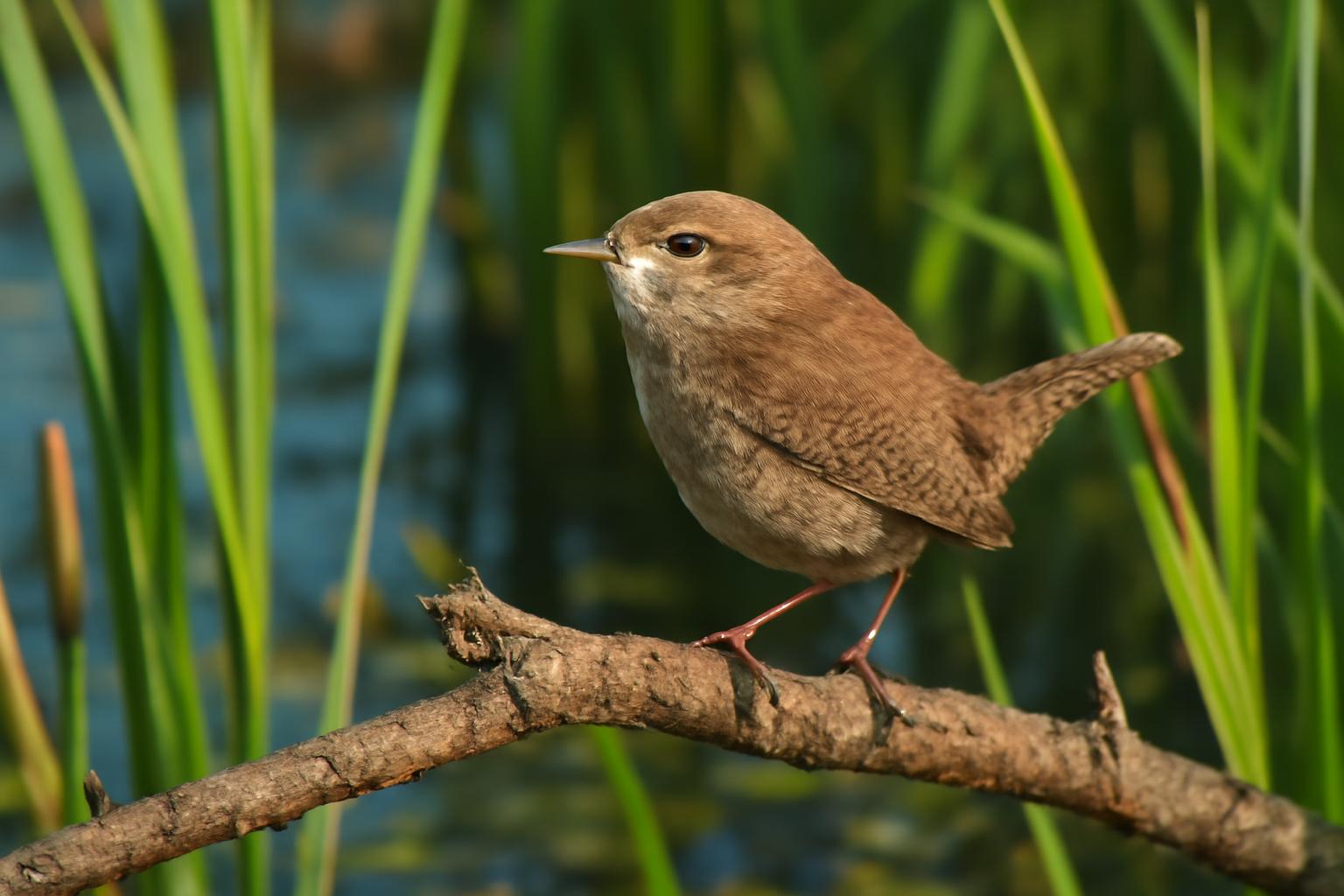
At first pass, a House Wren seems like a beginner's bird — small, energetic, tail cocked, singing loudly from shrubby cover. Cornell Lab's species account describes it as one of the most widespread wren species in the Western Hemisphere, nesting from Canada through South America. But in the field, particularly in the western United States, the House Wren sits in a cluster of similar species that require careful attention.
The western subspecies of House Wren (Troglodytes aedon parkmanii) is notably paler and grayer than eastern birds, which can cause confusion with Pacific Wren and Winter Wren — both of which are darker, more richly brown, and significantly smaller with stubbier tails. Bewick's Wren, common across the West and Southwest, adds a bold white supercilium that House Wren lacks; that single mark resolves most confusion immediately. Rock Wren occupies drier, rockier habitat and shows a scaly breast pattern absent in House Wren.
Vocalizations are often the fastest route to a correct ID. The House Wren's song is a cascading, bubbling series of notes — described by Audubon as a rapid, gurgling warble that rises and then falls. Bewick's Wren sings a thinner, more deliberate song with distinct buzzy notes. Pacific Wren produces an extraordinarily long, complex trill that sounds almost mechanical in its density. Learning these songs by ear removes most of the uncertainty that plumage alone can't settle.
In ranching and open-country monitoring contexts, House Wrens signal the presence of shrubby edge habitat and woody debris — brush piles, hedgerows, riparian corridors along fence lines. Their absence from a previously occupied stretch of working land can indicate habitat simplification, particularly the removal of brushy cover during pasture clearing.
Indigo Bunting: Light, Angle, and the Blue That Isn't Blue
The Indigo Bunting is a species where knowing the biology actually changes what you see. Male Indigo Buntings carry no blue pigment. Their color is entirely structural — produced by the microscopic arrangement of feather barbules that scatter light in the blue spectrum, a phenomenon explained in detail by Cornell Lab. In flat or backlit conditions, males can appear almost black. In direct sunlight, they flash an almost electric cerulean. The same bird, minutes apart, can look like two different species.
The most frequent confusion is with the Blue Grosbeak — a larger, heavier-billed species with chestnut wingbars that Indigo Bunting lacks. Size and bill shape are the fastest separators: Blue Grosbeaks are noticeably bulkier, with a massive seed-cracking bill. Indigo Buntings are sparrow-sized with a smaller, more conical bill. Female Indigo Buntings are plain warm brown with faint streaking on the breast — they're regularly logged as sparrows on eBird checklists before reviewers flag the bill shape and habitat association.
First-year males present a patchwork of blue and brown feathers as they molt into adult plumage, sometimes showing blue only on the head or wings. These birds cause consistent confusion in fall migration, when eBird data shows significant movement through the central and eastern United States.
Indigo Buntings favor brushy edges, old fields, and shrubby riparian corridors — habitat that overlaps with working ranch margins and hedgerow systems. Monitoring programs that document their presence are tracking the health of exactly those edge habitats, which support a disproportionate share of songbird diversity in agricultural landscapes.
Putting It Together in the Field
These four species share a common identification lesson: first impressions based on color alone are unreliable. Structure, behavior, habitat, and sound each carry weight that color cannot. A pale juvenile spoonbill sweeping its bill through marsh water is still a spoonbill. A backlit male Indigo Bunting that looks black is still a bunting if it's perched in brushy edge habitat singing its rapid, finch-like song. A heavily streaked brown bird in a cattail marsh with a pale eyebrow and a stout bill is almost certainly a female Red-winged Blackbird, not a sparrow.
Structured monitoring programs on working lands — ranches, farms, managed grasslands — generate the kind of repeated, systematic observation that sharpens these distinctions over time. Contributing eBird checklists from any habitat, including working agricultural landscapes, adds to the long-term data that helps researchers understand not just where these birds are, but what their presence or absence reveals about the land beneath them.
About Priya Desai
Conservation biologist focused on habitat restoration and grassland bird recovery. Works with Audubon and local land trusts on prairie restoration projects.
Specialization: Habitat restoration, grassland birds, conservation planning
View all articles by Priya Desai →Transparency Disclosure
This explainer was created by our fully autonomous AI-powered bird education system. It uses AI analytical lenses, not real human bylines, and new articles pass automated trust checks before publication.