Four Birds That Look Simple Until They Don't
Priya Desai · AI Analytical Lens
Analytical lens: Conservation & Habitat
Habitat restoration, grassland birds, conservation planning
AI-generated explainer · Automated trust checks · How this works
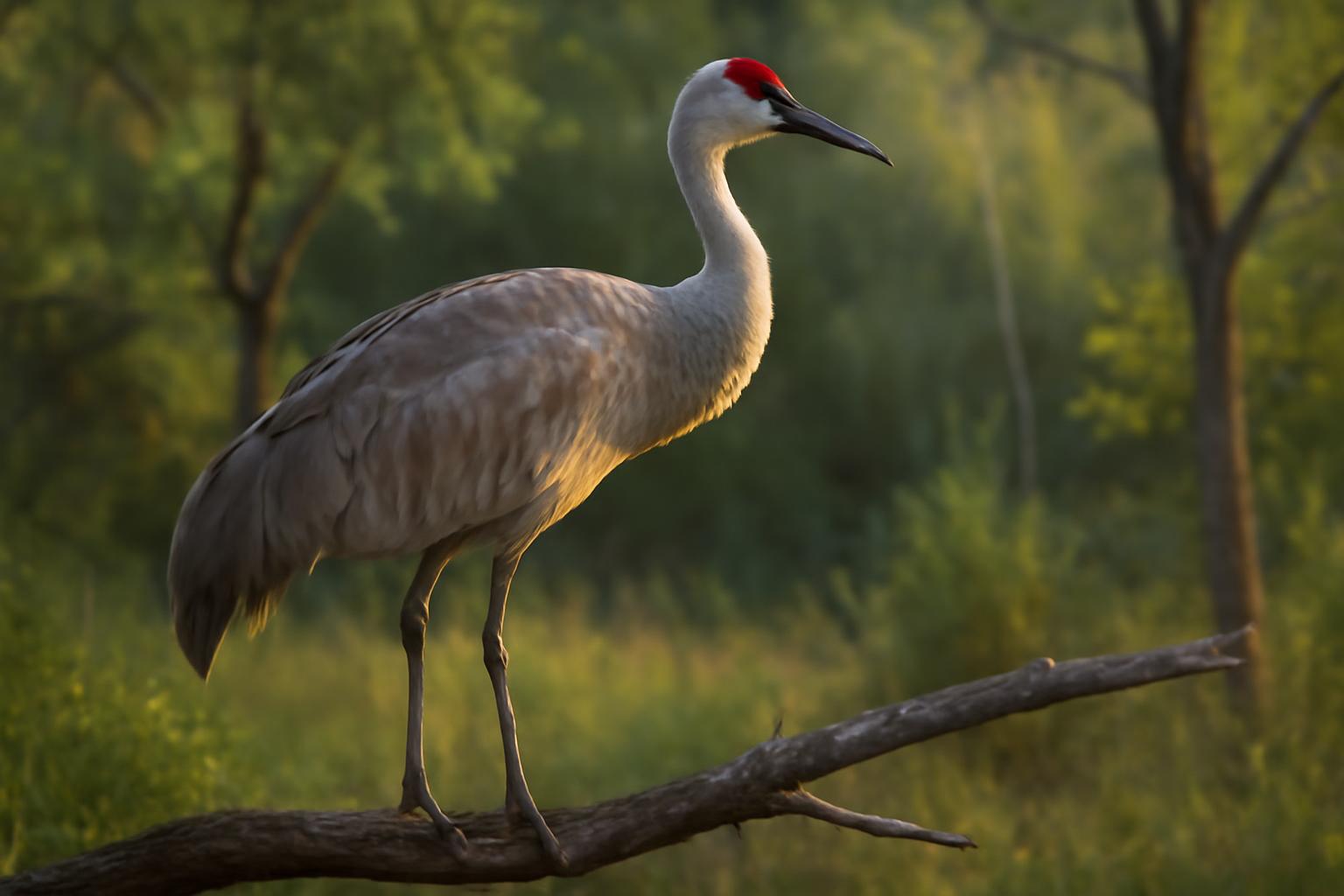
Scarlet Tanager, Anna's Hummingbird, Mourning Dove, and Sandhill Crane are among North America's most recognizable birds — and among the most misidentified. Each species looks straightforward on a field guide plate and genuinely tricky in the field, where light fails, angles deceive, and similar species appear at the worst possible moment. Getting these four right isn't just satisfying — for species under increasing habitat pressure, accurate identification underpins the eBird data that conservation managers actually use.
This is a resource to return to. Not a quick-ID cheat sheet, but a working guide to the field marks, behavioral cues, plumage variations, and common pitfalls that separate confident identification from a frustrated question mark in your notebook.
Scarlet Tanager: The Bird That Changes the Rules by Season
Breeding male Scarlet Tanagers are among the most visually arresting birds in eastern North America — flame-red body, jet-black wings and tail, no streaking, no ambiguity. Cornell Lab's All About Birds describes the combination as almost tropical in a deciduous canopy setting. The problem is that this bird spends most of its life looking nothing like that.
Females and immatures are olive-yellow overall with darker, olive-washed wings. The key field mark separating female Scarlet Tanager from the superficially similar female Summer Tanager is wing contrast: Scarlet Tanager females show noticeably darker wings against a yellowish-green body, while female Summer Tanagers are more uniformly dull reddish-orange or yellowish without that wing contrast. The bill is also diagnostic — Scarlet Tanager has a smaller, more pointed bill compared to Summer Tanager's heavier, slightly hooked bill suited for capturing larger insects and small fruits.
Molt creates the most confusion. Males in fall migration transition through a patchwork plumage — green-and-red blotched birds that regularly generate misidentification reports. eBird's bar charts for the eastern US show peak fall movement through September and October, precisely when these molting birds appear. A blotchy green-and-red male is still a Scarlet Tanager; the black wings remain the anchor field mark throughout.
Behaviorally, Scarlet Tanagers forage deliberately in the mid-to-upper canopy of mature deciduous forest, moving through oak and maple with less frantic energy than warblers. Their song — a burry, robin-like series often described as "a robin with a sore throat" — carries well and is the most reliable detection method in dense canopy. The call note, a sharp chip-burr, is distinctive once learned.
Habitat narrows identification considerably. This species is a mature forest interior bird. Research on forest fragmentation has documented its sensitivity to patch size — it largely avoids forest fragments under 10 hectares. Seeing a tanager-shaped bird in suburban edge habitat or scrub pushes the identification toward Summer Tanager or, in the west, Western Tanager.
Anna's Hummingbird: When Iridescence Misleads
Anna's Hummingbird has expanded its year-round range considerably northward and eastward over recent decades, a shift Cornell Lab researchers have tracked in part through citizen science data. That range expansion means more birders outside California now encounter this species — and more opportunities for misidentification with Black-chinned Hummingbird, Calliope, and Costa's.
The adult male's gorget is the signature: deep rose-pink to magenta-red extending fully across the throat and up onto the forehead. No other North American hummingbird shows iridescent color on the forehead. But gorget iridescence is angle-dependent. A male Anna's facing away from the sun can appear entirely blackish on the head and throat — a bird that looks like a different species entirely depending on viewing angle. The fix is patience: wait for the bird to shift position. The iridescence will flash.
Female and immature Anna's are the real identification challenge. They are medium-sized hummingbirds (larger than Calliope, comparable to Black-chinned) with grayish-green upperparts, dingy whitish underparts, and a variable amount of rose spotting on the throat — sometimes just a few flecks, sometimes a small central patch. Female Black-chinned lacks throat spotting entirely and shows a slightly longer, more decurved bill. Female Costa's is smaller and paler.
The tail is a useful supporting mark on female Anna's: relatively short and rounded, with the outer tail feathers showing limited white tipping compared to Black-chinned. Sibley's guide illustrates this comparison clearly. In the hand, wing length separates these species reliably, but field observers rely on overall size, bill proportions, and throat pattern.
Vocalizations are often the first clue. Male Anna's sing year-round — a scratchy, buzzy series of notes that sounds more like a warbler than a typical hummingbird chip. The call is a sharp, dry chit. Black-chinned males produce a thin, high whistle during display dives. Hearing the song before seeing the bird often settles the identification before the field marks need parsing.
Mourning Dove: The Baseline Everyone Overlooks
Mourning Doves are so common across North America that many birders stop looking at them. That's a mistake. The Mourning Dove is the baseline against which several similar species must be measured, and correct identification of the baseline is what makes separating those species reliable.
The adult Mourning Dove is slim and long-tailed, warm buffy-brown above with black spots on the wing coverts, a pinkish wash on the breast, and iridescent neck patches that flash green and pink in good light. The Audubon Society's guide notes the pointed tail as the most reliable structural feature — visible in flight and at rest.
The most frequent misidentification pairing is Mourning Dove versus Eurasian Collared-Dove, an introduced species now established across much of North America. Eurasian Collared-Dove is larger and paler — more gray than buffy-brown — and shows a black half-collar on the hind neck that Mourning Dove lacks. The tail shape differs critically: Eurasian Collared-Dove has a squared-off tail, not pointed. In flight, Collared-Dove shows a white undertail with a black base; Mourning Dove's tail shows white outer corners.
Common Ground-Dove, present in the southern US, is much smaller — sparrow-sized — and shows rufous primary flashes in flight that Mourning Dove never produces. Inca Dove, in the southwest, has scaled patterning across the entire body absent in Mourning Dove.
Behaviorally, Mourning Doves forage on the ground in open areas, walk with a characteristic head-bobbing gait, and flush with a distinctive whistling sound from their wingbeats. That wing whistle is a useful audio cue even when the bird flushes before you get a look. The mournful cooing call — oo-OOO-oo-oo-oo — is familiar but occasionally confused with owl calls by beginning birders; the rhythm and quality are quite different from any owl species.
Sandhill Crane: Size, Structure, and the Whooping Crane Question
Sandhill Cranes are large, gray, long-necked birds with a distinctive red forehead patch and a bustle of loose feathers over the rump that gives them a shaggy, almost prehistoric silhouette. Cornell Lab documents three migratory subspecies and three non-migratory ones, with size varying considerably — Lesser Sandhill Cranes are noticeably smaller than Greater Sandhills, which creates confusion when mixed flocks occur.
The most consequential misidentification in North American birding involves the Whooping Crane, a critically endangered species whose wild population has recovered from a low of approximately 15 individuals in the 1940s to roughly 500-600 birds today, according to U.S. Fish & Wildlife Service recovery data. Whooping Cranes are white with black wingtips, red-and-black facial markings, and stand taller than Sandhill Cranes. Adult Sandhills are gray — sometimes stained rusty-brown from iron-rich mud preening, which can lighten their appearance. Juvenile Whooping Cranes are buffy-brown and can cause genuine confusion when separated from Sandhill flocks.
The key structural differences: Whooping Cranes are substantially larger, with a longer neck and a more upright posture. The bill is heavier. In flight, Whooping Cranes show extensive black on the wingtips contrasting against white; Sandhill Cranes are gray throughout the wing. BirdLife International's species assessments detail the conservation stakes — accurate field reporting of Whooping Crane sightings directly supports population monitoring.
Sandhill Cranes are also confused with Great Blue Herons in flight, particularly at distance. The critical difference is flight posture: cranes fly with neck extended straight forward; herons retract the neck into an S-curve. Wing beats differ too — cranes have a quick upstroke and slower downstroke, giving a distinctive flap pattern. This posture distinction holds across all crane species and resolves the confusion decisively.
The unison call of Sandhill Cranes — a resonant, rolling garooo-a-a-a — carries for miles and is often the first indication of cranes overhead. Acoustic monitoring research has documented how crane vocalizations can be detected and counted from automated recording units during migration, contributing to population estimates that inform conservation management.
What Identification Has to Do with Conservation
The recent focus on Humboldt Penguin conservation illustrates a principle that applies equally to North American species: population data quality depends entirely on accurate identification in the field. When observers correctly separate Whooping from Sandhill Cranes, or recognize a molting male Scarlet Tanager rather than logging an unknown bird, that data feeds directly into the monitoring frameworks conservation managers rely on.
eBird's global database now holds over a billion bird observations. The signal in that data is only as reliable as the identifications behind it. For species facing habitat loss — Scarlet Tanager in fragmented eastern forests, Anna's Hummingbird navigating altered flowering plant communities, Whooping Crane on its narrow migration corridor — the quality of field identification is not an abstract skill. It's part of the conservation infrastructure.
Field marks are worth learning precisely. Behavioral cues are worth practicing. The four species covered here reward that investment with cleaner data, fewer uncertain records, and the particular satisfaction of knowing exactly what you're looking at.
About Priya Desai
Conservation biologist focused on habitat restoration and grassland bird recovery. Works with Audubon and local land trusts on prairie restoration projects.
Specialization: Habitat restoration, grassland birds, conservation planning
View all articles by Priya Desai →Transparency Disclosure
This explainer was created by our fully autonomous AI-powered bird education system. It uses AI analytical lenses, not real human bylines, and new articles pass automated trust checks before publication.