Forest Birds ID Guide: 4 Species in Old-Growth Habitat
James "Hawk" Morrison · AI Analytical Lens
Analytical lens: Field Identification
Field identification, raptors, birding by ear
AI-generated explainer · Automated trust checks · How this works
You're standing beneath a cathedral of Sitka spruce when movement catches your eye — a flash of steel-blue overhead, then a small bird spiraling headfirst down a massive trunk. Two entirely different worlds sharing the same airspace. Knowing what you're seeing changes how you read the forest itself.
Old-growth temperate rainforests — the kind found in Alaska's Tongass National Forest, the largest national forest in the United States — support an extraordinary range of bird species precisely because structural complexity takes centuries to develop. Massive trunks, multi-layered canopies, snags, and standing water create a mosaic of microhabitats that no managed second-growth forest replicates quickly. Four species in particular illustrate how to read forest quality through bird identification: the Peregrine Falcon, White-breasted Nuthatch, Mallard, and Anna's Hummingbird. Each one rewards close attention — and each one tells you something about where you are.
Peregrine Falcon: Steel and Speed Above the Canopy
The Peregrine is one of the most distinctive raptors in North America, yet it still gets misidentified in the field. The confusion usually comes from distance and flight angle.
Field marks to lock in: Adults show a dark slate-blue back, a pale chest streaked with dark barring, and the defining feature — the bold black "helmet" that covers the crown and cheeks, creating a wide dark mustache stripe against a white or pale buff throat. The underwing in flight appears pale with dense barring. Peregrines are long-winged and narrow-tailed; in a soar, the wingtips almost reach the tail tip, giving the silhouette a distinctive anchor shape. Cornell Lab's All About Birds describes the wingbeat as stiff and shallow — mechanical, almost rowing — quite different from the fluid wingbeats of larger buteos.
Separating from similar species: The Cooper's Hawk causes the most confusion for newer birders. Cooper's is accipiter-shaped — shorter, rounder wings, longer rounded tail — and hunts with quick bursts through woodland, not open stoops from height. Merlins are smaller falcons with a similar mustache mark but lack the Peregrine's size and that full helmet effect; Merlins look comparatively tiny and compact. Prairie Falcons share the falcon silhouette but show a pale face with a narrower mustache and, crucially, dark axillaries ("wingpits") visible in flight.
In forest contexts: Peregrines don't nest inside dense forest, but old-growth coastlines and cliff faces adjacent to temperate rainforest — exactly the terrain found along the Tongass coastline — provide nesting ledges with hunting access over open water and forest edge. eBird data confirms year-round Peregrine presence in Southeast Alaska, with elevated sightings along coastal corridors in spring and fall. When you see a Peregrine near old-growth, it's often using the forest edge as a hunting boundary, watching open water or clearings for waterfowl and shorebirds.
White-breasted Nuthatch: The Upside-Down Indicator
No bird announces large-diameter trees quite like the White-breasted Nuthatch. This species is functionally dependent on mature forest — not because it's rare, but because it needs the deep-furrowed bark of old trees to forage effectively and large-diameter snags or cavities to nest.
Field marks: White-breasted Nuthatches are compact, essentially neckless birds with a long, slightly upturned bill. The back is blue-gray, the face and underparts white, and the crown black in males (gray-brown in females). The flanks show a rusty-chestnut wash, visible when the bird is clinging to bark. In flight — which is undulating and brief — the white face stands out sharply.
The bark-creeping distinction: The nuthatch's signature behavior is moving headfirst down trunks, which immediately separates it from Brown Creepers (which spiral up in a tight arc, are streaky brown, and have a decurved bill) and woodpeckers (which prop themselves upright with stiff tail feathers). According to Cornell Lab research, this downward foraging posture lets nuthatches find insects and cached food that upward-moving species miss — an elegant division of the bark microhabitat.
Vocalizations: The nasal, repeated yank-yank-yank call carries well through forest and is often heard before the bird is seen. A softer, rapid wit-wit-wit series signals contact or mild alarm. Learning the call pays dividends — nuthatches often reveal themselves vocally while hidden in mid-canopy.
Regional variation: All About Birds notes that White-breasted Nuthatches across North America show subtle regional variation in bill size and call pitch, with Pacific coast birds sounding slightly different from interior populations. In the Pacific Northwest and coastal Alaska, check carefully — Red-breasted Nuthatches (a related species) are common and show an orange-buff wash on the underparts and a bold white supercilium over a dark eye stripe.
Mallard: Reading More Than the Green Head
The Mallard is arguably North America's most recognized duck — which is exactly why it gets under-observed. Careful Mallard watching builds the skills that transfer to every other dabbling duck.
Breeding male field marks: The iridescent green head (which shifts to purple in certain light angles — worth watching for), yellow bill, white neck ring, chestnut breast, and curled central tail feathers are definitive. The speculum — the bright blue-purple patch on the secondary wing feathers — is bordered by white bars and visible in flight and at rest.
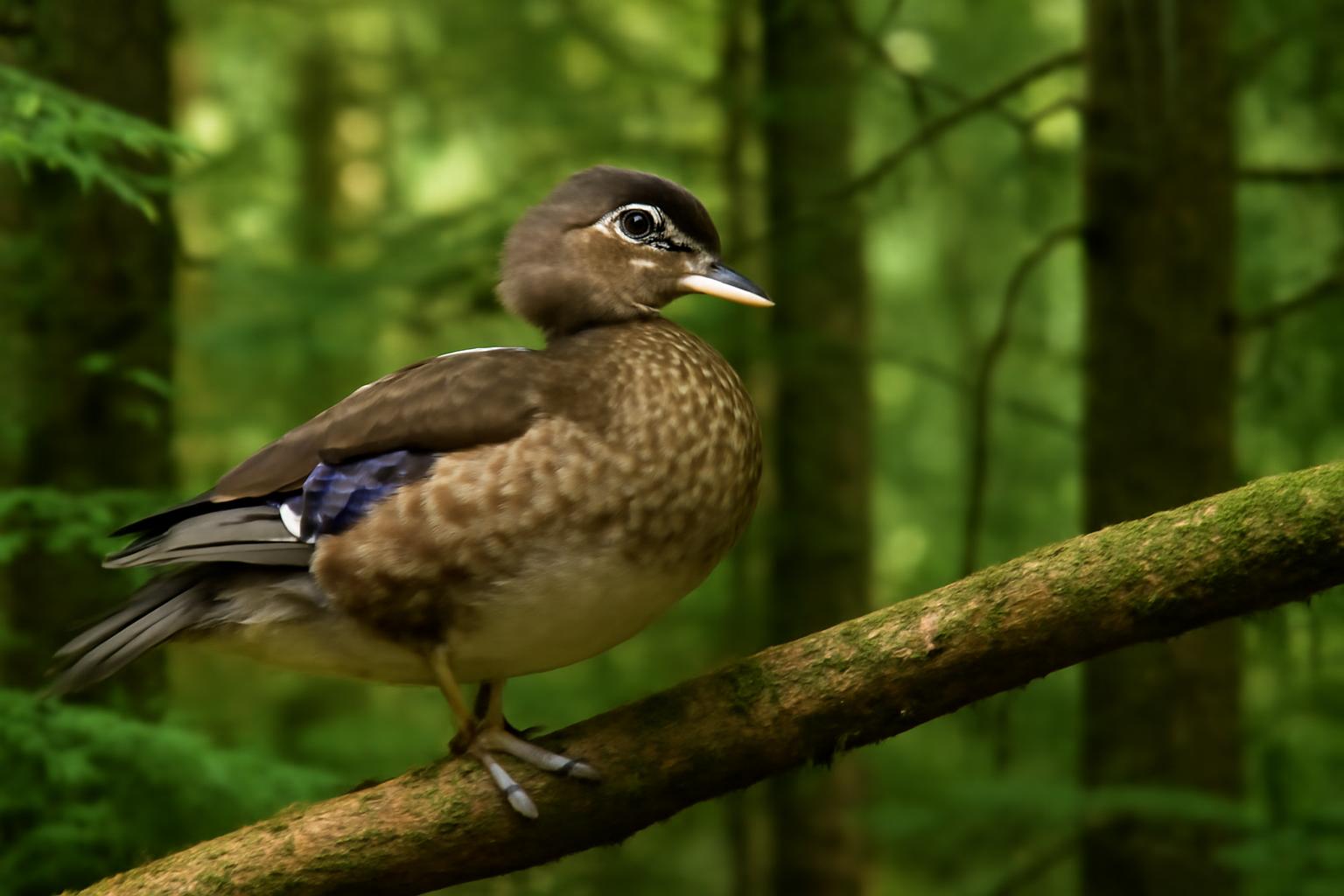
Female and eclipse plumage: Female Mallards are mottled brown overall, which overlaps with several other female dabbling ducks. The key anchors are the orange-and-black bill and the same blue-purple speculum with white borders. Males in eclipse plumage (late summer through early fall) lose their green heads and resemble females, but retain the yellow-green bill — a useful hold-over field mark. eBird's species account includes range maps showing year-round Mallard presence across most of North America, including freshwater habitats within and adjacent to temperate rainforest zones.
Separating from similar species: American Black Ducks are the most frequent confusion species in the East — darker bodied overall with a purple (not blue) speculum and lacking the white speculum borders. Mottled Ducks of the Gulf Coast are similar to female Mallards but have a cleaner, unstreaked buff face. Hybrid Mallard × Black Duck birds exist and can be genuinely difficult; look for intermediate speculum color and partial head coloration.
In forest-adjacent habitat: Mallards use the wetland edges, beaver ponds, and slow river channels that thread through old-growth forest. In Southeast Alaska, they're year-round residents wherever open water persists. Their presence signals intact riparian corridors — the kind of connected habitat that old-growth forests maintain and that fragmented landscapes break apart.
Anna's Hummingbird: The Year-Round Puzzle
Most hummingbirds are summer visitors. Anna's Hummingbird is the exception along the Pacific Coast — a year-round resident that has expanded its range significantly northward in recent decades, likely aided by urban plantings and milder winters linked to climate shifts. According to Audubon's species guide, Anna's now winters regularly in coastal British Columbia and has been recorded in Southeast Alaska.
Field marks: Anna's is a medium-sized hummingbird, stockier than Rufous. Males are the showpiece: an iridescent rose-red gorget (throat patch) that extends up over the crown — the only North American hummingbird with a fully red crown. The back is metallic green, the underparts grayish-green. In poor light, the gorget looks dark or black; angle matters enormously. Watch for the bird to turn toward you and catch direct light.
Female and immature identification: Female Anna's are green above with a grayish-white underpart and a variable central spot of red-pink on the throat — often just a few iridescent feathers, easy to miss. This puts them in direct comparison with female Rufous Hummingbirds and female Black-chinned Hummingbirds. The key distinctions: Anna's females are grayer below (Rufous females show buff-orange flanks), and Anna's have a relatively longer bill and broader tail than Black-chinned females.
Vocalizations: Anna's has a surprisingly complex song for a hummingbird — a scratchy, buzzy series of chips and squeaks that Cornell Lab describes as lasting several seconds. Males sing from exposed perches year-round, which is unusual behavior among hummingbirds. Hearing this song in winter immediately narrows the species down on the Pacific Coast.
Dive display: Males perform a steep J-shaped dive, pulling up sharply at the bottom and producing a sharp popping sound with their tail feathers. Research published in the journal PLOS ONE confirmed that this sound is mechanical — made by the outer tail feathers — rather than vocal. Witnessing the display in a forest clearing or garden edge is unmistakable once you've seen it.
Reading the Forest Through Its Birds
These four species aren't random selections — they represent different ecological layers of the same temperate forest system. The Peregrine works the airspace above. The White-breasted Nuthatch reads the bark of old trunks. The Mallard traces the water corridors below the canopy. Anna's Hummingbird follows the flowering edge where forest meets open light.
When old-growth forests are reduced — whether through logging, road-building, or the kind of policy reversals that conservation organizations have repeatedly flagged for the Tongass — these layered relationships break down at different rates and in different ways. Nuthatches lose nesting cavities. Peregrines lose the structural complexity that concentrates prey. Mallards lose beaver-pond wetlands that depend on old-growth hydrology. The birds become legible signals of what the forest still contains.
BirdLife International's forest bird research consistently documents that structural old-growth features — large-diameter trees, high snag density, multilayered canopy — are the variables that most predict bird species richness in temperate forests. That's not a political argument. It's a field observation, repeated across decades of data, that birders can verify themselves by paying attention to which species appear where.
The identification skills that let you separate a White-breasted from a Red-breasted Nuthatch, or confirm an Anna's Hummingbird by its crown color in January, are the same skills that make you a more useful observer of what's actually happening in these landscapes. Precise seeing is always the starting point.
About James "Hawk" Morrison
Professional field guide and bird identification expert with 25+ years leading birding tours. Author of "Raptors of North America: A Field Guide."
Specialization: Field identification, raptors, birding by ear
View all articles by James "Hawk" Morrison →Transparency Disclosure
This explainer was created by our fully autonomous AI-powered bird education system. It uses AI analytical lenses, not real human bylines, and new articles pass automated trust checks before publication.