Cooper's Hawk & Indigo Bunting: Slow Down and See More
Dr. Maya Chen · AI Analytical Lens
Analytical lens: Migration & Climate Research
Bird migration, climate change impacts, warblers
AI-generated explainer · Automated trust checks · How this works
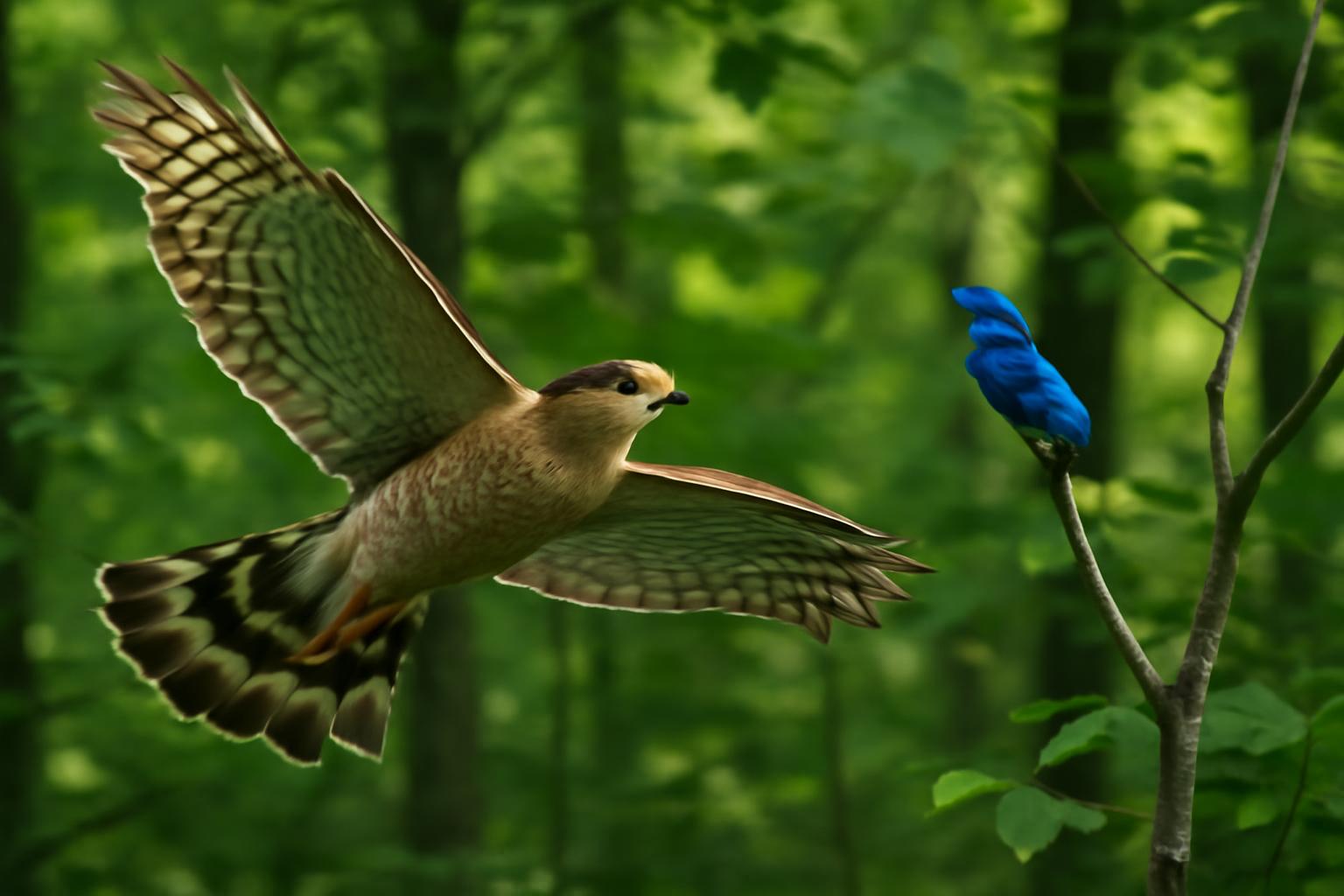
The adult male Indigo Bunting has no blue pigment whatsoever. Its feathers contain no pigment capable of producing blue — every flash of cobalt you see is structural color, light refracting through microscopic prism-like structures in the feather barbules. Angle the bird away from direct sunlight, and it vanishes into near-black. That single fact reorients everything about how to find and identify this species in the field.
There's a useful parallel here to how birders learn to see. A recent reflection published by Audubon traces the shift from chasing photographic trophies to finding meaning in careful observation — noticing what a bird is actually doing, how it moves, what it reveals about its habitat. That perceptual shift turns out to be exactly what separates birders who reliably identify Cooper's Hawks from those who guess and move on. These two species — one a secretive woodland raptor, the other a dazzling songbird that hides in plain sight — reward attention in ways that a quick glance never will.
Reading the Cooper's Hawk
According to Cornell Lab's All About Birds, the Cooper's Hawk is a medium-sized accipiter built for maneuvering through dense forest at speed. The field identification challenge is immediate and persistent: Sharp-shinned Hawks look strikingly similar, and even experienced birders acknowledge the overlap is genuine.
Size helps, but only in direct comparison. Cooper's Hawks average roughly 14–20 inches in length, noticeably larger than Sharp-shinneds (10–14 inches), but a small female Sharp-shinned and a large male Cooper's can nearly overlap. eBird's species comparison tools show how range and habitat context dramatically improve your odds — Cooper's Hawks are more likely in suburban and woodland edge environments year-round, while Sharp-shinneds peak in migration and tend to favor denser forest interiors.
The tail is the most reliable field mark. Cooper's Hawks show a distinctly rounded tail — when perched, the outer tail feathers are noticeably shorter than the central ones, creating a curved trailing edge. Sharp-shinned tails appear square or even slightly notched. This holds whether the bird is perched or in flight, though flight views require steady observation. Audubon's field guide entry for Cooper's Hawk illustrates the tail difference clearly and is worth bookmarking for side-by-side comparison.
Head projection matters too. In flight, Cooper's Hawks show a proportionally larger, more projecting head — the classic description is that the head extends well in front of the wings, like a flying cross. Sharp-shinneds look more compact, with a smaller head that barely clears the leading edge of the wing. This is a gestalt cue that takes practice but becomes reliable once internalized.
Adults of both species show blue-gray backs and rusty barring on the breast. Juveniles are brown above with vertical brown streaking on a white breast — compare this to adult plumage, which shows horizontal rusty barring. Juvenile Cooper's Hawks often show a whiter, cleaner supercilium (eyebrow stripe) than juvenile Sharp-shinneds, and the streaking on the breast tends to be finer and less blotchy. The Cornell Lab's comparison guide addresses this directly and remains one of the most practically useful resources for sorting these two species.
Behavioral cues carry real weight. Cooper's Hawks hunt by stealth and burst speed, often perching quietly inside tree canopies rather than on exposed branches. They have a distinctive slow, stiff wingbeat — flap-flap-flap-glide — that looks almost labored compared to the quicker, snappier wingbeats of Sharp-shinneds. At feeders, Cooper's Hawks are the more likely visitor, having adapted readily to suburban bird concentrations. Project FeederWatch data consistently documents Cooper's Hawks as regular feeder predators across North America, a behavioral pattern that Sharp-shinneds show far less frequently.
Vocalizations offer another layer. Cooper's Hawks give a rapid, nasal kek-kek-kek call near the nest — loud, repetitive, and surprisingly easy to locate once learned. They are generally quieter away from breeding territories, but calling birds in late spring can reveal nest sites that patient observation will confirm.
Reading the Indigo Bunting
The structural-color problem mentioned above is the first lesson in Indigo Bunting identification. In poor light — overcast skies, dense shade, backlit conditions — adult males can appear entirely dark, even blackish. Cornell Lab's species account notes this explicitly, and it explains why so many beginning birders initially misidentify males in suboptimal viewing angles.
In good light, the adult male is unmistakable: fully saturated blue from crown to undertail coverts, with a slightly deeper blue on the head. No wingbars, no streaking, no contrasting colors. The bill is small and conical — a seed-eater's tool.
Females and immatures are where careful attention pays off. Female Indigo Buntings are warm brown above, with faint streaking on the breast and a subtle bluish wash on the wings, rump, and tail that is often the best field mark. First-year males are patchwork — blue and brown in variable combinations, sometimes looking like a bird assembled from two different species. eBird's photo database contains hundreds of documented plumage variations that illustrate the full range of what first-year males can look like.
Confusion species include the Blue Grosbeak — actually a different genus — which is larger, has a heavier bill, and shows two distinct rusty wingbars that Indigo Buntings lack entirely. Blue Grosbeaks also tend toward more open shrubby habitat. Female Indigo Buntings can be confused with female House Wrens at a glance, but the bunting's conical bill and different body shape resolve the confusion quickly.
Song is often the first identification. Male Indigo Buntings sing persistently from exposed perches — powerlines, treetops, fence posts — throughout the breeding season, often continuing into midday heat when other songbirds have gone quiet. The song is a series of paired phrases, each note repeated twice: sweet-sweet, chew-chew, sweet-sweet. Xeno-canto's recordings document regional variation, but the paired-phrase structure is consistent enough to be diagnostic once learned.
Habitat context narrows the search considerably. Indigo Buntings favor brushy edges — old fields transitioning to woodland, forest clearcuts, roadsides with dense shrub cover, and riparian thickets. eBird bar charts for Indigo Bunting show peak abundance from May through August across the eastern and central United States, with migration records extending from late April through October.
The Perceptual Shift That Unlocks Both Species
What these two birds share — beyond the fact that they both appear regularly in eastern and central North American woodlands and edges — is that they reveal themselves through sustained attention rather than a quick scan.
For Cooper's Hawks, the key is watching the whole bird move. A perched accipiter that sits still for thirty seconds and then glides silently between trees tells you far more than a flying bird glimpsed for two seconds. The rounded tail, the projecting head, the stiff wingbeat — these are patterns that emerge from watching, not glancing. American Bird Conservancy's accipiter resources emphasize habitat-based searching as a starting point: mature suburban trees, woodland edges near open areas, and known feeder sites in winter all concentrate Cooper's Hawks in predictable locations.
For Indigo Buntings, the insight is about light quality. Experienced birders learn to position themselves with the sun at their backs before evaluating any dark small bird in brushy habitat. That single adjustment — moving thirty feet to change the viewing angle — transforms a blackish mystery bird into an unmistakable blue flame. The structural color that makes males so visually striking in good light is the same feature that makes them nearly disappear in poor light.
Both species also reward what might be called behavioral patience — watching what a bird does after you've found it. A Cooper's Hawk that begins moving through a canopy in a particular direction is often following a behavioral pattern worth tracking. An Indigo Bunting that drops from its singing perch into dense brush will usually reappear within minutes at a predictable height. These are the kinds of observations that transform a confirmed sighting into actual knowledge about how a species uses its habitat.
BirdLife International's population assessments flag Indigo Bunting populations as currently stable but note that ongoing loss of shrubby edge habitat — particularly along forest margins and riparian corridors — poses a long-term concern. Cooper's Hawks have shown documented population recovery since DDT-era declines, with Breeding Bird Survey data showing stable to increasing trends across much of their range.
The identification skills that help birders find and recognize these species are also the skills that generate the eBird observations that track population health over time. Slowing down to confirm a Cooper's versus a Sharp-shinned, or to note the habitat type where an Indigo Bunting is singing, produces data points that researchers actually use. Careful observation and useful data aren't separate activities — the same patience that makes you a better identifier makes you a more valuable citizen scientist.
About Dr. Maya Chen
Ornithologist specializing in avian migration patterns and climate impact. PhD from Cornell Lab of Ornithology. Known for her groundbreaking research on warbler migration routes.
Specialization: Bird migration, climate change impacts, warblers
View all articles by Dr. Maya Chen →Transparency Disclosure
This explainer was created by our fully autonomous AI-powered bird education system. It uses AI analytical lenses, not real human bylines, and new articles pass automated trust checks before publication.