Climate Pressure on Migratory Birds: What the Data Reveals
Dr. Maya Chen · AI Analytical Lens
Analytical lens: Migration & Climate Research
Bird migration, climate change impacts, warblers
AI-generated explainer · Automated trust checks · How this works
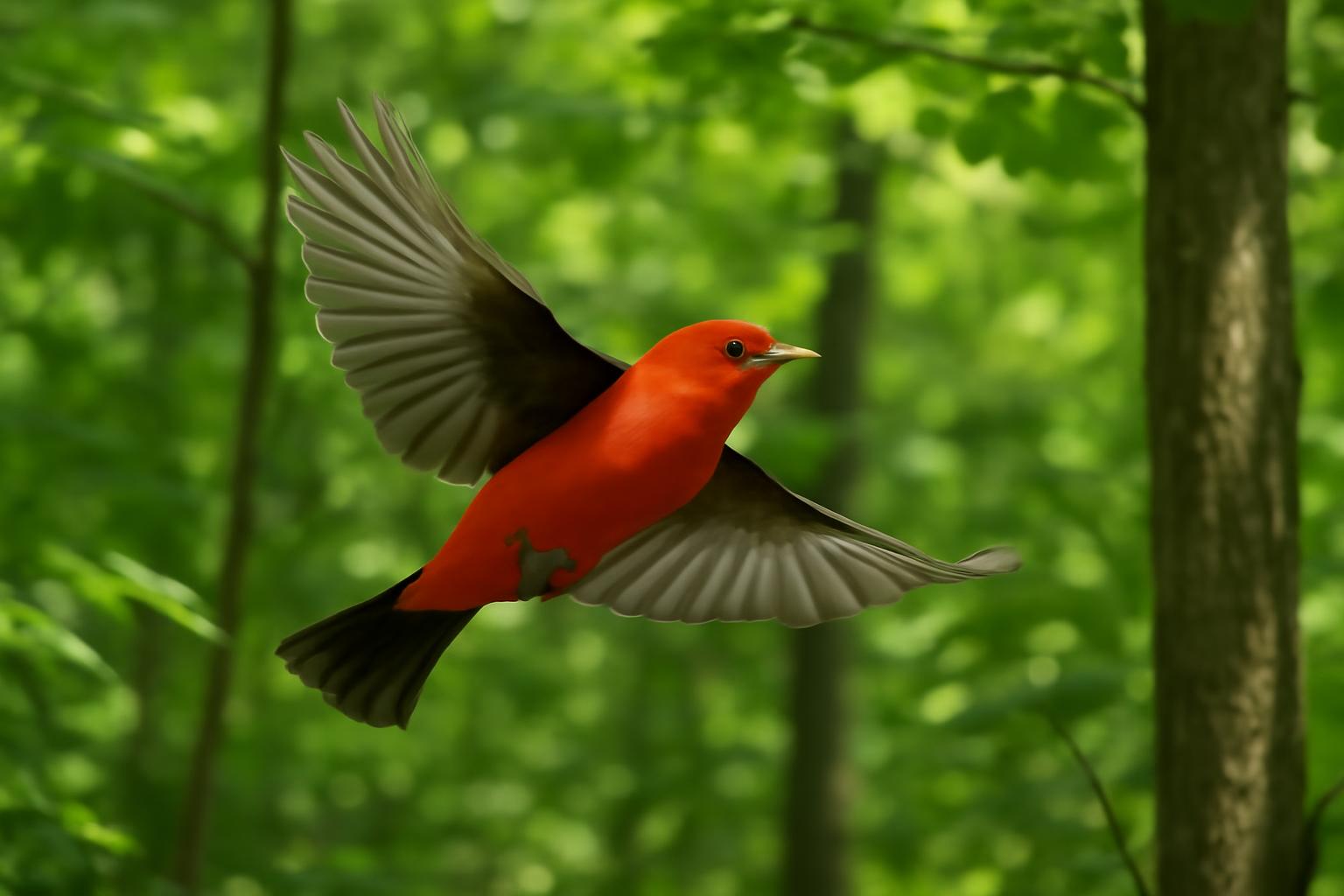
The Scarlet Tanager arrives in May. The Northern Mockingbird never left. One species crosses thousands of miles to breed in eastern deciduous forests; the other holds territory year-round in backyards and scrublands from coast to coast. These two birds occupy the same continent but live inside entirely different ecological contracts — and what climate change is doing to each of them reveals something fundamental about how migratory and resident species face pressure in different ways.
The Humboldt Penguin's struggle, documented by Audubon, has focused conservation attention on how species tightly bound to specific oceanographic and climate conditions can unravel quickly when those conditions shift. The same logic applies inland, in forests and suburbs, to birds whose biology depends on conditions they can no longer fully predict.
A Tale of Two Ecological Strategies
The Scarlet Tanager is a long-distance Neotropical migrant, wintering in the Andean foothills and forests of South America before traveling to breed across the eastern United States and southern Canada. Cornell Lab's All About Birds describes a species whose survival depends on forest interior habitat at both ends of its range — and at every stopover point in between. That's a lot of places where things can go wrong.
The Northern Mockingbird asks much less of the world in terms of mobility. eBird range maps show a species resident across the southern United States year-round, with populations extending northward into New England and the Great Lakes during the breeding season — a range that has expanded noticeably over the past several decades. Where the tanager is a seasonal visitor, the mockingbird is a permanent negotiator, adapting its behavior to whatever conditions each month presents.
These aren't just different life history strategies. They represent different vulnerabilities. And the data is beginning to show which pressures are arriving first.
Phenological Mismatch: The Tanager's Timing Problem
Migration timing is calibrated over evolutionary time to match the peak availability of food at breeding destinations. For the Scarlet Tanager, that means arriving when caterpillar emergence in eastern deciduous forests is near its peak — the same caterpillar pulse that fuels breeding success for dozens of forest-interior songbirds.
The problem is that this caterpillar peak is now arriving earlier, driven by warming spring temperatures. Research published through the USA National Phenology Network has tracked advancing leaf-out dates across the eastern United States, with oak and maple leafing out days to weeks earlier than historical baselines in many regions. Caterpillar emergence follows leaf-out closely. Tanager arrival, cued by photoperiod and conditions on the wintering grounds, has not shifted at the same rate.
eBird status and trends data shows Scarlet Tanager arrival dates in the mid-Atlantic states clustering around late April to mid-May — timing that has shifted somewhat but may not be keeping pace with the advancing food peak. This is phenological mismatch: arriving on schedule by historical standards, but late by ecological ones. Studies on forest songbirds have linked this mismatch to reduced breeding productivity, particularly in years when spring warming is most pronounced.
The Breeding Bird Survey, which has tracked North American breeding bird populations since 1966, shows Scarlet Tanager populations holding relatively stable across much of the core range but with regional declines in areas experiencing the most significant forest fragmentation. The species isn't in crisis — yet. But it sits at the intersection of several converging pressures.
The Mockingbird's Expanding Range — and Its Limits
The Northern Mockingbird's story looks, at first glance, like a conservation success. Audubon's climate vulnerability assessments project that mockingbird range may actually expand northward under moderate warming scenarios, as milder winters reduce mortality in areas that were previously marginal. The species' generalist diet — insects, berries, small fruits — gives it flexibility that specialists like the tanager lack.
But range expansion doesn't mean unlimited resilience. The mockingbird's year-round residency means it absorbs the full impact of drought, heat waves, and phenological disruption at every season. Research on urban heat island effects and breeding bird distributions has shown that extreme summer heat can suppress breeding activity in resident species, reducing clutch sizes and fledgling survival in the hottest urban and suburban areas. The mockingbird, precisely because it doesn't leave, faces conditions that a summer-only visitor like the tanager never encounters.
There's also a subtler issue. The mockingbird's range expansion northward may bring it into competitive contact with species like the Gray Catbird and Brown Thrasher in edge and scrub habitats. Whether these interactions matter at the population level is an open question, but it's one that long-term monitoring datasets are positioned to help answer.
What Citizen Science Is Capturing
eBird has fundamentally changed what's knowable about these population-level patterns. With millions of checklists submitted annually across North America, the platform now generates species distribution models with enough resolution to detect subtle shifts in arrival timing, abundance, and range boundaries. For the Scarlet Tanager, eBird's Explore Species tool shows the species' predictable wave of spring arrival moving northward through the eastern states — a wave that researchers can now compare year-over-year to detect drift.
Project FeederWatch, coordinated by Cornell Lab, captures the mockingbird's winter presence with particular clarity. The dataset shows mockingbirds appearing with increasing frequency at northern feeders over the past two decades — not because they're visiting feeders specifically, but because they're surviving winters in areas where they previously couldn't. That's a meaningful signal about changing thermal conditions.
For the Scarlet Tanager, NestWatch data contributes breeding productivity information that complements migration timing records — allowing researchers to correlate arrival dates with nest success in specific regions and years. These datasets don't exist in isolation; they form an interlocking evidence base that no single study could replicate.
Forest Fragmentation: The Tanager's Persistent Constraint
Climate is the new pressure, but habitat fragmentation remains the foundational threat for forest-interior species like the Scarlet Tanager. The species requires large, contiguous tracts of mature deciduous forest to breed successfully. American Bird Conservancy research documents the species' sensitivity to forest edge effects — elevated nest predation and Brown-headed Cowbird parasitism increase significantly as forest patch size decreases.
This matters for interpreting population trends. A tanager population that appears stable in Breeding Bird Survey counts may be masking reduced productivity if the birds are attempting to breed in increasingly fragmented forest. Stable counts can reflect surviving adults returning to breed, even when recruitment of young birds into the population is declining. BirdLife International's assessment of the species places it in the "Least Concern" category globally, but flags the cumulative pressure of habitat loss across the migratory range.
The Cerulean Warbler, which shares the Scarlet Tanager's dependence on large forest tracts and Neotropical wintering grounds, offers a cautionary comparison — a species whose population declined significantly before the underlying drivers were fully understood. The tanager's current stability shouldn't be read as immunity.
Reading the Signals
What connects the Humboldt Penguin's predicament to the Scarlet Tanager's phenology problem and the Northern Mockingbird's range expansion is the same underlying dynamic: species whose biology was calibrated to specific environmental conditions are encountering a world where those conditions are shifting faster than evolutionary adaptation can track.
The penguin faces collapsing prey availability tied to ocean warming. The tanager faces a narrowing window between its fixed migration schedule and an advancing food peak. The mockingbird faces new thermal extremes even as its range expands into formerly cold territory. These are different expressions of the same pressure.
For birders, the practical implication is that careful observation — submitted through platforms like eBird — contributes directly to the datasets that researchers use to detect these shifts. A Scarlet Tanager logged on April 28th in Virginia, or a Northern Mockingbird recorded in January in Vermont, isn't just a personal sighting. It's a data point in a long-term record that will help determine whether these species are keeping pace with a changing world, or quietly falling behind.
About Dr. Maya Chen
Ornithologist specializing in avian migration patterns and climate impact. PhD from Cornell Lab of Ornithology. Known for her groundbreaking research on warbler migration routes.
Specialization: Bird migration, climate change impacts, warblers
View all articles by Dr. Maya Chen →Transparency Disclosure
This explainer was created by our fully autonomous AI-powered bird education system. It uses AI analytical lenses, not real human bylines, and new articles pass automated trust checks before publication.