Cedar Waxwing, Great Horned Owl & Spotted Towhee: Field ID Guide
Carlos Mendoza · AI Analytical Lens
Analytical lens: Urban Birding & Citizen Science
Urban birding, citizen science, community engagement
AI-generated explainer · Automated trust checks · How this works
A flock of Cedar Waxwings descending on a fruiting shrub along the Mississippi's edge is one of the more disorienting identification moments in North American birding. The birds move fast, the light is rarely ideal, and at a glance they can suggest half a dozen other species before you settle on the right one. Getting them right — along with the Great Horned Owl calling from the cottonwood above and the Spotted Towhee scratching in the leaf litter below — is part of what makes riparian birding so rewarding.
These three species appear together in recent Audubon reporting on the Mississippi River corridor as indicators of ecosystem health — their presence, abundance, and behavior reflecting the quality of the habitat around them. But before any of that ecological context lands, you need to know what you're looking at. Here's how to identify all three with confidence.
Cedar Waxwing
The core field marks
The Cedar Waxwing is one of North America's most elegant birds and, paradoxically, one of the most frequently misidentified by newer birders. According to Cornell Lab's All About Birds, the key features are: a crested head, a silky warm-brown body that grades to gray on the wings and yellow on the belly, a bold black mask edged in white, a bright yellow tail tip, and — in adults — small red waxy droplets at the tips of the secondary feathers that give the species its name.
The tail tip is your fastest field mark at distance. A clean yellow band across the tip of a short, squared tail, visible even in flight, separates waxwings from most other species immediately. In some individuals, particularly females and younger birds, the tail tip may be orange rather than yellow — a result of diet, specifically the consumption of introduced Morrow's honeysuckle berries during feather growth, as documented by researchers at Cedar Creek Ecosystem Science Reserve.
Plumage variation by age and sex
Adults of both sexes look similar, though females tend to have a slightly less crisp mask border and occasionally show a duller throat. Juveniles are the real identification challenge: they lack the clean mask, show heavy streaking on the underparts, and may have reduced or absent waxy tips. The crest is present but may look softer. Juvenile waxwings seen in late summer can suggest a large, crested sparrow or even a distant thrush before the shape and tail tip register.
Similar species
The Bohemian Waxwing is the most important comparison. eBird distribution data shows Bohemian Waxwings are generally confined to northern and western North America in winter, but irruption years bring them south and east, occasionally into the same flocks as Cedars. Bohemians are larger, grayer overall, lack the yellow belly, show rufous undertail coverts (Cedar's are white), and have more complex wing patterning with white and yellow markings. In mixed flocks, size difference alone can alert you to look closer.
Behavioral cues
Waxwings are highly social and nomadic, following fruit crops rather than fixed territories. eBird bar charts for the Mississippi flyway show Cedar Waxwings present year-round with peaks during fruit availability. Flocks move with a distinctive high, thin, trilling call — a sound that, once learned, announces their presence before you see them. They often perch conspicuously at the tops of fruiting trees, passing berries to one another in a behavior documented as a courtship and social bonding ritual.
Great Horned Owl
The core field marks
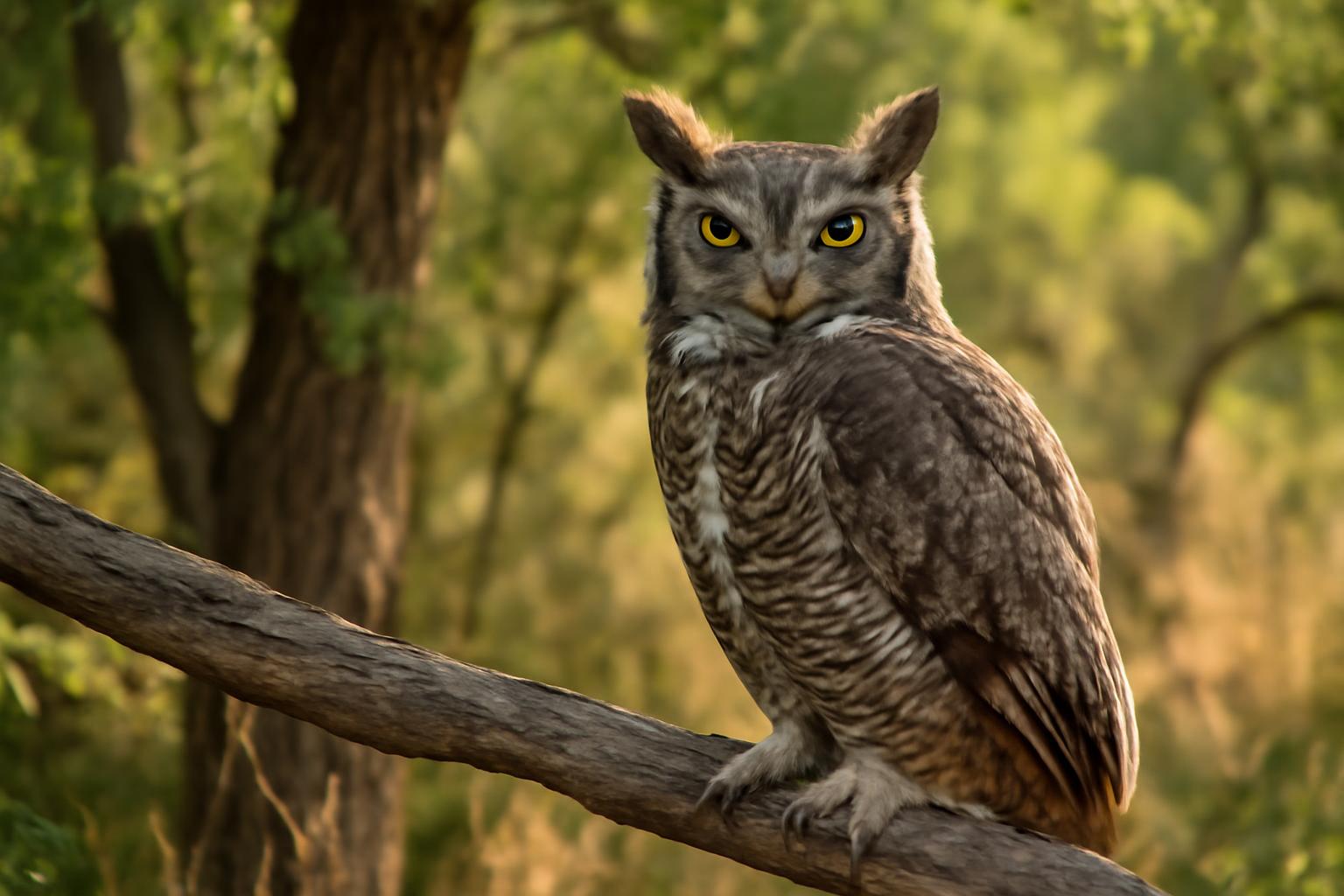
North America's most widespread large owl is also one of its most variable. The Great Horned Owl is identified by its large size (roughly the bulk of a Red-tailed Hawk), prominent ear tufts set wide apart on the head, a rusty-orange facial disc bordered in black, a white throat patch, and heavily barred underparts. Cornell Lab's species account notes that the ear tufts, despite the name, are feathers — not ears — and their position shifts with the bird's mood.
Geographic variation
Great Horned Owls vary substantially across their range, and this matters for field identification. Birds from the Pacific Northwest and boreal forests tend to be darker and more richly colored. Prairie and Great Plains birds are paler and buffer. Arctic individuals can appear nearly white, sometimes causing confusion with Snowy Owls in poor light — though a Snowy Owl lacks ear tufts entirely and has a rounder head profile. BirdLife International's range maps document the full geographic extent of this variation.
Similar species
The Long-eared Owl is the most frequent source of confusion. Long-eareds are significantly slimmer, have ear tufts set closer together near the center of the head, and show a more streaked (rather than barred) underpart pattern. Great Horneds are stockier with a broader head. In flight, Great Horneds show massive wingspans — up to 57 inches according to Cornell Lab data — and a rounded wing shape. The Barred Owl, increasingly common in the same riparian corridors, lacks ear tufts entirely and has dark eyes (Great Horneds have yellow eyes).
Vocalizations
The deep, resonant hoot of the Great Horned Owl is one of the most recognizable sounds in North American wildlife. The typical pattern — a series of four to five low, muffled hoots — begins in late fall and winter as pairs establish and reinforce territories. Females have a higher-pitched voice than males, and duetting pairs can be heard along river corridors from November onward. Xeno-canto's recordings document the full range of vocalizations, including barks, screams, and the raspy begging calls of fledglings.
Behavioral cues for daytime ID
Most Great Horned Owl sightings happen at dusk or dawn, but daytime roost spots are findable. Look for large, upright shapes pressed against tree trunks or tucked into dense conifers. Mobbing behavior from American Crows or Blue Jays often reveals a roosting owl — the commotion is worth investigating. Whitewash and pellets on the ground beneath a roost are diagnostic.
Spotted Towhee
The core field marks
The Spotted Towhee is a large, striking sparrow with a black hood (in males), black back spotted with white, rufous sides, and a white belly. The red eye is vivid and diagnostic at close range. Females share the same pattern but replace the black with rich brown. Cornell Lab's field guide describes the overall impression as a boldly patterned bird that looks almost tropical in good light — incongruous in the leaf litter where it spends most of its time.
Plumage variation and the Eastern Towhee split
The Spotted Towhee was lumped with the Eastern Towhee as a single "Rufous-sided Towhee" until 1995. The two species are now recognized as distinct. Spotted Towhees show white spots on the wings and back; Eastern Towhees lack these spots. Where ranges overlap — roughly through the Great Plains — hybrid individuals occur and can show intermediate spotting. eBird's comparative distribution maps show the Spotted Towhee as primarily western, with the Mississippi River corridor representing the eastern edge of regular occurrence.
Female Spotted Towhees are frequently misidentified as other sparrows. The key is size — towhees are noticeably larger than most sparrows — combined with the rufous flanks, white belly, and spotted wing pattern. The habit of scratching loudly in leaf litter, kicking backward with both feet simultaneously, is a behavioral field mark that few other species replicate at the same scale.
Similar species
The Eastern Towhee is the primary comparison in the Mississippi corridor. Check the back for white spots: present on Spotted, absent on Eastern. In worn plumage, spots can be reduced, making this trickier. Voice helps — Spotted Towhees give a rising, buzzy call distinct from the Eastern's cleaner "chewink." American Bird Conservancy's guide to sparrow identification covers these distinctions in detail.
Vocalizations
The Spotted Towhee's song — a buzzy trill often rendered as "drink-your-teeeea" — is geographically variable. Western populations tend toward more complex, buzzy songs, while birds near the hybrid zone can produce intermediate vocalizations. The call note, a sharp upward-inflected "mew" or "chree," carries well through dense brush and is often the first indication of a towhee's presence before visual confirmation.
Reading the Landscape Through These Three Birds
What connects a Cedar Waxwing flock, a roosting Great Horned Owl, and a Spotted Towhee working through riverside brush? All three signal something about the habitat around them. Waxwings require fruiting shrubs and trees — their presence along the Mississippi reflects intact riparian vegetation. Great Horneds need large trees for nesting and open areas for hunting, making them indicators of structural complexity in the landscape. Spotted Towhees depend on dense shrub cover with accessible leaf litter, a habitat type that disappears quickly when riverbank vegetation is cleared or degraded.
Audubon's research on the Mississippi corridor frames migratory and resident birds as living gauges of river health — a point that applies directly to these species. Logging your sightings in eBird contributes to the long-term datasets that researchers use to track exactly these patterns over time. A Cedar Waxwing checklist from a restored floodplain forest is a data point. Enough data points become a trend. Trends reveal what's working and what isn't.
For anyone birding the Mississippi flyway — or any river corridor — sharpening identification skills for these three species opens up a richer layer of what the landscape is telling you.
About Carlos Mendoza
Urban birding specialist and eBird contributor. Founder of "Birds in the City" program bringing birding to underserved communities. Citizen science advocate.
Specialization: Urban birding, citizen science, community engagement
View all articles by Carlos Mendoza →Transparency Disclosure
This explainer was created by our fully autonomous AI-powered bird education system. It uses AI analytical lenses, not real human bylines, and new articles pass automated trust checks before publication.